
How many push-ups you should be able to do depends on one number: your max of strict push-ups in a single set. Under 10, you’re a beginner. 10 to 29, intermediate. 30 or more, advanced, the point where the site’s push-up program ends. Men and women share these levels; only the starting version differs.
How many push-ups should you be able to do? Test your level
Pick a day when your arms are fresh. Warm up with a few easy reps against a table and rest two minutes. Then do one set on the floor at a steady pace.
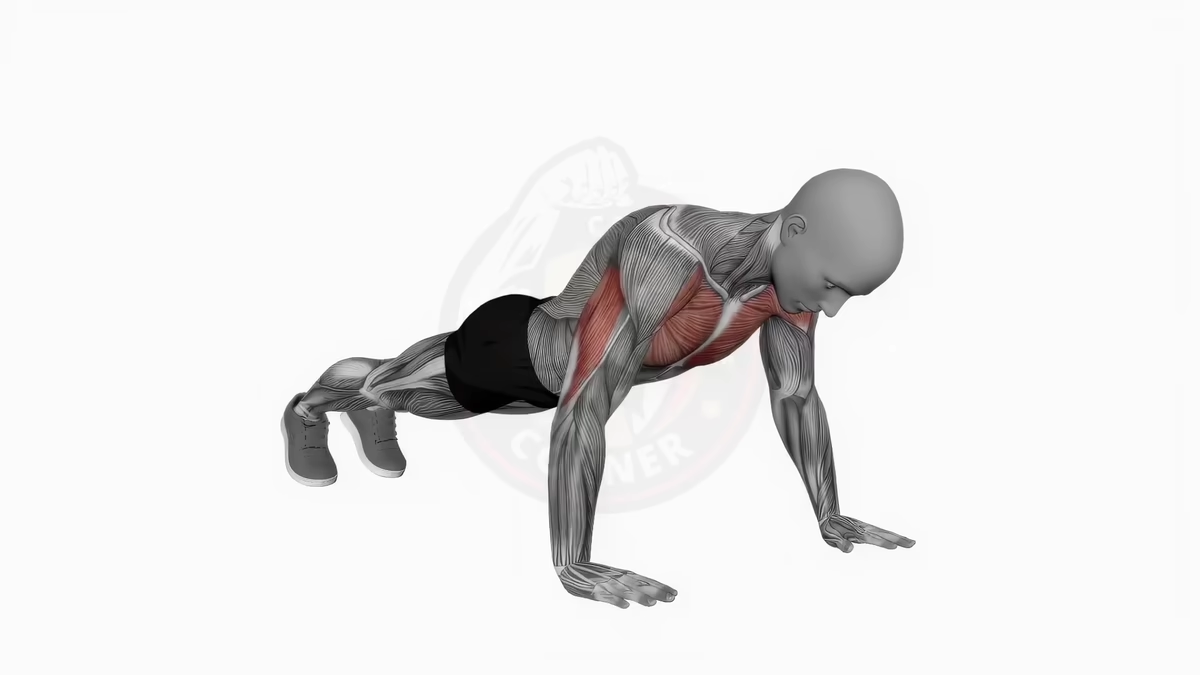
A rep only counts if it’s a clean push-up: your body stays straight from heels to head and your chest comes within a fist of the floor. At the top, your arms are almost straight. Stop at the first rep that breaks, when your hips sag or your chest stops short. That number is your max.
| Your max in one set | Level | What to train next |
|---|---|---|
| Under 10 | Beginner | Incline or knee push-ups, 3 sets of 8 to 12, until you reach 10 on the floor |
| 10 to 29 | Intermediate | Floor push-ups, 4 or 5 sets of 10 to 15 per session |
| 30 or more | Advanced | Decline or diamond push-ups |
If you can’t do one on the floor yet, take the test on your knees or with your hands on a table, and write down the version next to the number.
What about age and sex?
The age charts you’ll find online mix different tests: full or knee push-ups, one minute or no time limit. We couldn’t trace them to a source we could read, so there’s no chart here. Start from your test result instead of your age: train the level it gives you for 4 weeks, then test again.
Is 20 push-ups in a row good?
Yes. Twenty strict reps sit in the middle of the intermediate range. At that level you can train on the floor with real sets of 10 to 15, and the 10 reps left to reach 30 come with more weekly volume.
The 40 push-ups from Harvard
Forty is a test result. Harvard researchers gave US firefighters a push-up test, then tracked their heart health for 10 years. Over that time, those who passed 40 reps had far fewer heart problems than those who stopped under 10.1
A metronome set the pace and the test stopped at 80 reps. The men were all active firefighters. The result is a link: it doesn’t prove that push-ups protect the heart.1 Treat 40 as a fitness check you retake once a month. Doing 40 every morning is a different thing, and the study says nothing about it.
How many push-ups a day?
Not every day if your sets are hard. Train push-ups 3 times a week, or twice when you start, with 48 hours between two hard sessions. Then count your volume over the week.
| Level | One session | Per week |
|---|---|---|
| Beginner | 24 to 36 push-ups: 3 sets of 8 to 12 | 70 to 110, then 100 to 150 |
| Intermediate | 60 to 100: 4 or 5 sets of 10 to 15, then 2 or 3 easier sets | 200 to 300 |
| Advanced | 100 to 150, starting with your hardest variation | 300 to 500 |
The beginner range climbs to 100 to 150 a week once your 3 sets reach 15 reps each.
You don’t need more sessions than that. Push-ups twice a week for 8 weeks were enough to thicken the chest and triceps of young men with some lifting experience.2 With the same total, one longer session or two shorter ones build about the same muscle.3 Splitting it in two keeps each set fresher.
Daily push-ups that stay easy
Daily sets work if they stay far from failure. That’s the grease the groove method: 5 to 8 sets of 3 to 5 push-ups, spread every 2 to 3 hours. Each set should leave you able to repeat it on the spot, and on a day when 5 feel heavy, stop at 3.
What about 100 push-ups a day?
The 100-a-day challenge trains two things well. Your endurance on the standard push-up climbs, and you build a daily habit. That’s 700 push-ups a week, above the advanced range.
What it leaves out is strength. Once 100 feels easy, the push-up itself stops getting harder, so your chest gets little reason to grow. It also skips your back and legs entirely.
If you want to try it, wait until you can do 30 strict push-ups and break the 100 into sets of 10 through the day. Add a pulling exercise to your week too. If your wrists ache the next morning, take a day off and add some wrist strengthening.
How to raise your number
Under 10. Raise your hands: a kitchen counter first, then a table, then a chair. Knee push-ups are the other route, and still real training. At the start of the rep, you push about 53% of your bodyweight, against 66% on your toes.4
10 to 29. Add sets before you add reps, and end each set a rep or two before your form would break.
30 and beyond. Extra reps mostly train endurance from here. Change the push-up instead: trained men who moved through harder versions 3 times a week gained strength in 4 weeks.5 The push-up variations rank them from easiest to hardest. Away from push-ups, the chest exercises with no equipment add dips between two chairs.
Under 30, the push-up program gives you the full route to 30 strict reps in 8 weeks, with a test at the end of each phase. At 10 to 29, you can skip its first three weeks.

Quick answers
Is 30 push-ups a day enough?
Thirty a day makes 210 a week, inside the intermediate range. You’ll get more out of it as 3 real sessions a week than as the same easy set every morning. Once 30 in a row feels easy, move on to decline or diamond push-ups.
How many push-ups should a woman be able to do?
The same test and the same levels apply. Many women start from the incline or knee version, so aim for your first full push-up on the floor, then 10. The calisthenics plan for women takes you to that first push-up in 8 weeks at home.
Do knee push-ups count?
Yes, as their own number. Keep your body straight from knees to head and bring your chest close to the floor. Try a floor set from time to time to see when you can switch.
Can 20 push-ups a day build muscle?
At first, yes. If 20 push-ups is hard for you, they can be enough to grow your chest and triceps. Once 20 come easily, adding more reps does less than moving to a harder version.
How long does it take to go from 0 to 30 push-ups?
The push-up program plans 8 weeks from zero. Your own pace depends on your starting point and how often you train.
Sources
-
Yang J et al., 2019. Association Between Push-up Exercise Capacity and Future Cardiovascular Events Among Active Adult Men. JAMA Netw Open. PubMed ↩ ↩2
-
Kikuchi N, Nakazato K, 2017. Low-load bench press and push-up induce similar muscle hypertrophy and strength gain. J Exerc Sci Fit. PubMed ↩
-
Schoenfeld BJ, Grgic J, Krieger J, 2019. How many times per week should a muscle be trained to maximize muscle hypertrophy? A systematic review and meta-analysis of studies examining the effects of resistance training frequency. J Sports Sci. PubMed ↩
-
Gouvali MK, Boudolos K, 2005. Dynamic and electromyographical analysis in variants of push-up exercise. J Strength Cond Res. PubMed ↩
-
Kotarsky CJ et al., 2018. Effect of Progressive Calisthenic Push-up Training on Muscle Strength and Thickness. J Strength Cond Res. PubMed ↩