
What is Grease The Groove?
Grease The Groove is a training method created by Pavel Tsatsouline, a former Soviet special forces instructor. The principle is simple: repeat one exercise several times per day, at low intensity, never reaching failure.
Where classic training pushes muscles to fatigue to drive hypertrophy, GTG takes the opposite road. You work well below your max, with short sets spread across the day. The goal is not to destroy muscle fibres, but to sharpen the nervous signal that activates them.
Concretely, if your max is 10 pull-ups, you do sets of 4 to 6 reps, 5 to 8 times during the day. Every set feels easy. That is exactly the point.
Why GTG works: neural adaptation
GTG relies on a neurological principle called Hebb’s law: neurons that fire together wire together. The more you repeat a movement with perfect technique, the more efficient the pathway between your brain and muscles becomes.
This neural adaptation operates at two levels. At the neuromuscular junction, signal transmission frequency rises. Your nervous system recruits more muscle fibres at every rep. At the brain level, coordination between the muscles involved sharpens: agonists, antagonists and stabilisers learn to work in sync.
The result: you get stronger without adding size. You do more reps with the same muscle mass. That is why some calisthenics athletes look disproportionately strong compared to their physique.
By avoiding failure, you never anchor fatigue into your nervous system. Every rep is clean, controlled, and reinforces the correct motor pattern.
How to apply the Grease The Groove method
The GTG protocol follows precise rules. Ignoring them turns the method into a regular low-intensity workout with no results.
Start by picking one exercise. GTG demands high frequency, and working two movements in parallel dilutes the effect and increases the risk of overtraining. Focus on the one you want to progress on the most.
Before starting, test your rep max on that exercise. That number is your baseline: each GTG set represents 40 to 60% of that max. If you max out at 30 push-ups, each GTG set will be 12 to 18 reps. If you do 8 dips, your sets will be 3 to 5 reps.
Spread 5 to 10 sets through your day, with 15 minutes minimum between each, ideally 30 to 45 minutes. You must feel completely fresh at every set. One when you wake up, one before the shower, one at a coffee break, one when you come home from work. GTG fits into your day, not into a gym slot.
Every 2 weeks, retest your max and adjust the reps per set. A GTG cycle typically runs 4 to 6 weeks.
Which exercises work best for GTG
Grease The Groove works best on exercises you master technically but where you want to increase reps or strength.
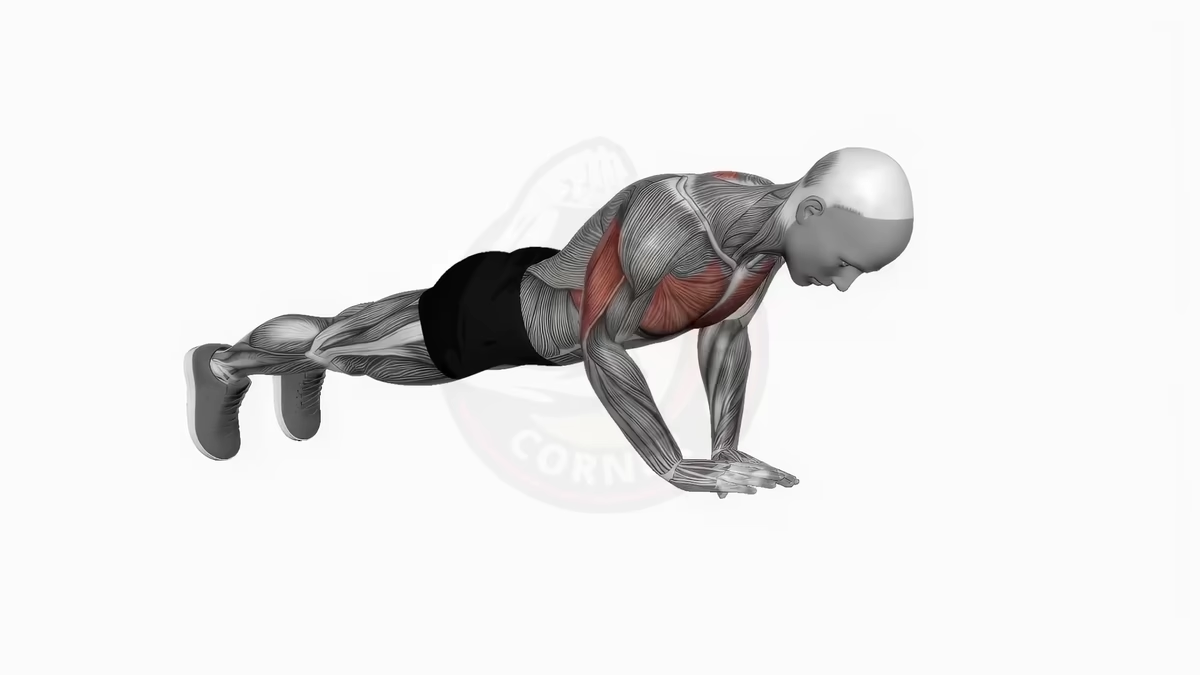
Pull-ups are the classic pick. Install a doorway bar and do a few reps every time you walk past it. Diamond push-ups and standard push-ups work just as well, with the advantage of requiring no equipment. Dips are another excellent option if you have parallel bars or a stable piece of furniture.
For the lower body, pistol squat gets a huge benefit from GTG. The neural component of that exercise, between balance, coordination and mobility, responds perfectly to frequent practice. Advanced athletes can also apply GTG to muscle-up prep work, stringing explosive pull-ups at 50-60% of max to reinforce the transition coordination.
On the other hand, avoid GTG on highly technical movements you do not yet own.
Mistakes that kill your progression
Going too close to failure is the most common mistake. If your last rep slows down or your form breaks, you are doing too much. GTG is not a disguised classic workout. Every set should feel almost too easy.
Stacking sets too close together is just as counterproductive. Three sets in an hour, and your nervous system piles up local fatigue. The neurological signal loses quality, and you encode a less efficient movement. Respect 15 minutes of rest minimum between each set.
Working several exercises in GTG at the same time is tempting, but your nervous system has limited adaptation capacity. Concentrating the stimulus on a single motor pattern maximises the speed of adaptation.
Forgetting to retest your max. Without a retest every 2 weeks, you keep working from an old percentage. Your 50% from before may have become your 35%.
Every rep should be executed in flawless form. If you are tired or in a rush, skip the set rather than half-ass it.