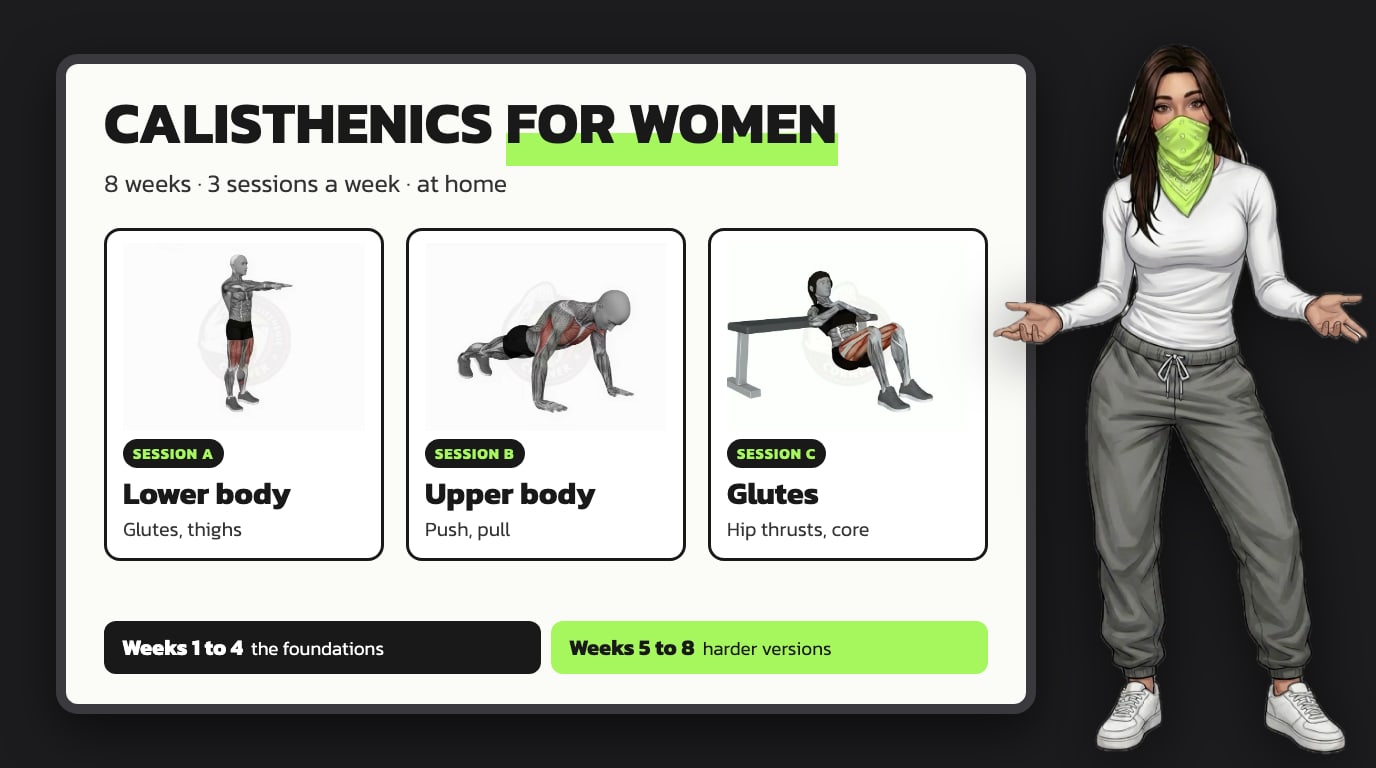
Calisthenics for women is the same bodyweight strength training anyone can do: push-ups, squats, rows and planks, scaled to your level. It works, and you can do it at home without a pull-up bar. This free 8-week plan gives you 3 sessions a week, with your first full push-up as the goal. It also comes as a printable PDF.
The 8-week calisthenics workout plan for women
Three sessions a week, 35 to 45 minutes each. That makes 24 sessions over the 8 weeks.
- Monday, Session A (lower body): squats, lunges, glute bridges, plank.
- Wednesday, Session B (upper body): incline push-ups, table rows, core.
- Friday, Session C (glutes and core): hip thrusts, wall sit, sumo squats, side plank.
Weeks 1 to 4 build the foundations, then seven of the moves step up to a harder version. Two sessions out of three work your lower body. The third breaks your upper body into small steps toward that first push-up.
Any other days work too, as long as you keep 48 hours between two sessions that work the same muscles. In practice, never do A and C back to back: both load your glutes.
Is calisthenics good for women?
Yes. Bodyweight training builds strength in women through the same rules as anyone else: hard sets, harder versions as you improve, and rest between sessions. The moves, sets and rules below would be the same for a man. Your starting point is what this plan adjusts to.
Studies on resistance training in general, not on calisthenics, point the same way. On the same program, men and women gain muscle and lower-body strength at a similar rate, and women gain more upper-body strength relative to where they started.1 Muscle size follows the same pattern: a similar gain in percentage, with men slightly ahead in absolute terms.2
Are calisthenics harder for women?
Push-ups and rows usually feel harder at first. Women’s biceps are about 50 to 60% of men’s in cross-section, against 70 to 80% for the quadriceps, so the gap is wider in the upper body.2 That’s why this plan breaks pushing and pulling into small steps.
How to start calisthenics as a woman
This plan fits you if you’re a complete beginner, or if you already run, dance or do yoga but have never trained with your bodyweight. There’s no minimum level: every move has an easier version. You need a sturdy table for the rows, and an exercise mat makes bridges and planks more comfortable.
Before your first session, take a starting test and write the numbers down:
- incline push-ups with your hands on a table, without a pause;
- clean squats, thighs parallel to the floor;
- plank time, on your toes or your knees.
You’ll run the same test in week 8. If you’d rather split the work evenly between upper and lower body over a longer plan, the 12-week beginner program follows the same logic.
Warm-up
Five minutes before each session: 10 slow squats, 10 glute bridges, shoulder circles, then 30 seconds of easy plank. The goal is warm joints before your first set.
Weeks 1 to 4: the foundations
Technique comes first this month: stop each set with 1 to 2 reps in reserve, so your last rep looks like your first.
- Air squats 4×12-15 rest 90 s
- Reverse lunges, alternating 3×8-10 per leg rest 90 s
- Glute bridge 3×15 rest 60 s
- Donkey kick 3×12 per leg rest 45 s
- Plank 3×20-30 s rest 45 s
- Incline push-ups, hands on a table 4×8-12 rest 90 s
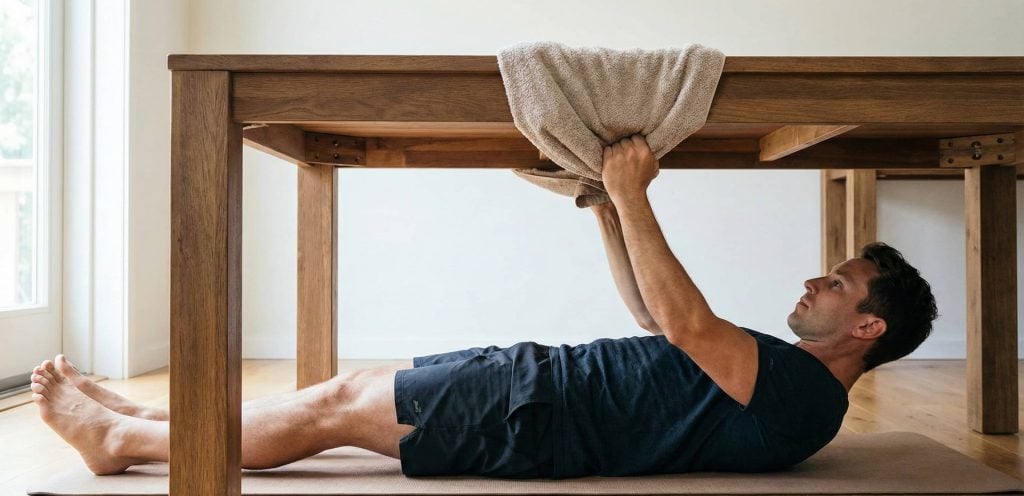
- Table rows, knees bent 4×6-10 rest 90 s
- Shoulder taps, on your knees or toes 3×16 alternating rest 60 s
- Superman hold 3×20 s rest 45 s
- Dead bug 3×8 per side rest 45 s
For table rows, lie on your back under the table with your chest below the edge. Reach up with straight arms and hold the edge, on a folded towel if it digs in. With your knees bent and feet flat, row your chest up and lower yourself slowly.
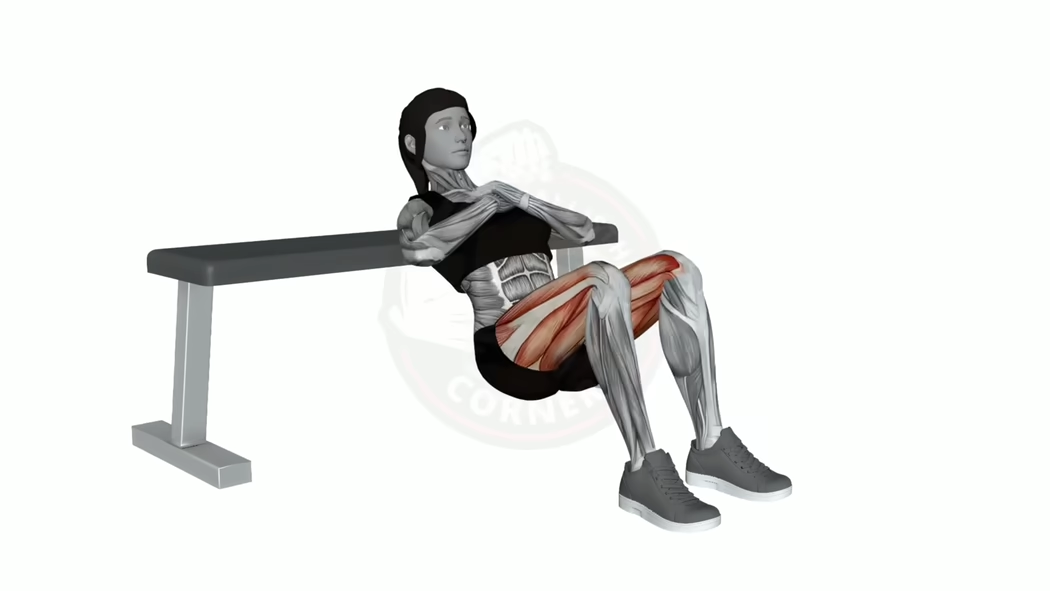
- Hip thrust, back on the couch 4×12-15 rest 90 s
- Wall sit 3×30-45 s rest 60 s
- Sumo squat, feet wide 3×12-15 rest 60 s
- Fire hydrant 3×12 per leg rest 45 s
- Side plank 3×15-20 s per side rest 45 s
The hip thrust anchors Session C. Rest your shoulders on the edge of a couch that can’t slide, drive your hips up until they line up with your shoulders and knees, and squeeze your glutes for a second at the top.
Too hard? Easier versions of every move
Use these for as long as you need, and switch to the session’s move once you reach the bottom of its range.
- Session A: squats down to a chair, reverse lunges with one hand on a wall, bridges with a smaller lift, smaller donkey kicks, plank on your knees.
- Session B: push-ups with your hands on a wall, superman holds in place of rows, slow shoulder taps on your knees, superman with arms or legs only, dead bug with your legs only.
- Session C: glute bridges on the floor in place of hip thrusts, a wall sit higher up the wall, sumo squats down to a chair, smaller fire hydrants, side plank on your knees.
Weeks 5 to 8: harder versions
In the second month, seven moves step up to a harder version in the same sessions. The other moves stay as they are.
| Weeks 1 to 4 | Weeks 5 to 8 |
|---|---|
| Air squats | Squats with a 3-second pause at the bottom |
| Reverse lunges, alternating | Bulgarian split squats, back foot on a chair |
| Glute bridge | One-leg glute bridge, 4×10 per leg |
| Hip thrust | One-leg hip thrust |
| Incline push-ups on a table | Incline push-ups on a chair, then negatives on the floor |
| Table rows, knees bent | Legs straight, then feet raised |
| Plank | Plank up-downs, 3×20 s |
Move to the harder version when every set reaches the top of its range, two sessions in a row. If that happens in week 3, don’t wait for week 5: each move goes at its own pace.
The table is also on page 2 of the free PDF, with a log for all 24 sessions.
Your first push-up, step by step
You get to a full push-up by lowering your hands one step at a time:
- Hands on a table: 4 sets of 12 clean reps, body straight from shoulders to ankles.
- Hands on a chair or a step: same target, 4×12. Put the chair against a wall so it can’t slide.
- Negatives on the floor: lower for 4 seconds, then come back up on your knees. 3 sets of 5.
- Your first full push-up: chest close to the floor, body straight from start to finish. Harder push-up variations come after that.
Pulling follows the same logic. Table rows start with your knees bent and feet flat, then legs straight, then feet raised on a chair that won’t slide. Your target by the end of the plan is 10 rows with your feet raised.
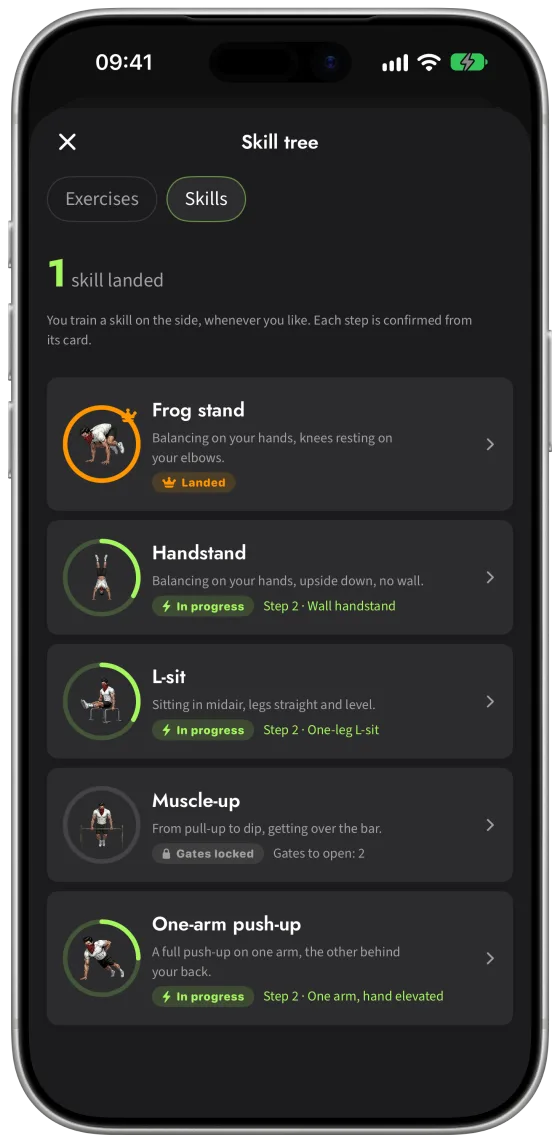
With your coach in the app
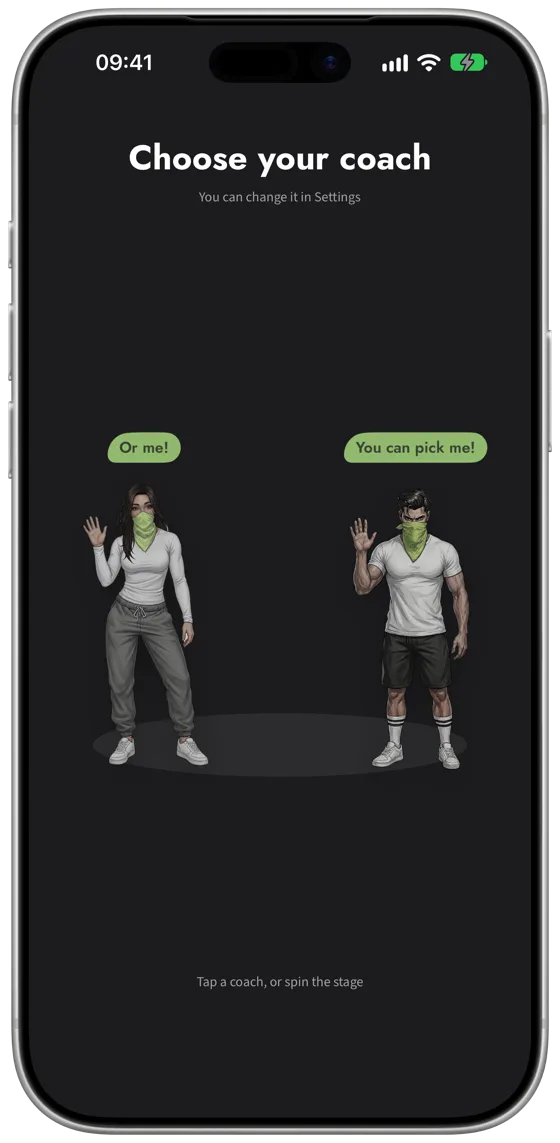
In the Calisthenics Corner app, you pick a female or a male coach, and that coach’s voice follows you through each session. You log your reps, the next session adjusts, and harder variations unlock when your numbers justify it. Both coaches run the same sessions and the same unlock thresholds.
The plan above stays free. The app is a paid subscription, with a 3-day trial on iPhone and your first month free on Android. Use it if you’d rather not figure out the progression yourself.

What holds people back
The most common mistake is staying on the easy version too long. If your 4 sets of incline push-ups reach 12 with no effort, the table has stopped working for you. Lower your hands.
The opposite mistake is rushing to the floor. Your hips sag, your lower back takes over, and the rep stops training what it should. A clean incline push-up beats a broken one on the floor.
Then there’s skipping sessions. Three a week for 8 weeks is 24 sessions, and finishing them matters more than how hard any one of them feels.
After the 8 weeks
Run your starting test again in week 8 and compare your numbers.
If you liked the lower-body work, the lower body program moves on to one-leg exercises for 10 weeks. If pulling is what motivates you, the pull-up program takes over with a bar, up to 10 strict pull-ups.
Without a bar, the other option is the military calisthenics plan: 4 weeks of longer sets, three sessions a week of 20 to 35 minutes.
Sources
-
Roberts BM et al., 2020. Sex Differences in Resistance Training: A Systematic Review and Meta-Analysis. J Strength Cond Res. PubMed ↩
-
Refalo MC et al., 2025. Sex differences in absolute and relative changes in muscle size following resistance training in healthy adults. PeerJ. DOI. The biceps and quadriceps figures are from Refalo et al. 2025, citing Nuzzo 2023. ↩ ↩2