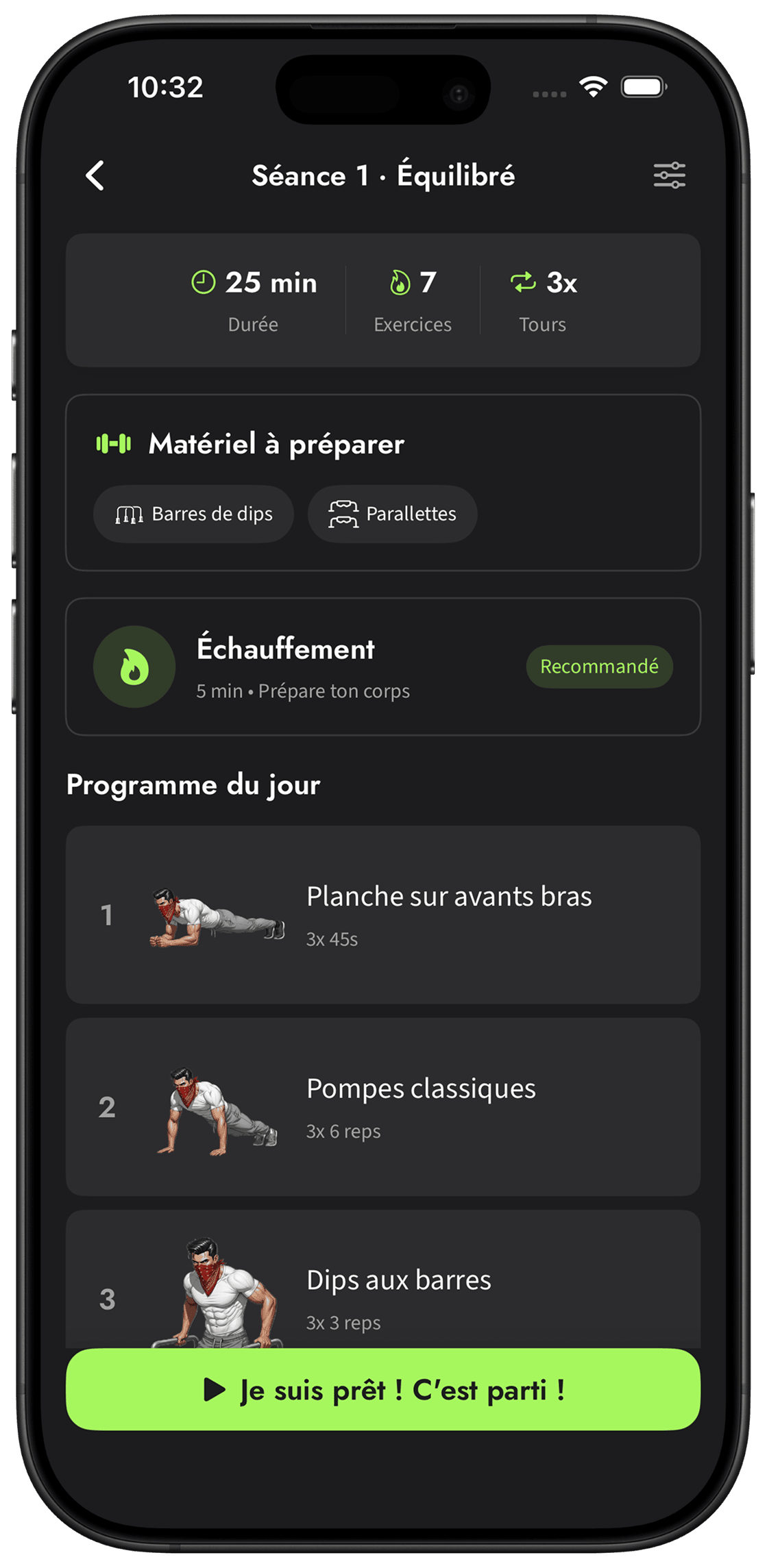
PPL (Push Pull Legs) splits training sessions into three categories: push, pull and legs. In calisthenics, it is one of the most effective formats to build strength and volume with bodyweight only, no gym, at home or outside.
This PPL calisthenics program is free, structured over 12 weeks in 3 phases, and suits men and women equally. Formats from 3 to 6 days per week depending on your level. The goal: methodical progression toward advanced variations and calisthenics skills.
Who is this PPL program for?
This program targets intermediate calisthenics athletes who want to structure their training with a smart split. You already have a solid base on the fundamental movements and you want to add volume per muscle group to build strength and size. The PPL format lets you target each movement pattern deeper than a full body program.
Commitment: 3 to 6 sessions per week, 45 to 60 minutes each, for 12 weeks.
Equipment: one pull-up bar. Parallettes are a nice-to-have but not required.
PPL principles in calisthenics
PPL splits your training into three session types based on the movement pattern. Push targets chest, shoulders and triceps: push-up variations and dips. Pull works back, biceps and grip: pull-ups, Australian pull-ups, dead hang. Legs hits quads, hamstrings, glutes and calves: squats, lunges, pistol squat, Nordic curl.
The PPL advantage in calisthenics: each session allows high volume per muscle group while leaving 48 to 72 hours of recovery before you train the same muscles again. It is movement logic, not isolation logic. With bodyweight, exercises are compound by nature. PPL respects that reality.
Base frequency: 3 days per week (Push Monday, Pull Wednesday, Legs Friday). As you handle the volume and recovery keeps up, you gradually move to 4, then 5, then 6 days. The program details every format in the next section.
Which format to pick (3, 4, 5 or 6 days)
PPL is flexible. The same program works at 3, 4, 5 or 6 sessions per week. The difference: how many times you repeat each session during the week. More frequency = more total volume = more gains. But also more accumulated fatigue. Start low, build up progressively.
3 days per week
The baseline format. One complete cycle per week: Push Monday, Pull Wednesday, Legs Friday. Each muscle is trained once a week. This is the recommended starting point for the first 4 weeks, even if you feel capable of more. Your tendons need time to adapt to the PPL volume.
4 days per week
You add a 4th session by continuing the cycle: Push, Pull, Legs, Push. The next week picks up where you left off: Pull, Legs, Push, Pull. In practice, each session comes up about 1.3 times per week. This is the sweet spot for most athletes in phase 2.
5 days per week
Almost two complete cycles per week. Total volume increases significantly. Save this format for the end of phase 2 or the start of phase 3, once your body has handled 4 sessions for at least 2 weeks.
6 days per week (PPL x2)
Two full cycles per week: Push, Pull, Legs, Push, Pull, Legs. Sunday off. Each muscle is trained twice a week. This is the maximum format, reserved for phase 3 and for athletes who recover well (sleep, nutrition, no joint pain).
Warm-up before every session
The warm-up runs 5 to 10 minutes and targets specifically the joints loaded in today’s session. In PPL, each day has its own warm-up. Shoulders and wrists are the weak points in calisthenics: never skip them.
Push warm-up (5-10 min)
- Shoulder rotations: 15 forward, 15 backward
- Wrist rotations: 15 each direction
- Shoulder dislocates (with towel or band): 10 slow reps
- Incline push-ups (hands on wall): 10 reps, slow tempo
- Standard push-ups slow tempo: 5 activation reps
Pull warm-up (5-10 min)
- Shoulder rotations: 15 forward, 15 backward
- Shoulder dislocates: 10 slow reps
- Scapular pull-ups: 8 activation reps
- Dead hang: 15-20 second activation
- Slow Australian pull-up: 5 reps
Legs warm-up (5-10 min)
- Hip circles: 10 each direction
- Light forward lunges: 5 per leg, slow tempo
- Air squats: 10 reps with controlled descent
- High knees on the spot: 20 reps
Program structure, week by week
Phase 1: Adaptation, Weeks 1-4, 3 sessions/week
Goal: install the PPL rhythm, anchor technique on every movement pattern, build base volume. You train 3 times a week: Push Monday, Pull Wednesday, Legs Friday. Each muscle is trained once a week. Do not try to add frequency in phase 1, even if you feel fresh.
Push (Chest + Shoulders + Triceps)
- Standard push-ups: 4×10, 90s rest
- Pike push-ups: 3×8, 90s rest
- Dips (chair or bars): 3×8, 90s rest
- Diamond push-ups: 3×8, 60s rest
Pull (Back + Biceps + Grip)
- Pronated pull-ups: 4×6, 120s rest
- Australian pull-ups: 4×10, 90s rest
- Dead hang: 3×30s, 60s rest
- Scapular pull-ups: 3×8, 60s rest
Legs (Quads + Glutes)
- Air squat: 4×15, 60s rest
- Lunges: 3×10/leg, 60s rest
- Glute bridge: 4×15, 60s rest
- Calf raises: 3×15, 45s rest
- Mountain climbers: 3×30, 45s rest
End of Phase 1 target: 4×12 standard push-ups, 4×8 pronated pull-ups, 4×20 air squats, 4×8 dips.
Phase 2: Volume, Weeks 5-8, 3 to 5 sessions/week
Goal: raise total training volume per session and per week. Add sets, reps and new exercises. This is where mass gains start in earnest.
You can move to 4 and then 5 days per week if recovery keeps up. Simple test: if you show up to a session with no lingering soreness and your performance is not dropping, you can add a day.
Push (Chest + Shoulders + Triceps)
- Standard push-ups: 4×12, 75s rest
- Decline push-ups: 3×10, 90s rest
- Pike push-ups: 4×10, 90s rest
- Dips: 4×10, 90s rest
- Diamond push-ups: 3×10, 60s rest
Pull (Back + Biceps + Grip)
- Pronated pull-ups: 4×8, 120s rest
- Australian pull-ups: 4×12, 75s rest
- Dead hang: 4×40s, 60s rest
- Scapular pull-ups: 3×10, 60s rest
- Chin-ups: 3×6, 120s rest
Legs (Quads + Glutes)
- Air squat: 4×20, 60s rest
- Bulgarian split squats: 3×8/leg, 90s rest
- Single leg glute bridge: 3×10/leg, 60s rest
- Nordic curl (eccentric): 3×5, 120s rest
- Mountain climbers: 3×40, 45s rest
End of Phase 2 target: 4×15 standard push-ups, 4×10 pronated pull-ups, 4×12 dips, 4×10 Bulgarian split squats/leg.
Phase 3: Intensity, Weeks 9-12, 4 to 6 sessions/week
Goal: move to advanced variations and push intensity. Archer push-ups replace standard push-ups, chin-up volume rises, pistol squat makes its entrance. This is the phase that builds the foundation for calisthenics skills.
If recovery is solid and you sleep 7-8 hours per night, this is the time to shift to 6 days (PPL x2). Each muscle is trained twice a week with maximum volume.
Push (Chest + Shoulders + Triceps)
- Archer push-ups: 4×6/side, 90s rest
- Decline push-ups: 4×12, 75s rest
- Pike push-ups, feet elevated: 4×10, 90s rest
- Dips: 4×12, 75s rest
Pull (Back + Biceps + Grip)
- Pronated pull-ups: 4×10, 90s rest
- Chin-ups: 4×8, 90s rest
- Close-grip Australian pull-ups: 4×12, 60s rest
- Dead hang: 4×50s, 60s rest
Legs (Quads + Glutes)
- Pistol squat (or progression): 3×5/leg, 120s rest
- Bulgarian split squats: 4×10/leg, 75s rest
- Nordic curl: 3×6, 120s rest
- Single leg glute bridge: 4×12/leg, 60s rest
End of Phase 3 target: 4×8 archer push-ups/side, 4×12 pronated pull-ups, 3×8 pistol squats/leg, 4×50s dead hang.
PPL program exercises
Push
Standard push-ups, diamond push-ups, decline push-ups, pike push-ups, archer push-ups, dips.
Pull
Pronated pull-ups, Australian pull-ups, dead hang, scapular pull-ups.
Legs
Squats, lunges, Bulgarian split squats, pistol squat, Nordic curl, single leg glute bridge.
Tips to succeed on this PPL program
Technique first. In PPL, volume per muscle group is high. If your technique is sloppy, you pile up low-quality reps that fatigue joints without stimulating muscles correctly. Every rep should be controlled: 2-second descent, explosive concentric, full range. 8 clean reps beat 15 sloppy ones.
Respect rest between sessions. In the 3-day format it is simple: 48 hours between each session. In the 6-day format, PPL logic means you never train the same muscles two days in a row. Push Mon, Pull Tue, Legs Wed, Push Thu, Pull Fri, Legs Sat. Your chest has 48 hours of rest between the two Push sessions. Respect that structure.
Increase frequency gradually. Going from 3 to 6 days does not happen in one week. Phase 1 = 3 days. Phase 2 = 3 to 5 days depending on recovery. Phase 3 = 4 to 6 days. If performance drops (fewer reps than the previous session), you are doing too much volume. Go back to the lower format.
Mistakes to avoid on PPL
PPL is an effective format, but it leaves room for mistakes that can stall progress or cause injuries. Here are the 5 most common.
Doing only Push and neglecting Pull. Push-ups and dips feel rewarding, pull-ups less so. But a push/pull imbalance creates shoulder pain and a forward-rounded posture. This program balances both patterns: Pull day has as much volume as Push day. Respect that.
Skipping Leg day. The #1 beginner mistake in PPL. Upper-body results show up faster, leg results are slower. But skipping Leg day creates an aesthetic (the “inverted triangle”) and functional imbalance. Weak legs limit your stability on every upper-body movement.
Moving to 6 days too early. The PPL x2 format (6 days) doubles total volume. Jumping from 3 to 6 days in one week stacks fatigue your body cannot handle. Result: overtraining, performance drop, injury risk. Add one day every 2-3 weeks.
Not progressing variations. Have you been doing 4×15 standard push-ups for 3 weeks without increasing difficulty? You are no longer progressing. In calisthenics, progressive overload runs through variations: diamond, decline, archer push-ups. This program is built for that. Once you clear the target reps, move to the next variation.
Skipping the warm-up. Shoulders and wrists are the weak points in calisthenics. Dips, pike push-ups and archer push-ups load these joints in extreme ranges. 5 to 10 minutes of targeted warm-up before every session cuts injury risk dramatically. This is not optional.
What comes after this program?
In 12 weeks of PPL calisthenics, you will have built a serious strength base: archer push-ups, 4×12 pull-ups, pistol squat, solid dips. That is the foundation that opens the door to advanced skills and specialisation programs.
Split program. A different split to change the load pattern. An Upper/Lower split or a muscle-group split adds new stimuli after 12 weeks of PPL.
Advanced skills. Muscle-up, front lever, planche. With 4×12 pull-ups and 4×8 archer push-ups, you have the strength base to start these calisthenics skills.
Run PPL again. With the next phase of variations to keep progressing. You can also add a weighted vest or resistance bands to raise intensity.
Whatever you pick, PPL has given you the foundation. The next step depends on your goals: aesthetics, performance, skills. But you start from a base that 90% of athletes do not have.