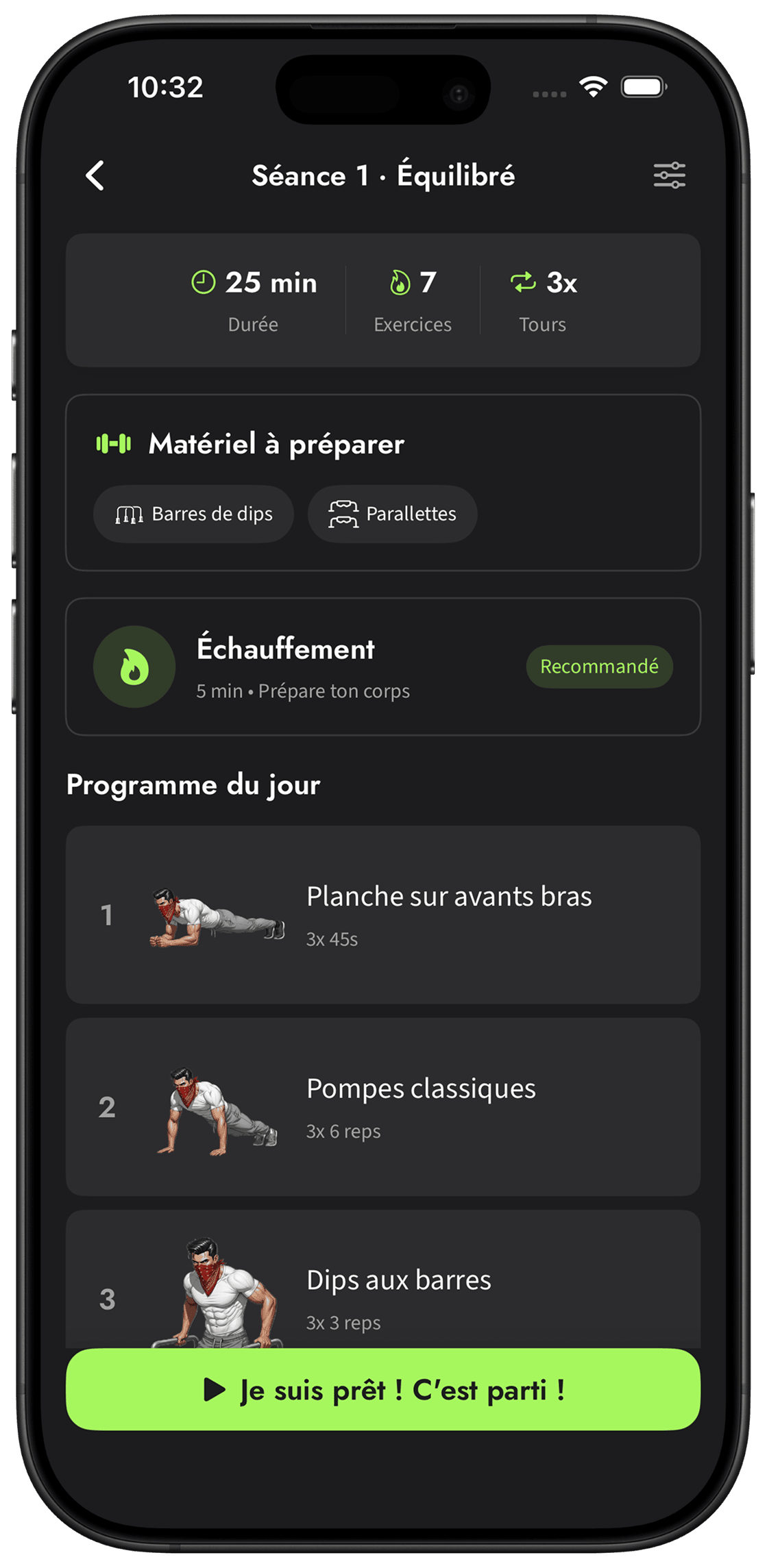
The push-up program starts where most guides stop: at zero. Not at “I already do a few reps”, not at “I have a base”. At zero. The progression runs 8 weeks, 3 sessions per week, no equipment. The goal: 30 strict push-ups in a row at bodyweight.
Thirty push-ups is the threshold that separates a beginner from a solid athlete. It is also the base you need to attack the advanced calisthenics variations: decline, military, archer. This program gets you there through a rigorous progression, exercise by exercise, week by week.
Who is this push-up program for?
This push-up program targets two profiles: the complete beginner who cannot yet do a floor push-up, and the one who is stuck below 10 reps with no idea how to progress. No equipment required, just a floor and 30 minutes three times a week. A weighted vest stays optional in phase 3 if you move fast. The prerequisites and equipment are listed at the top of the page.
Want to build a complete base alongside it (legs, pull-ups, core)? The beginner calisthenics program covers all of that over the same duration.
Program principles
This program rests on three principles: specificity, progressive overload and recovery.
Specificity. Each exercise prepares the push-up movement directly. You do not train “pushing” in general. You train the exact muscles, angles and motor patterns of the push-up.
Progressive overload. Each week, you increase either reps, or volume, or you move to a harder variation. The body adapts only if it gets a stimulus slightly above the previous week.
Recovery. Chest, triceps and shoulders need at least 48 hours between two intensive pushing sessions. The 3 weekly sessions are spaced by at least one rest day each time.
Overall structure:
- Weeks 1-3: Phase 1 · Build the base
- Weeks 4-6: Phase 2 · First push-ups and volume
- Weeks 7-8: Phase 3 · Final sprint
Warm-up
The same warm-up comes before every session. 5 minutes, do not skip it.
- Shoulder circles: 10 forward, 10 backward
- Scapular push-ups: 2 × 10 slow reps (arms straight, push your shoulder blades outward)
- Light incline push-ups on a high surface: 1 × 10 reps at 50% effort
- Static top push-up position: 1 × 20 seconds (body aligned, abs braced)
Program structure, week by week
Phase 1: Build the base (weeks 1-3)
The goal of this phase is not to do floor push-ups. It is to build the strength chain, the technique and the body awareness that make them possible. Almost everyone skips this phase: that is why so many people stall at 5 push-ups for years.
You alternate two sessions (A and B) across the 3 weeks.
Session A
- Incline push-ups: 4×10-12, 90 s rest
- Scapular push-ups: 3×10, 60 s rest
- Plank: 3×30 s, 60 s rest
Session B
- Eccentric push-ups (5 s descent): 4×4-5, 2 min rest
- Incline push-ups: 3×max, 90 s rest
- Plank: 3×30 s, 60 s rest
Week-to-week progression: Lower the height of your surface by 10 to 15 cm each week. Week 1: hands at shoulder height. Week 2: belly height. Week 3: knee height or directly on the floor if you can.
End of phase 1 test (end of week 3): max reps of floor push-ups, full range. Target: 10 clean push-ups before moving to phase 2.
Phase 2: First push-ups and volume (weeks 4-6)
You enter the productive zone. The goal is to go from 10 reps to 20 consecutive reps. This phase combines volume on classic push-ups, targeted variations and a Grease the Groove session.
Session A
- Classic push-ups: 5×(max-2), 2 min rest
- Military push-ups: 3×8-10, 90 s rest
- Scapular push-ups: 2×12, 60 s rest
Session B
- Classic push-ups: 4×max, 2 min rest
- Decline push-ups: 3×8-10, 90 s rest
- Plank: 3×40 s, 60 s rest
Session C · Grease the Groove
No classic session. Across the whole day, do 5 to 8 mini-sets of 3-5 clean push-ups, spread every 2-3 hours. Each set is clean, well below failure. The accumulated volume without fatigue is the most effective trigger for adding reps.
Progression: Add 1 rep per set of classic push-ups each week. When you reach 5 × 12 clean reps in session A, you are ready for phase 3.
End of phase 2 test (end of week 6): max reps of strict push-ups. Target: 20 push-ups.
Phase 3: Final sprint (weeks 7-8)
You do 20 push-ups. Two weeks to reach 30.
Session A
- Classic push-ups: 5×(max-1), 2 min rest
- Diamond push-ups: 3×8-10, 90 s rest
- Decline push-ups: 3×10, 90 s rest
Session B · Grease the Groove
Across the whole day, do 6 to 10 mini-sets of 5-8 clean push-ups, spread every 2-3 hours. The daily accumulated volume reaches 50 to 80 push-ups with no significant fatigue. This frequent, submaximal volume is what drives progress on big sets.
Session C (test + volume)
- Test max clean push-ups: 1×max
- Classic push-ups: 4×(80% of max), 90 s rest
- Scapular push-ups: 3×12, 60 s rest
Final test, week 8: max reps of strict push-ups, full range. Target: 30 reps.
The program exercises
The incline push-up
Hands on a raised surface (table, counter, step), feet on the floor. The higher the surface, the easier it is: at shoulder height you work with about 40% of your bodyweight, at 30 cm from the floor you approach 80%. The movement is exactly the same as the classic push-up, elbows at 45°, body aligned, full range. This is your base regression for all of phase 1: it builds the pattern cleanly before you add load.
The eccentric push-up
You get into the top position using your knees if needed, then you lower in 5 seconds, controlling every centimetre. Eccentric work generates larger muscle adaptations than the concentric alone. That is why eccentrics unlock the first clean push-ups much faster than simple set volume.
The classic push-up
Body aligned head to heels, hands slightly wider than the shoulders, elbows at 45° from the body. You lower until your chest grazes the floor, you push back up to fully straight arms. Full range mandatory on every rep. A half push-up does not count.
The military push-up
Military push-ups keep the elbows tucked along the body: the triceps become the main driver instead of the chest. This variation builds the tucked-elbow strength that transfers directly to dips and advanced variations. In phase 2, it complements the classics without replacing them.
The decline push-up
Feet raised on a chair or bench, decline push-ups target the upper chest and the shoulders. They serve as a variation in phases 2 and 3 to hit the chest from a different angle. The higher the feet, the higher the intensity.
Tips to succeed
Eat enough. The push-up is a strength exercise. A large calorie deficit slows gains. You do not need a surplus, but cover your needs with 1.6 to 2 g of protein per kilo of bodyweight per day.
Sleep 7 to 9 hours. Strength is built during sleep, not during training. A 5-hour night cancels much of the adaptation from the previous session.
Film your technique from the side. Put your phone on a stable surface and film every session. You will immediately see if your hips sag, if your elbows flare, or if your range is incomplete. Clean technique is the condition for progress.
Respect the rest times. 2 minutes between sets of classic push-ups is not laziness. It is the condition for the next set to be productive.
Mistakes to avoid
The first mistake is skipping phase 1. Incline and eccentric push-ups seem too easy. They are not when they are executed well. And even if you find them easy, they build the neuromuscular connections specific to the movement. Without this phase, the first classic push-ups arrive later, not sooner.
The second mistake is cheating on the range of motion. A half push-up does not count. You lower chest to the floor, you push back up to fully straight arms. Half push-ups build strength you cannot use on the part of the movement you skip.
The third mistake is letting the hips sag. When the core gives up, the lower back takes a load it should not carry. Brace your abs and glutes from start to finish on every rep. If you cannot, reduce the reps rather than sacrifice the alignment.
The fourth mistake is working too close to failure too often. Grease the Groove only works if the reps are clean and submaximal. Training to failure every session fatigues the nervous system and blocks progress.
What comes after this program?
Thirty clean push-ups is a solid base to move in several directions.
You want full-body volume. Fit push-ups into the full body program that combines them with pull-ups and squats in a 3-session-per-week structure.
You want performance by muscle group. Move to the PPL program where the Push day is entirely dedicated to push-ups, dips and pushing exercises. It is the natural next step when you want faster upper-body progress.
You want the advanced variations. Archer push-ups are the logical next step. They build unilateral strength by loading each arm with 70-80% of your bodyweight. The road to one-arm push-ups starts there.