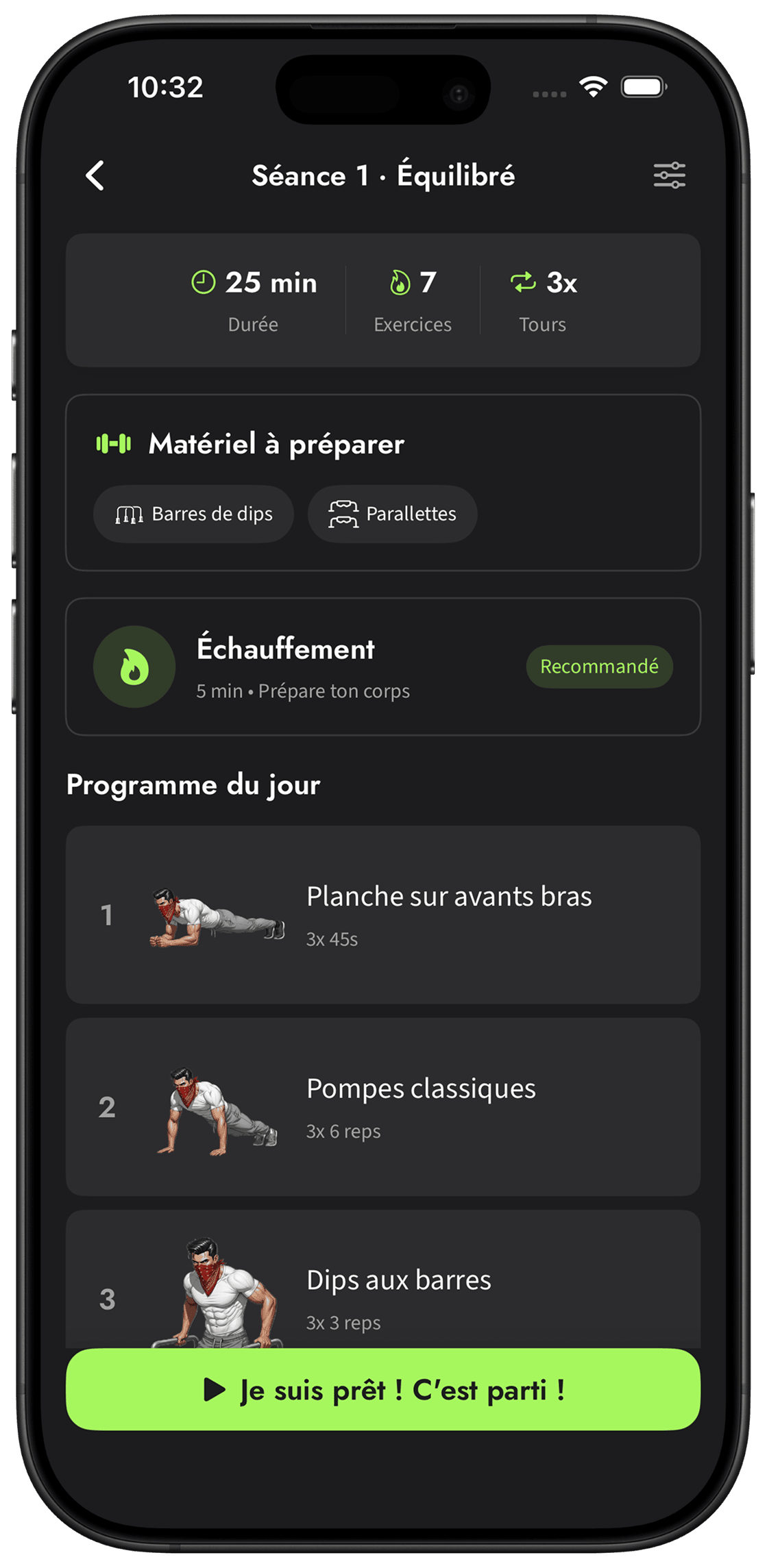
The full body approach trains the entire body in a single session. In calisthenics, it is the best way to build strength and size with bodyweight only, no gym, at home or outside.
This full body program is designed for athletes who already own the basics (push-ups, pull-ups, squats). It is fully free, structured over 12 weeks in 3 progressive phases, and works equally well for men and women. The goal: move from a beginner-intermediate level to a solid base, ready for calisthenics skills.
Who is this full body program for?
| Duration | Frequency | Per session | Equipment |
|---|---|---|---|
| 12 weeks | 3-4×/week | 45-60 min | Pull-up bar |
This program targets intermediate calisthenics athletes. You have been training for at least 6 months and the basics are solid. You want to step up and build size and strength across your whole body.
Level prerequisites
- ✓ 15 strict push-ups in one set
- ✓ 5 full pronated pull-ups (chin above the bar)
- ✓ 10 dips on a chair or parallel bars
- ✓ 30 seconds of strict front plank
- ✓ 15 clean squats with no compensation
Not there yet? Start with the beginner calisthenics program.
Commitment: 3 to 4 sessions per week, 45 to 60 minutes each, 12 weeks with no skipped phase.
Equipment: one pull-up bar. Everything else is floor-based or uses a chair for dips.
Full body program principles
This program relies on progressive overload: each week, you add reps or move to a harder variation. No improvisation, every session has a numeric target.
Structure: full body every session. You train push, pull, legs and core in every workout. Two alternating sessions (A and B) vary the stimulus and optimise recovery.
| Phase | Weeks | Goal |
|---|---|---|
| Phase 1: Adaptation | 1-4 | Anchor movement patterns and build a strength base |
| Phase 2: Volume | 5-8 | Increase total workload for hypertrophy |
| Phase 3: Intensity | 9-12 | Advanced variations and maximum training density |
Frequency: 3 sessions per week in phases 1 and 2, 4 sessions in phase 3.
Warm-up before every session
Each session starts with a 5 to 10 minute warm-up. At this level, exercises are more demanding on shoulders and wrists. The warm-up is non-negotiable.
Warm-up routine (5-10 min)
- Shoulder rotations: 15 forward, 15 backward
- Wrist rotations: 15 each direction
- Hip circles: 10 each direction
- Shoulder dislocates (with towel or band): 10 slow reps
- Incline push-ups (hands on wall): 10 reps, slow tempo
- Scapular pull-ups (if bar available): 8 reps
- Light air squat: 10 reps
- Cat-cow: 10 reps
Shoulders and wrists: pull-ups, dips and advanced push-ups load these joints hard. Shoulder dislocates and wrist rotations prep those areas specifically. If you feel nagging joint discomfort, check our grip training and wrist strengthening guides.
Program structure, week by week
Phase 1: Adaptation, Weeks 1-4, 3 sessions/week
Goal: anchor clean movement patterns and build a strength base.
Session A
- Standard push-ups: 4×8-10 reps, 90s rest
- Pronated pull-ups: 4×4-6 reps, 2 min rest
- Squats: 3×15-20 reps, 60s rest
- Dips: 3×6-8 reps, 90s rest
- Front plank: 3×30-40s, 60s rest
Session B
- Pike push-ups: 4×8-10 reps, 90s rest
- Australian pull-ups: 4×10-12 reps, 90s rest
- Lunges: 3×10-12 reps per leg, 90s rest
- Leg raises: 3×10-12 reps, 60s rest
- Side plank: 3×25-30s per side, 45s rest
End of Phase 1 target: 4×10 standard push-ups, 4×6 full pronated pull-ups, 3×12 clean lunges.
Phase 2: Volume, Weeks 5-8, 3 sessions/week
Goal: raise total workload to drive hypertrophy.
Session A
- Diamond push-ups: 4×10-12 reps, 75s rest
- Pronated pull-ups: 4×6-8 reps, 2 min rest
- Jump squats: 3×12-15 reps, 75s rest
- Dips: 4×8-10 reps, 90s rest
- Front plank: 4×40-50s, 45s rest
Session B
- Decline push-ups: 4×10-12 reps, 75s rest
- Australian pull-ups: 4×12-15 reps, 75s rest
- Bulgarian split squats: 3×10 reps per leg, 90s rest
- Leg raises: 4×12-15 reps, 60s rest
- Side plank: 4×35-40s per side, 45s rest
End of Phase 2 target: 4×12 diamond push-ups, 4×8 pronated pull-ups, 3×10 Bulgarian split squats per leg.
Phase 3: Intensity, Weeks 9-12, 4 sessions/week
Goal: progress to advanced variations and increase training density.
Session A: Push + Core
- Archer push-ups: 4×6-8 reps per side, 90s rest
- Dips: 4×10-12 reps, 90s rest
- Decline push-ups: 3×12-15 reps, 75s rest
- L-sit progression: 4×10-15s hold, 60s rest
Session B: Pull + Legs
- Pronated pull-ups: 5×6-8 reps, 2 min rest
- Slow Australian pull-ups (3s descent): 3×12 reps, 75s rest
- Bulgarian split squats: 4×12 reps per leg, 90s rest
- Pistol squat progression: 3×5-8 reps per leg, 2 min rest
End of Phase 3 target: 8 archer push-ups per side, 5×8 pronated pull-ups, 8 pistol squats per leg.
Full body program exercises
Push
Standard push-ups, diamond push-ups, decline push-ups, archer push-ups, pike push-ups, dips.
Push exercises build chest, triceps and shoulders. You progress from standard push-ups to archer push-ups, a unilateral movement that preps the one-arm push-up.
Pull
Pronated pull-ups, Australian pull-ups.
Pull exercises build back, biceps and the rear of the shoulders. Pronated pull-ups are the backbone of the program, Australian pull-ups add volume and slow-tempo work.
Legs
Squats, lunges, Bulgarian split squats, pistol squat.
Leg exercises target quads, glutes and hamstrings. The progression runs from the bilateral squat toward the pistol squat, an advanced unilateral movement that is the end-of-program goal.
Core
Front plank, side plank, leg raises, L-sit.
The core stabilises the torso and transfers force between upper and lower body. The L-sit is the end-of-program goal: a compression hold that demands both abdominal strength and flexibility.
Tips to succeed on this program
Recovery: 48 hours minimum between sessions in phases 1 and 2. In phase 3, two back-to-back days are possible because weeks 1-8 have prepared your body for the load. Sleep 7-8 hours minimum.
Progression: add reps before adding sets. When you hit the top of the range on every set, move to the next harder variation instead of adding another set.
Nutrition: a small calorie surplus (+200-300 kcal/day) supports mass gain. Aim for 1.6 to 2g of protein per kg of bodyweight. Muscle hypertrophy depends on nutrition as much as on training.
Plateaus: if you stall 2 weeks in a row on the same exercise, repeat the previous week. That is progress, not failure.
Injury prevention: the 5-10 minute warm-up is mandatory before every session. If persistent joint pain shows up in shoulders or wrists, stop and check your technique.
Mistakes to avoid on full body
At this level, mistakes are no longer beginner mistakes. They are more subtle and can stall progress for months.
Staying on the same variation too long. If you have been doing 4×15 standard push-ups for 3 weeks, you are no longer progressing. In calisthenics, progressive overload runs through variations: diamond, decline, archer push-ups. This program is built for that.
Neglecting pull work. Push-ups and dips feel rewarding. Pull-ups, less so. But a push/pull imbalance creates shoulder pain and a rounded posture. This program balances both: respect the pull sessions.
Training every day with no rest. In full body, every session loads the entire body. Without 48 hours of recovery between sessions, muscles do not repair and strength stalls. 3 to 4 sessions per week, no more.
Ignoring rep tempo. Doing 10 pull-ups in 15 seconds and 10 pull-ups in 40 seconds do not produce the same effect. Control the descent (2-3 seconds) to maximise muscle tension and strength gains.
Underestimating nutrition. You will not build mass on full body calisthenics in a calorie deficit.
What comes after this program?
In 12 weeks, you will have the strength base for several directions. Pick based on your goals.
Static skills. With 8 clean archer push-ups per side, you have the push strength to start the planche progression.
Dynamic skills. With 5×8 pull-ups banked, you have the base needed to work the muscle-up.
Keep building size. Move to the PPL program or half body to add volume per muscle group.
Whatever you pick, come back to this program in 6 months. The progression will be visible.