Calisthenics naturally develops the core. Every push-up, every pull-up, every skill demands trunk stability. But a functional trunk does not mean sculpted abs. For that, you need targeted, progressive work, and a nutrition plan that keeps up.
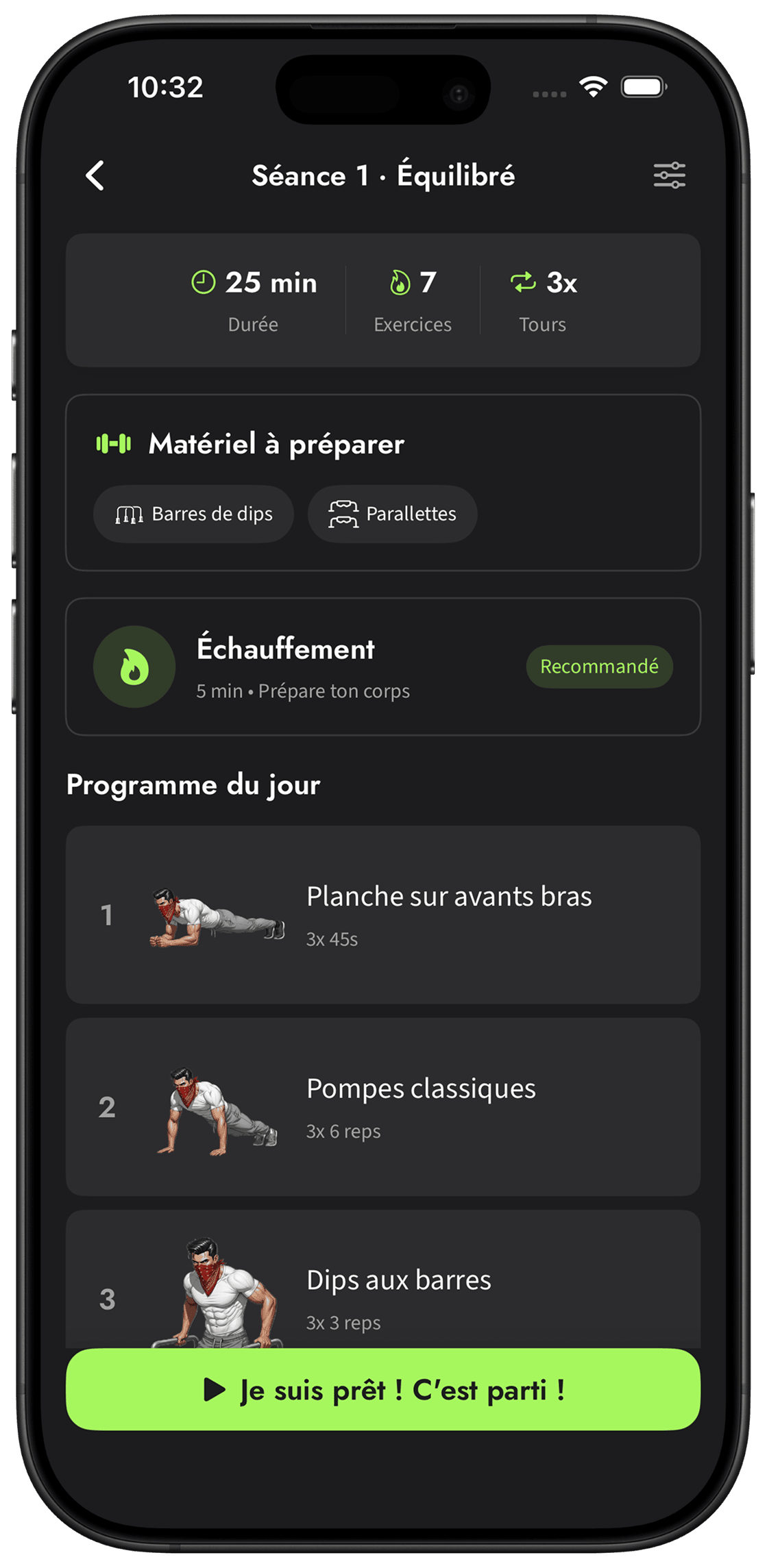
This no-equipment abs program covers the 4 functions of the core over 12 weeks, at home, from beginner to advanced. Not just crunches: from the crunch to the L-sit, through the plank, the hollow hold and hanging leg raises. Bodyweight only, 20 to 30 minutes per session.
Who is this program for
Three profiles fit here, across all levels, men and women alike (the abdominal muscles do not care).
The beginner who wants a flat stomach. A few crunches now and then but with no structure. The prerequisites are deliberately low: 30 seconds of plank, 10 clean crunches, knowing how to draw the stomach in.
The intermediate who wants a solid trunk. You already follow a full body or a PPL program and you want to strengthen your core specifically. This program combines with your main training.
The advanced athlete aiming for calisthenics skills. You want the L-sit, the dragon flag or the front lever. These skills demand a compression and anti-extension strength that crunches alone do not build.
Commitment required: 3 to 4 sessions per week, 20 to 30 minutes each. An exercise mat is comfortable for the floor work.
The 4 functions of the core
Most programs train only one function: flexion (crunches). That is not enough. The core has 4 distinct functions, and all 4 are trained here.
Anti-extension. Resisting the arching of the back. This is the plank, the hollow hold, the dead bug. This function stabilises your spine during push-ups, pull-ups and every static skill. The foundation.
Anti-rotation. Resisting the twisting of the trunk. This is the bird dog, the plank with shoulder taps, the mountain climber. Essential for unilateral movements and everyday stability.
Flexion. Bringing the ribs closer to the pelvis. This is the classic crunch, the reverse crunch, leg raises. The best-known function, the one that draws the visible six-pack.
Compression. Bringing the legs closer to the trunk in a hanging position. This is the L-sit, the V-sit, the front lever. The most demanding function, and the final goal of the program.
Phase 1: Foundations (weeks 1-4)
3 sessions per week. Circuit format: 3 rounds, 30-45 seconds rest between exercises, 90 seconds between rounds.
Goal: build base endurance and learn to engage the transverse. By the end of the phase, you will already have visible results at 1 month if nutrition keeps up.
Warm-up (5 min):
- Cat-cow (alternating arched and rounded back): 10 slow reps
- Transverse activation (exhale while drawing the navel in): 5 reps of 5 seconds
- Seated trunk rotation: 10 reps per side
- Slow dead bug: 5 reps per side
Phase 1 circuit (3 rounds)
- Front plank: 30-45 s
- Classic crunch: 12 reps
- Dead bug: 8 reps/side
- Mountain climbers, slow: 10 reps/side
- Side plank: 20 s/side
End of phase 1 target: 45 seconds of plank with no compensation, 15 controlled crunches, 10 dead bugs per side without lifting the lower back.
Phase 2: Volume (weeks 5-8)
3 sessions per week. Circuit format: 3 rounds, 30 seconds rest between exercises, 75 seconds between rounds.
Goal: raise volume and introduce the more advanced flexion exercises.
Phase 2 circuit (3 rounds)
- Hollow hold: 25-40 s
- Russian twists: 15 reps/side
- Leg raises on the floor: 12 reps
- Dynamic side plank: 10 reps/side
- Bicycle crunch: 12 reps/side
End of phase 2 target: 40 seconds of hollow hold, 15 floor leg raises with straight legs, 15 Russian twists per side with no momentum.
Phase 3: Intensity (weeks 9-12)
4 sessions per week. Circuit format: 4 rounds, 30 seconds rest between exercises, 60 seconds between rounds.
Goal: introduce hanging exercises and prepare the compression skills.
Phase 3 circuit (4 rounds)
- Hanging leg raises (or lying if no bar): 8 reps
- Reverse crunch: 15 reps
- Hollow hold: 30 s
- Bird dog (3 s hold): 8 reps/side
- Tuck L-sit on the floor: 4×10 s
End of phase 3 target: 8 hanging leg raises with straight legs, 35 seconds of hollow hold, 4 × 10 seconds of tuck L-sit on the floor. For the tuck L-sit, parallettes protect the wrists.
Nutrition for visible abs
You can follow this program to perfection for 12 weeks. If your diet does not keep up, your abs will stay hidden under a layer of fat. That is not an opinion, it is physiology.
Abs become visible at roughly 12 to 15% body fat in men, 18 to 22% in women. Above that, the program strengthens the muscles (strength, endurance, stability) but you will not see them.
To reveal the work: a moderate calorie deficit of 300 to 500 kcal/day below your maintenance. No crash diet. Combine it with 1.6 to 2 g of protein per kilo of bodyweight to preserve muscle mass.
A flat stomach is built in the kitchen, not in the gym. The program builds the house, nutrition removes the scaffolding.
Mistakes to avoid
- Doing only crunches. The crunch trains flexion alone. Without anti-extension, anti-rotation or compression, you build an unbalanced muscle that does not transfer into performance.
- Chasing volume instead of difficulty. 200 crunches a day is endurance in disguise. Progress runs through harder variations (crunch to hollow hold to hanging leg raises), not through adding reps forever.
- Ignoring nutrition. The six-pack is built in the gym and revealed in the kitchen. Both are needed, not one or the other.
- Training through lower-back pain. Discomfort in the lower back during leg raises means your transverse is not stabilising enough. Bend your knees, reduce the range, or drop back one phase while you rebuild the base.
What comes after this program
In 12 weeks, you have the core strength to go in several directions.
The L-sit is the natural goal. With 4 × 10 seconds of tuck L-sit on the floor, you are ready to work the straight-leg version. A visible skill that proves real compression strength.
The dragon flag is the next step in anti-extension. If you hold 35 seconds of hollow hold and 8 hanging leg raises, you have the base to start the tuck dragon flag progression. Aiming for the front lever is the other option on the static compression side, built on hollow body.
The full body program or the beginner program combine perfectly with this abs program. The 20 to 30 minute sessions slot in after a main workout or on a separate day.
To review the technique of every exercise in this program, the no-equipment abs exercises guide groups everything by function and level.