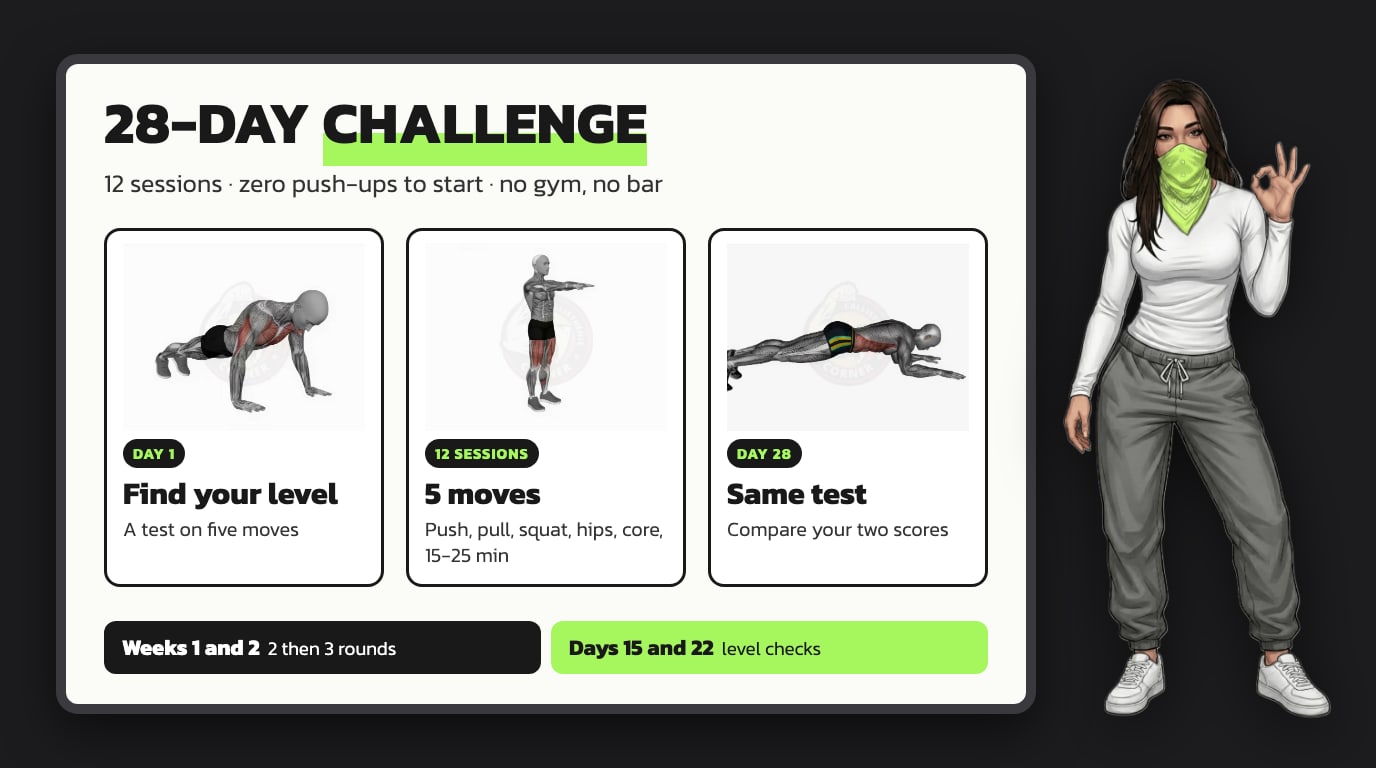
A 28-day calisthenics challenge is a four-week bodyweight plan with one instruction for every day. This one is built for complete beginners: 12 short sessions, easy days, rest days and the same test on day 1 and day 28. Print the free calendar as a PDF and check off a box each day. You can start with zero push-ups.
How the 28-day calisthenics challenge works
Nobody owns this name, so plans vary a lot: in November 2026, one of the top Google results had you train all 28 days with no rest day. This version has four kinds of day:
- Test (days 1 and 28): you find your level on each move, then measure how far you’ve come. Plan on 20 to 30 minutes.
- Session (12 days): one short circuit of five moves, 15 to 25 minutes.
- Easy day (7 days): a 10- to 15-minute walk. If you feel stiff, add a minute of slow arm circles.
- Rest (7 days): nothing to do. Check the box anyway.
Twelve sessions make three a week, above the CDC’s minimum for adults of 2 days of muscle-strengthening work. There is always at least one day between two hard days.
The 28-day calendar
Days are numbered, not dated, so you can start on any day of the week. Session days move around the week as the month goes on. If one doesn’t fit, add a rest day and push the rest of the calendar back.
A round is one pass through the session’s five moves. A level check is the day you decide which moves get harder.
| Week 1 · 2 rounds | ||||||
|---|---|---|---|---|---|---|
| Day 1 Test | Day 2 Easy | Day 3 Session 1 | Day 4 Rest | Day 5 Session 2 | Day 6 Easy | Day 7 Session 3 |
| Week 2 · 3 rounds | ||||||
| Day 8 Rest | Day 9 Session 4 | Day 10 Easy | Day 11 Session 5 | Day 12 Rest | Day 13 Session 6 | Day 14 Easy |
| Week 3 · 3 rounds | ||||||
| Day 15 Session 7 Level check | Day 16 Rest | Day 17 Session 8 | Day 18 Easy | Day 19 Session 9 | Day 20 Rest | Day 21 Easy |
| Week 4 · 3 rounds, 2 on session 12 | ||||||
| Day 22 Session 10 Level check | Day 23 Easy | Day 24 Session 11 | Day 25 Rest | Day 26 Session 12 | Day 27 Rest | Day 28 Test |
S7 = session 7. Check = level check.
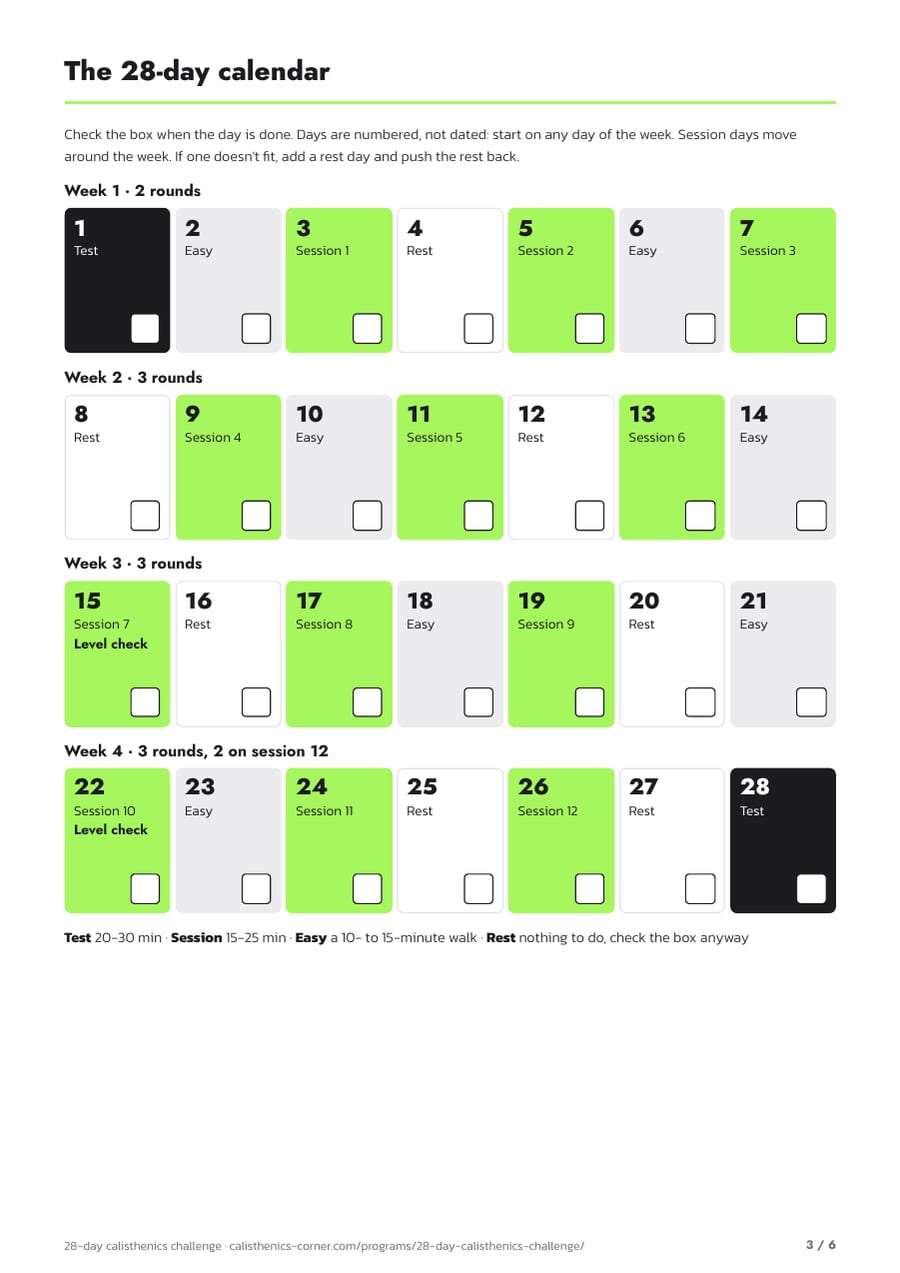
The printable calendar has a box to check for each day, and the PDF adds the session, a page for your scores and a log for your reps.
Who this challenge is for
It’s written for people who can’t do a push-up yet, and for anyone coming back after a long break. Most of the month happens on the easier versions of each move, and a day 1 test decides which ones.
If you already do 5 push-ups in a row, knees allowed, and hold a plank for 30 seconds, this month will be too easy. You’re already at the finish line: skip to what comes next.
What you need
A floor, a wall and a chair cover most of the plan. The rows need a sturdy table. Without one, stay on the superman hold, the level 1 pull, and add 5 seconds each week, even past the 30-second mark. On your test days, hold it as long as you can.
Day 1: find your level
Each move has four levels. You’ll probably land on different levels for different moves, and that’s fine.
| Move | Level 1 | Level 2 | Level 3 | Level 4 |
|---|---|---|---|---|
| Push | Wall push-up | Hands on a counter | Knee push-up | Full push-up |
| Pull | Superman hold | Table row, knees bent | Table row, legs straight | Table row, feet on a chair |
| Squat | Stand up from a chair | Air squat | Air squat, 3-second pause at the bottom | Reverse lunge |
| Hips | Glute bridge | Bridge, 2-second hold at the top | One-leg bridge | One-leg bridge, 2-second hold |
| Core | Dead bug | Knee plank | Plank | High plank, shoulder taps |
Warm up for about 3 minutes first: 30 seconds each of arm circles, marching in place, slow squats (down to a chair if you need it), hip hinges (hands on your thighs, push your hips back) and wall push-ups.
Then, for each move, start at level 1 and work up. Rest a minute after every set.
- Do one set, stopping at 12 clean reps or 30 seconds. A clean rep has the full range, with no sagging and no rushing.
- If you hit 12 reps or 30 seconds, try the next level. On level 4, keep going until your form slips and write down the number.
- If you stop at 8 to 11 reps, or 20 to 29 seconds, that’s your level.
- If you get less than that, your level is the one before. On level 1, stay there and do what you can.
Superman holds and the two planks count in seconds. A dead bug or shoulder tap rep means both sides. One-leg bridges and lunges count per leg.
Write down the last version you tried and your number: that line is your score. Say you do 12 wall push-ups, 12 on the counter and 4 on your knees. Your score is “knee push-ups, 4”, and you train at level 2 because 4 reps is under the minimum of 8.
Day 2 is an easy day because the test may leave you sore for a day or two. Mild soreness that fades as you warm up is fine to train through. Sharp pain, or pain in a joint, means dropping to the level below for that move, or skipping it on level 1.
The session
Every session is the same five moves, done as a circuit: one set of each, with 45 seconds of rest between moves. Five moves make one round, then you go back to the top. Start with the same warm-up as on day 1.
- Push 5-12 reps rest 45 s
- Pull 5-12 reps rest 45 s
- Squat 5-12 reps rest 45 s
- Hips 5-12 reps rest 45 s
- Core 5-12 reps rest 45 s
Holds (superman holds and planks) run 10 to 30 seconds instead. A round takes about 7 minutes, so with the warm-up a session runs about 17 minutes with 2 rounds and 24 with 3. Stop each set one or two reps before your form goes. Only the test days take you to your limit. The range starts at 5, below the 8 you needed on the test, because later rounds are tired rounds.
How to do each level
Push: from the wall to the floor
For a wall push-up, put your hands on the wall at shoulder height and step your feet back until you lean in. Keep your body straight from head to heels, bend your elbows until your face nears the wall, then press back. Stepping farther back makes it harder, and shoes with some grip keep your feet from sliding.
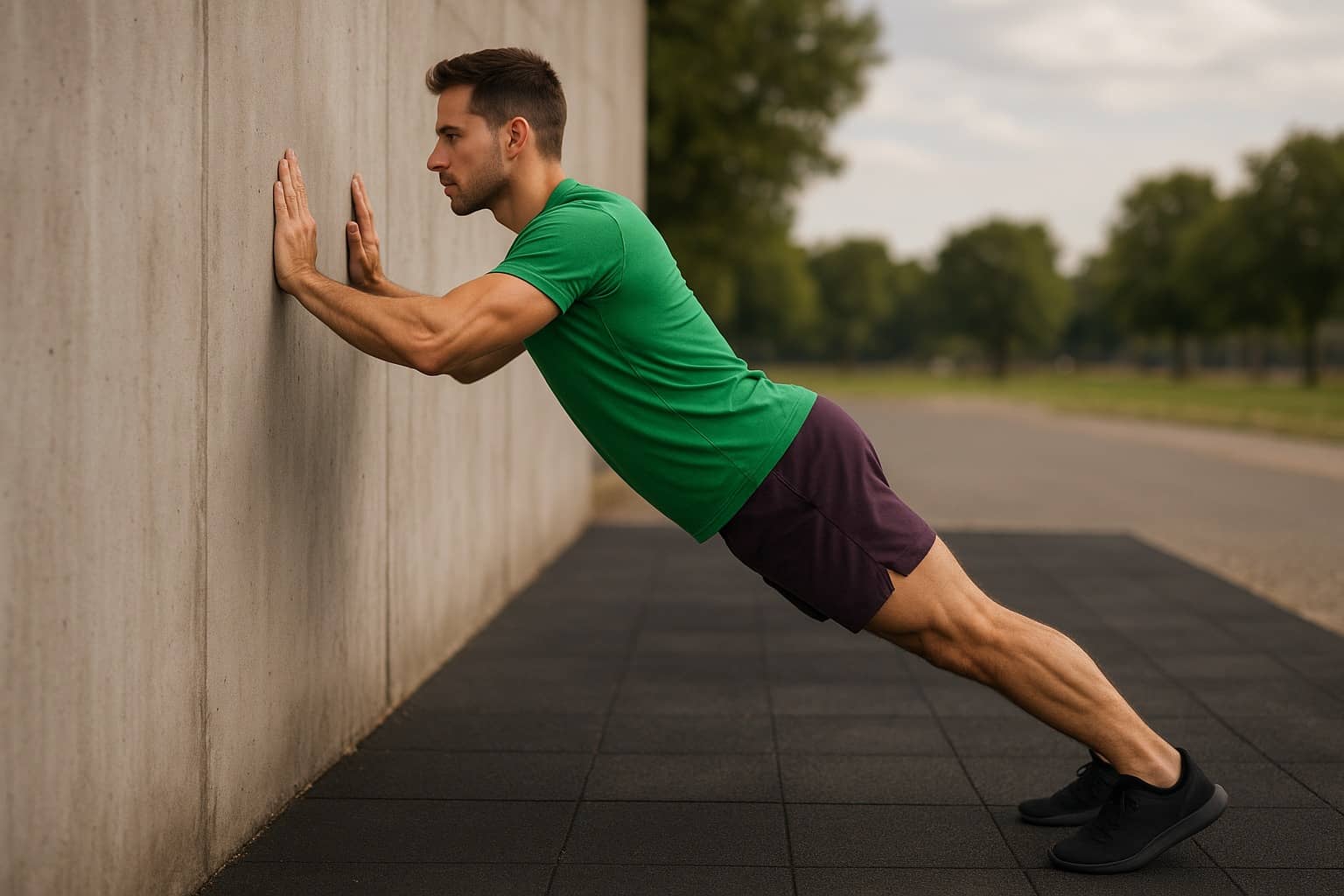
Level 2 is the same push-up on a kitchen counter, or on a sturdy table pushed against a wall so it can’t slide. A lower surface is harder.
On your knees, keep a straight line from knees to head and lower until your chest is a few inches off the floor. If your hips stay high and bent, you’ve lost most of the work. A full push-up keeps that same line from your feet.
Pull: from the floor to the table
For the superman hold, lie face down and lift your arms, chest and thighs off the floor together. Hold, breathing normally.
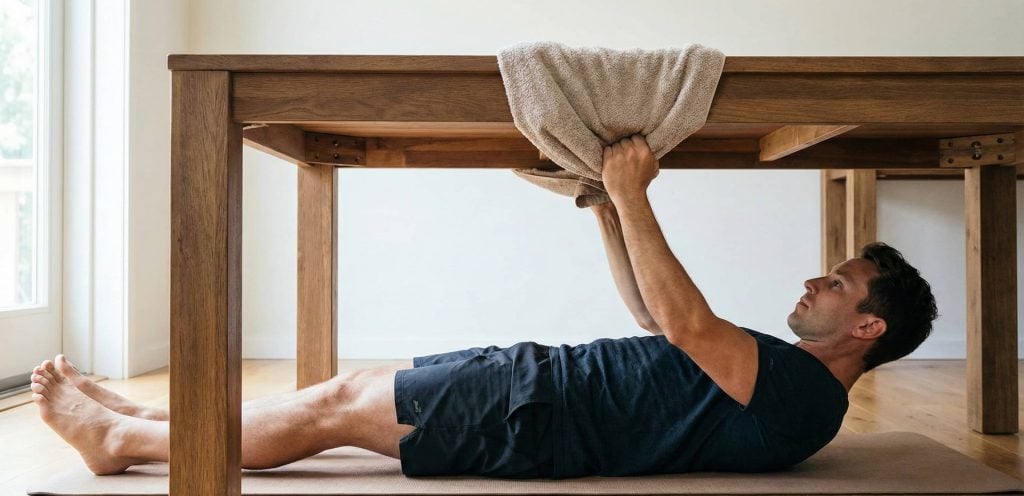
For table rows, slide onto your back until your chest sits below the edge. Grab it with straight arms, with a folded towel under your hands if it bites. Row your chest up until it nearly touches the table, body in one straight line, then lower slowly. Knees bent is level 2, legs straight is level 3. For level 4, set your heels on a chair that won’t slide, its back against a wall if you can.
Squat: from the chair to the lunge
Stand up from a chair with your arms out in front, no hands on your thighs, and sit back down over 3 seconds. Put the chair against a wall so it stays put. An air squat is the same move without the chair: sink until your thighs are parallel to the floor and keep your heels down.
For a reverse lunge, step one foot back, lower until your back knee nearly touches the floor, then push through your front heel to return.
Hips: from two legs to one
For a glute bridge, lie on your back with your knees bent and push through your heels until your shoulders, hips and knees form a line. The one-leg version is the same with one leg held straight in the air.
Core: from the floor to the plank
On a dead bug, lie on your back with your arms up and knees over your hips. Slowly lower one arm and the opposite leg, lower back pressed into the floor. If it arches, you’ve gone too far.
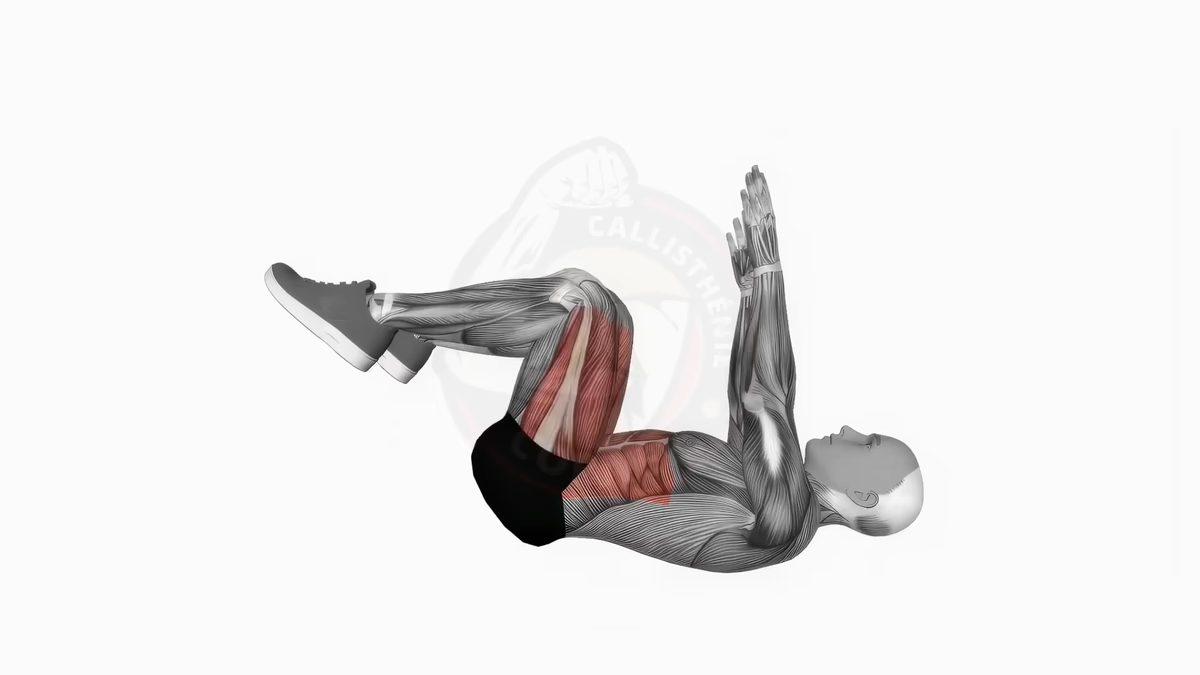
For a knee plank, rest on your forearms and knees, body straight from knees to head. A plank is the same from your toes. For shoulder taps, hold a high plank with your feet wide and touch one shoulder at a time, hips still.
Week by week
| Week | Sessions | Rounds | What changes |
|---|---|---|---|
| 1 | 1 to 3 | 2 | You learn the moves. Any number in the range is fine |
| 2 | 4 to 6 | 3 | One more round, same levels |
| 3 | 7 to 9 | 3 | Level check on day 15 |
| 4 | 10 to 12 | 3, then 2 on session 12 | Level check on day 22. The short last session keeps you fresh for the test |
Add a rep or a few seconds when a set feels easy, and write your numbers down after each session.
Days 15 and 22 are the only days you move up. Before that day’s session, read your log. Any move where you reached 12 reps or 30 seconds in every round of your last session goes up one level. The others stay put. On level 4, there’s no higher level, so slow down instead: take 3 seconds on the way down, or pause for a second on each shoulder tap.
A new level should feel hard. Three to five reps, or about 10 seconds, is normal that first session, so stay on it until the session ends, unless it hurts. After that, you can move down on any day: if a set falls under 5 reps or 10 seconds, switch that move to the level below for the rest of the session and stay there until the next check or the final test. On level 1, there’s nothing below, so do what you can.
If you miss a day
Pick up at the first empty box when you’re back.
- A rest or easy day: check it off and move on.
- A session: do it on your next free day and push the rest of the calendar back. After several missed sessions, restart from the first one you missed. Never fit two sessions into one day.
- More than a week off: go back to the first session of the week you were in. You don’t need to redo the test.
One gap costs you very little. In a 2010 University College London study of people forming a new daily habit (Lally et al., European Journal of Social Psychology), a single missed day had little effect on how automatic the habit became. There was some evidence that repeated misses add up, so don’t let one gap turn into three. If your 28 days take 33, the test at the end still counts.
What 28 days can and can’t do
Four weeks can make you measurably stronger. In Kotarsky et al., 2018 (Journal of Strength and Conditioning Research), 23 moderately trained men trained 3 days a week for 4 weeks, the same frequency and length as this challenge. The 14 on progressive push-up versions raised both their bench press max and their push-up level.
The mirror will lag behind. In that same study, muscle thickness didn’t change significantly. Those men already trained and the study only looked at the upper body, so it’s a guide to what a month can do, not a forecast for you.
This plan makes no promise about your weight: what you eat moves the scale more than 12 short sessions will.
The habit won’t be finished either. The Lally study put the median time for a new behavior to feel automatic at 66 days, from 18 to a projected 254, and exercise took longer than eating or drinking habits. You’ll need a plan for day 29.
After day 28
Run the day 1 test again, starting one level below the one you trained at (or at level 1), then put your two scores side by side. Two numbers decide your next month.
- 5 push-ups in a row, knees allowed, and a 30-second plank: move on to the military calisthenics plan, a 4-week step up in volume with no bar.
- Not there yet on one of them: run the calendar again from day 2 with your new levels. Your day 28 test counts as the next day 1.
If you’d rather follow a longer plan, the 12-week beginner program takes over with three longer sessions a week, and a pull-up bar or sturdy table from its second phase.
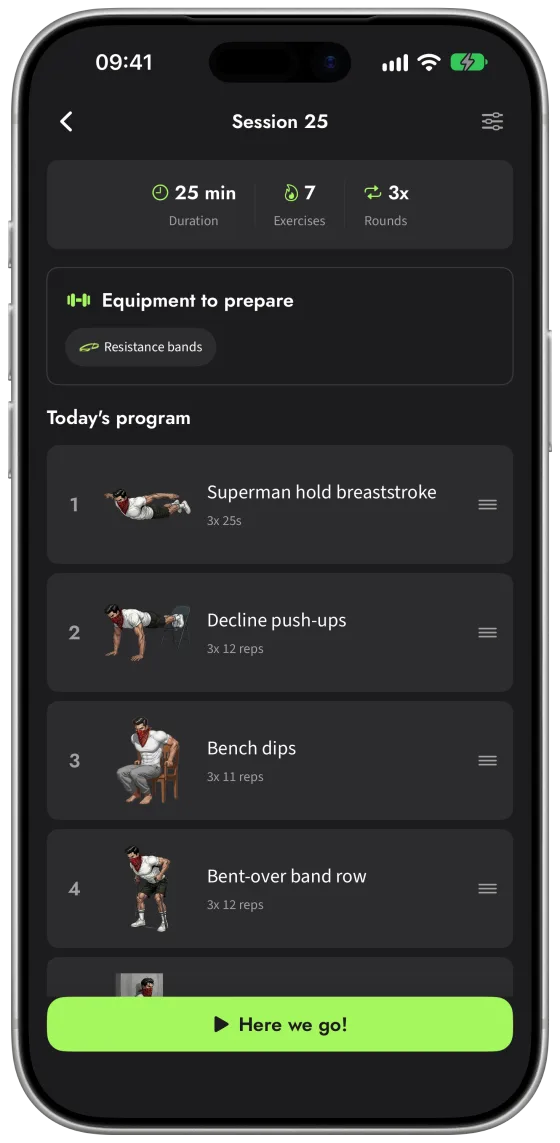
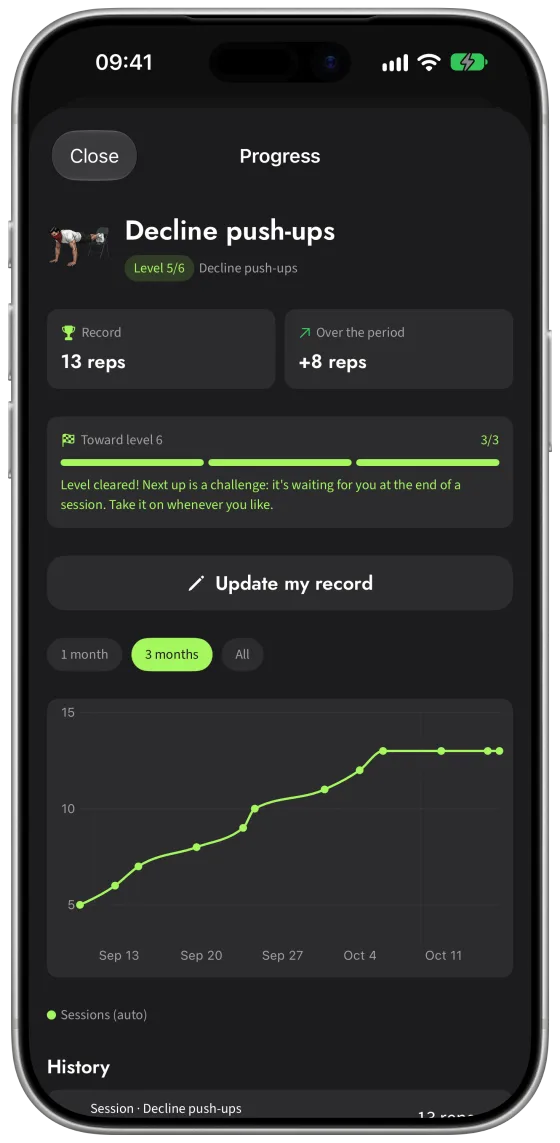
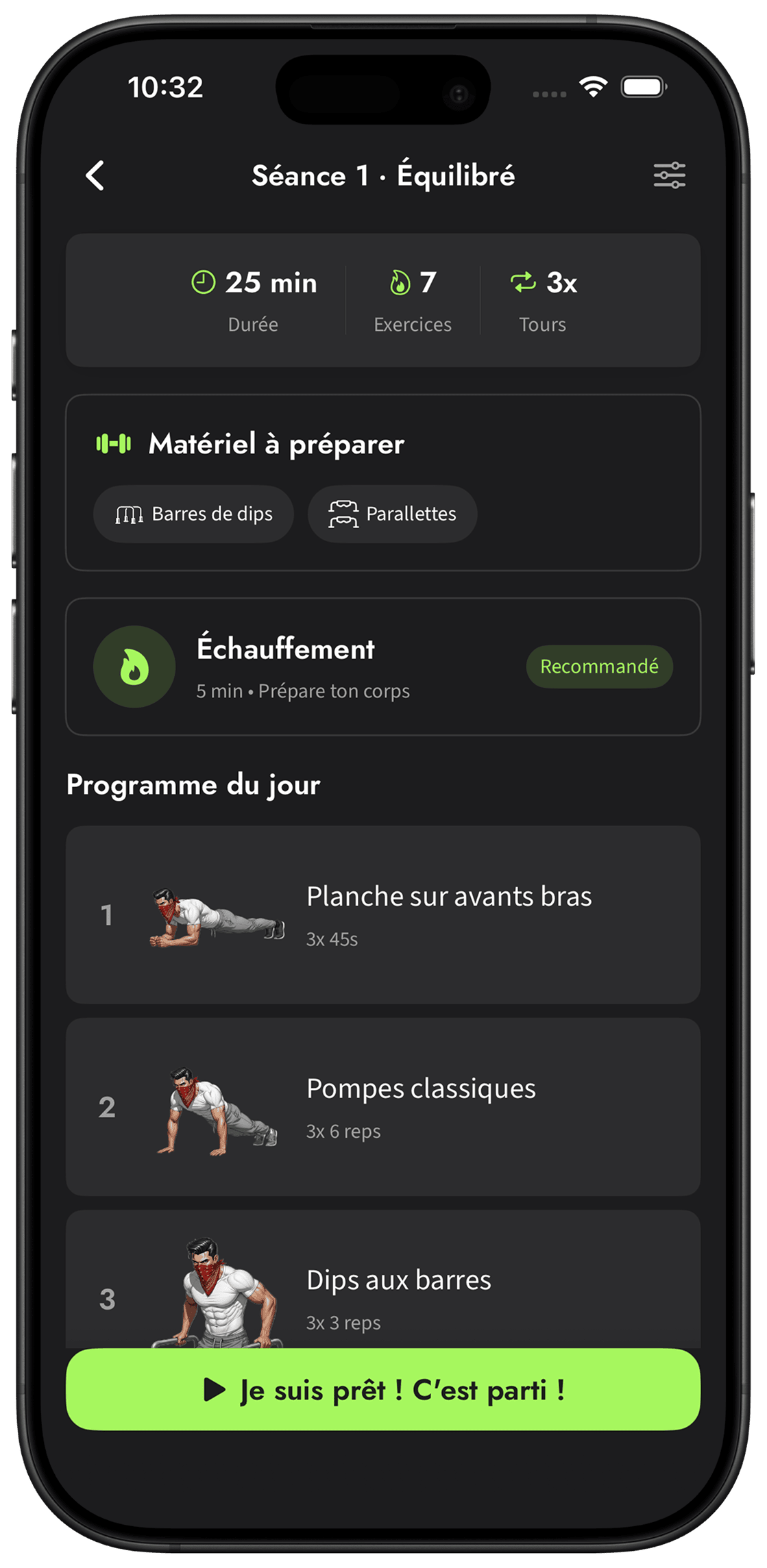
The calendar and the PDF stay free. If you’d rather not track levels and rounds by hand, the Calisthenics Corner app does that part: it sets today’s session and uses the reps you log to adjust the next one. It’s a paid subscription with a 3-day trial.