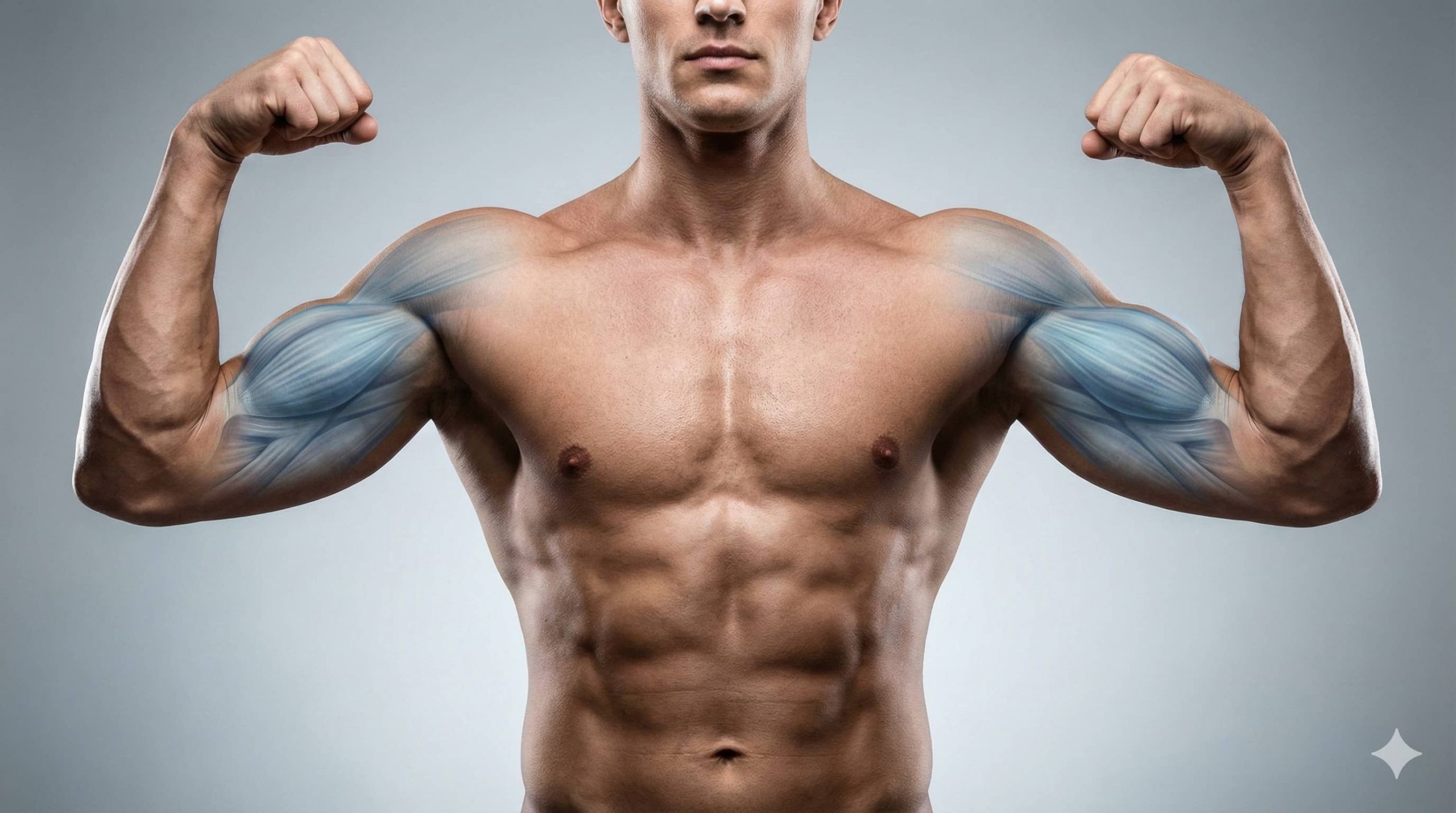
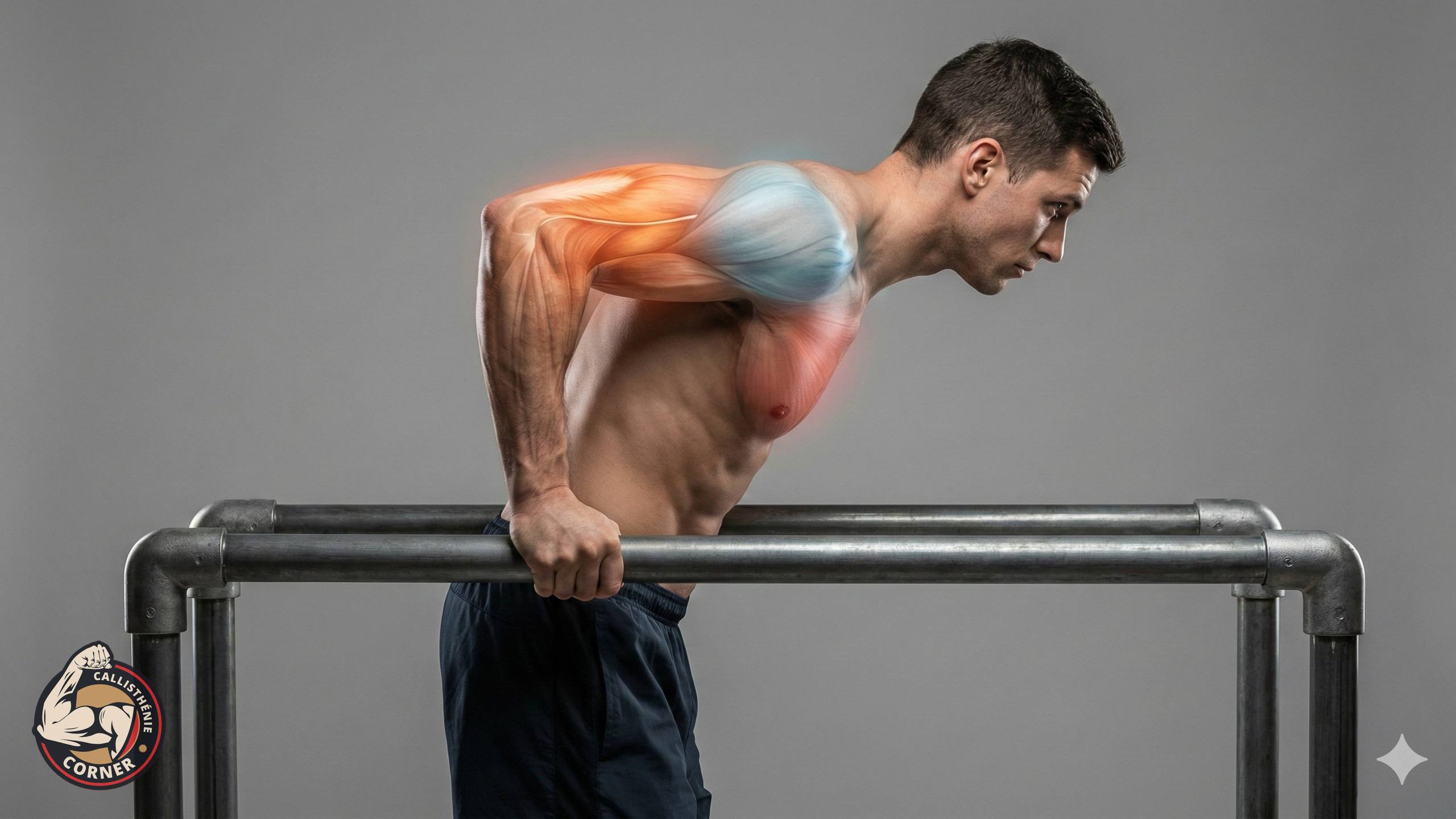
The arms split into two groups with opposite needs: the biceps demand pulling, the triceps demand pushing. With no gym, the triceps are easy to hit: every push-up works them. For the biceps, you have to improvise with what you have: a towel, a table, a door or a backpack.
Test the support before you pull on it. Half of these exercises lean on a table, a door handle or a chair. Before loading your full bodyweight, check that the support holds: door locked shut, sturdy table, chair braced against a wall. A support that gives way mid-pull means a guaranteed fall.
This guide is the overview. Each muscle has its own dedicated guide with the full exercise list, linked in its section.
Bicep exercises with no equipment
The biceps brachii flexes the elbow and turns the palm up. It is a pure pulling muscle: it works only when you bring your forearm toward your shoulder against resistance. With no bar, you recreate that with everyday objects.
The most reliable options are the isometric under-table curl (sit under a sturdy table, palms supinated against the underside, push up while the table resists, 5 × 30 s), the towel row under a table (lie under a table, loop a towel over the top, pull your chest up, 3 × 8-12), and the backpack curl (fill a bag with books, hold the straps like dumbbells, 3 × 10-15). A loaded door towel row and slow eccentric curls round out the toolbox.
The full list, with level-by-level progressions, is in the bicep exercises with no equipment guide.
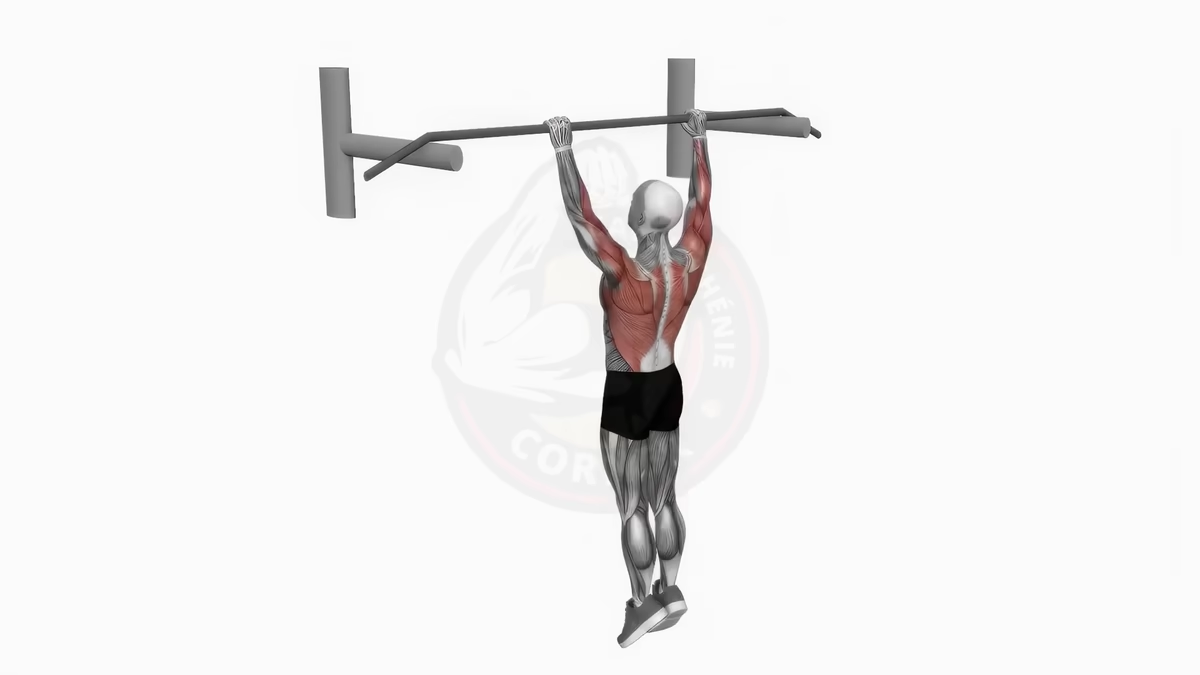
As soon as a bar is available: the chin-up (supinated pull-up) is the single most effective bicep exercise there is. Every option above is a valid alternative, but bring in the chin-up the moment you have access to a bar.
Tricep exercises with no equipment
The triceps make up two thirds of the arm’s mass. If your goal is size, pushing is what to prioritise, not curls. Every push-up works them, with varying intensity depending on the angle and the grip.
The key movements are diamond push-ups (hands close under the chest, elbows tucked, 3 × 8-12), chair dips (hands on the edge of a chair behind you, lower to 90°, 3 × 10-15), the sphinx push-up (from a forearm plank, press up to straight arms, 3 × 6-10) and pike push-ups (inverted V, lower the head toward the floor, 3 × 6-10). If the diamond is too hard, start with military push-ups before moving to it.
The full progression, from wall extensions to one-arm push-ups, is in the tricep exercises with no equipment guide. To push further with load, see weighted push-ups, and for the full push-up map, push-up variations.
Compound exercises
Two movements work the biceps and triceps together, with the back and shoulders as a bonus. They are the most functional exercises in the category.
Dips hit the triceps, chest and shoulders at once. Loaded, they are one of the most effective upper-body pushing exercises. Available on parallel bars or two chairs.
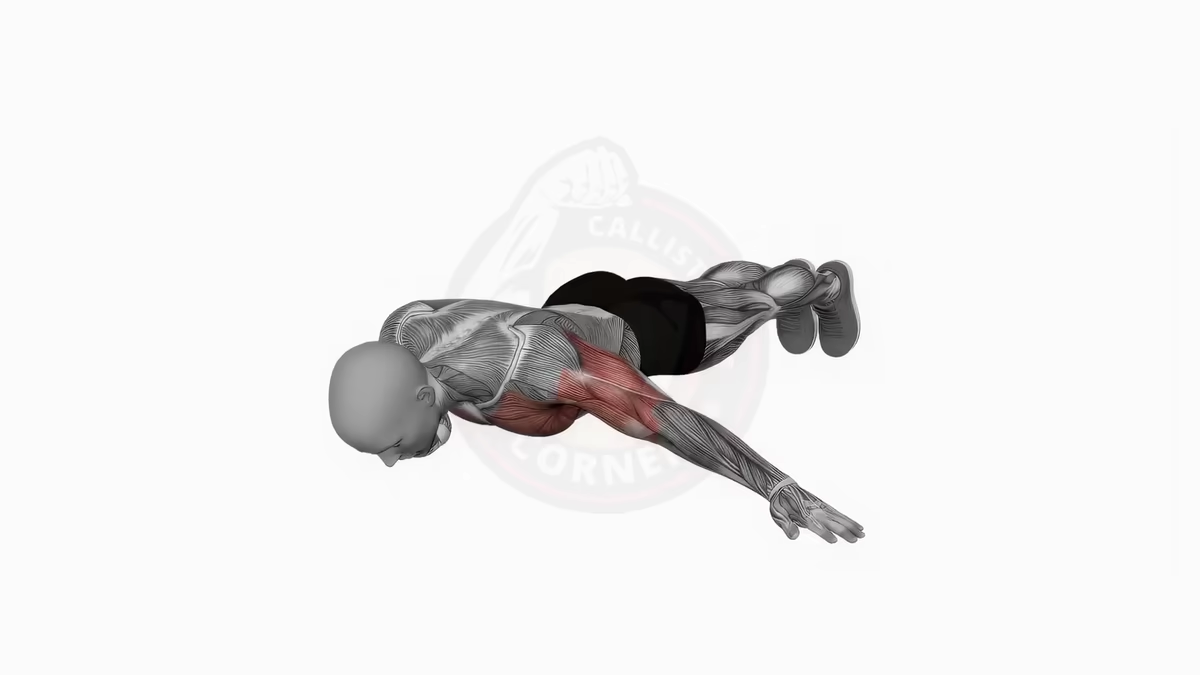
The archer pull-up is an advanced pull-up variation that works each arm in a unilateral focus. Biceps, back and shoulders under asymmetric tension. Prerequisite: 10 mastered strict pull-ups.
The chin-up with a supinated grip stays the king of bicep exercises as soon as a bar is available. A priority goal to reach alongside these no-equipment exercises.
Forearms, grip and wrists
The forearms are the link that gives out before the biceps on pull-ups, and before the triceps on dips. Grip strength, hang endurance on the bar and wrist stability: it is all in the forearm exercises with no equipment guide.
Where to start
| Level | Biceps | Triceps |
|---|---|---|
| Beginner | Isometric under-table curls, towel curls under the foot | Diamond push-ups, chair dips, wall extensions |
| Intermediate | Door towel rows, backpack curls, inverted table rows | Sphinx push-ups, two-chair dips, feet-elevated push-ups |
| Advanced | Eccentric curls, assisted one-arm rows, three-angle curls | One-arm push-ups, single-support dips, pike push-ups |
To structure your pulling, the pull-up program takes you from zero to 10 pull-ups step by step, the most direct progression for your biceps and back. For pushing and your triceps, the push-up program is the direct complement.