
Building a powerful back at home has never been more accessible. Whether you are a beginner in calisthenics or an advanced practitioner, developing your back muscles will serve your health, posture, and athletic performance. With hours spent sitting in front of screens, back strengthening is a necessity to prevent pain and improve quality of life.
This guide reveals how to transform your back using only your bodyweight and a bit of creativity. No more excuses about lack of time or equipment: your living room becomes your personal gym.
Why training your back matters
Posture and pain reduction
A strong back is the key to a straight, elegant posture. The back muscles, notably the rhomboids, trapezius, and spinal erectors, work in synergy to keep your spine aligned. By regularly practicing calisthenics back exercises, you significantly reduce the risk of lower back and neck pain.
Athletic performance
The back is the central pillar of functional strength. Whether you practice other sports or simply want to master advanced calisthenics movements like the muscle-up or the front lever, a powerful back is indispensable. The latissimus dorsi are particularly important for all pulling and climbing movements.
Muscular balance and injury prevention
Many practitioners focus excessively on “mirror muscles” with chest exercises, neglecting the back. This unbalanced approach leads to postural compensations and injuries. A balanced calisthenics program integrating back exercises prevents these imbalances and strengthens the entire posterior chain.
Anatomy of the back: understanding the muscles
To effectively build your back at home, understanding its anatomy is essential.
The latissimus dorsi (lats) form the “wings” of the back and are responsible for adduction, extension, and internal rotation of the arm. These are the primary muscles worked during pull-ups.
The trapezius divides into three portions (upper, middle, and lower) and controls scapular movement. It is essential for shoulder stability and upper body posture.
The rhomboids (major and minor) sit between the shoulder blades and are responsible for scapular retraction. They play a crucial role in correcting rounded posture.
The spinal erectors run along the spine and keep your back upright. They are constantly engaged in everyday life and deserve particular attention.
Beginner back exercises: building the foundations
1. Superman hold
The superman hold targets the spinal erectors perfectly. Lying face down, arms extended in front of you, simultaneously lift your chest and legs off the floor by contracting the lower back muscles. Hold 2-3 seconds, then lower slowly.
Progression: Start with 3 sets of 10 reps, then build up to 4 sets of 20 reps.
2. Reverse plank (reverse bridge)
The reverse plank strengthens the entire posterior chain. Seated on the floor with legs extended, place your hands behind you with fingers pointing forward. Push through your hands and heels to lift your hips until your body forms a straight line.
Technical tip: Keep your shoulder blades squeezed and chest open throughout the movement.
Dosage: 3 sets of 20-30 seconds.
3. Inverted rows under a table
Find a sturdy table, lie underneath and grip the edge. Pull your chest toward the table while keeping your body braced. This is the perfect exercise to prepare your muscles for pull-ups.
Variation: Adjust difficulty by changing your body angle. The more horizontal you are, the harder it gets.
4. Bird dog
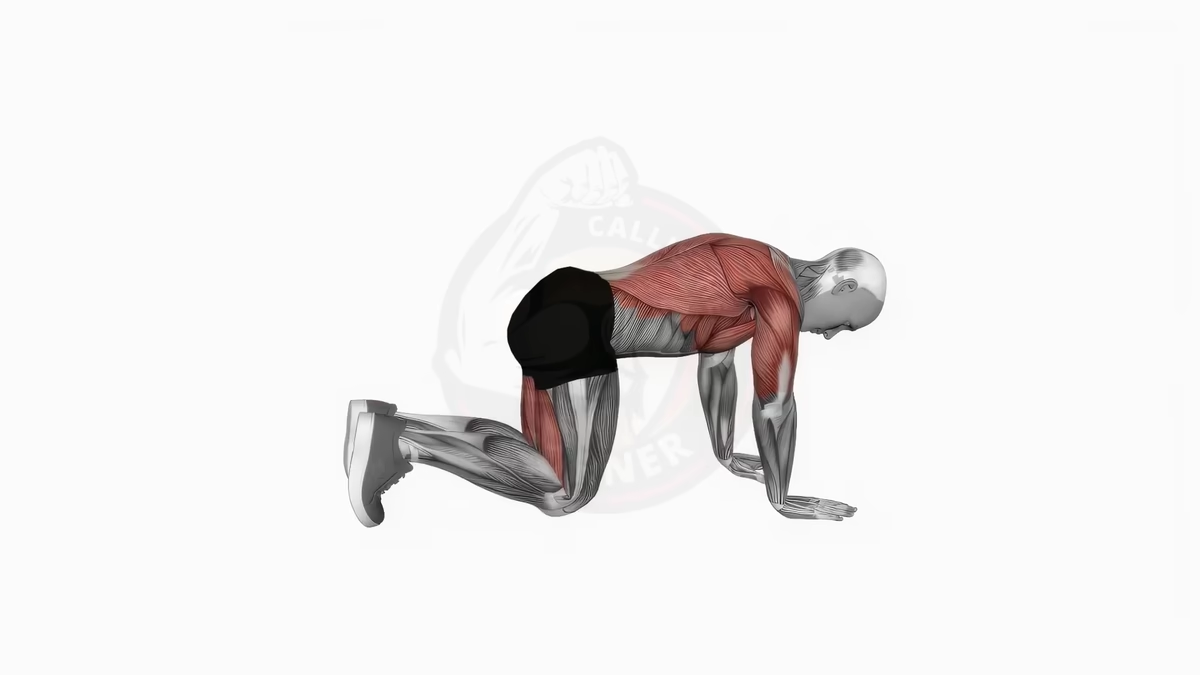
The bird dog improves coordination and strengthens the back stabilizers. In a quadruped position, simultaneously extend the right arm and left leg, hold 3 seconds, then alternate. This exercise teaches anti-rotation and spinal stability.
Dosage: 3 sets of 8-10 reps per side.
5. Dead hang
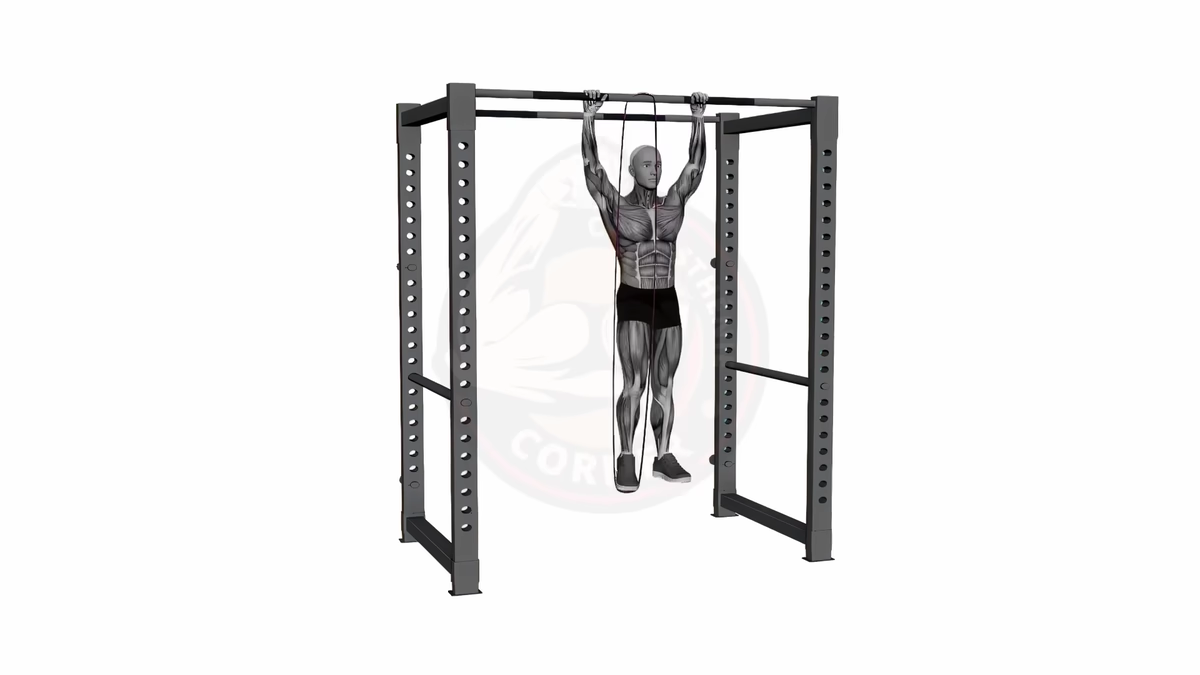
The dead hang is the simplest entry point to bar work. Simply hang from a pull-up bar with straight arms. This builds grip strength, decompresses the spine, and activates the lats isometrically. It prepares your connective tissue for all pulling movements ahead.
Dosage: 3 sets of 20-40 seconds.
Intermediate back exercises: increasing intensity
6. Australian pull-ups
Australian pull-ups (inverted rows) are horizontal pulls performed under a low bar or on rings. Your body forms an angle with the ground as you pull your chest to the bar. This exercise is an excellent bridge between table rows and real pull-ups.
Progression: Start with feet on the ground, then progressively elevate them on a support to increase difficulty.
Dosage: 4 sets of 8-12 reps.
7. Negative pull-ups
If you do not yet have full pull-ups, jump or use a chair to get to the top position, then lower yourself slowly over 5-10 seconds. This eccentric method rapidly builds the strength needed for complete pull-ups.
Dosage: 5 sets of 3 reps with 5-second descents.
8. Scapular pull-ups
Scapular pull-ups isolate the very first portion of the pull-up: the scapular retraction and depression. Hanging with straight arms, pull your shoulder blades down and together without bending your elbows. This movement teaches proper engagement of the lats before the arms even start pulling.
Dosage: 3 sets of 10-12 reps.
9. Hollow hold for back integration
The hollow hold may seem like an ab exercise, but it teaches the total-body tension required for every advanced back skill. The rigid body position you learn here transfers directly to front levers, muscle-ups, and strict pull-ups.
Dosage: 3 sets of 30-40 seconds.
10. Pull-up vs chin-up: choosing your grip
Understanding the difference between pull-ups and chin-ups is key to balanced back development. Pull-ups (overhand grip) emphasize the lats and teres major. Chin-ups (underhand grip) shift more work to the biceps and lower lats. Include both in your programming.
Advanced back exercises: mastering complex movements
11. Strict pull-ups
Pull-ups are the king exercise for the back. Hang from a bar, hands in overhand grip shoulder-width apart, and pull until your chin clears the bar. Control the descent to maximize gains.
Variations: Chin-ups (supinated), wide-grip pull-ups, commando pull-ups to target different angles.
Dosage: 4 sets of 6-12 reps.
12. Muscle-ups
The muscle-up is the ultimate pull-up progression. Combine an explosive pull with a transition and a dip to pass above the bar. Requires strength, coordination, and flawless technique.
Prerequisites: 10+ strict pull-ups and 15+ dips before attempting.
13. Front lever progressions
The front lever develops phenomenal back strength. Start with tuck front levers (knees tucked) and progress toward the full position with body parallel to the ground. This isometric exercise taxes the lats, rhomboids, and core simultaneously.
Dosage: 4 sets of 10-20 second holds (tuck to start).
14. Back lever
The back lever is performed by lowering your body backward from a hang until horizontal. It intensely engages back muscles and shoulders, and develops the shoulder flexibility that most pulling athletes lack.
Dosage: 4 sets of 10-15 second holds.
15. Archer pull-ups
Archer pull-ups are unilateral pulls where one arm does the majority of the work while the other slides along the bar. This is a crucial step toward the one-arm pull-up.
Dosage: 3 sets of 4-6 reps per side.
Back training programs
Beginner program (4 weeks)
Weeks 1-2:
- Monday: Superman hold 3x10, Reverse plank 3x15s, Bird dog 3x8 per side
- Wednesday: Table rows 3x8, Wall handstand shrugs 3x10
- Friday: Full circuit, all exercises, 2 sets each
Weeks 3-4:
- Increase reps by 2-3 per exercise
- Add an extra set on Friday
- Introduce negative pull-ups (3x3, 5-second descent)
Intermediate program (6 weeks)
Phase 1 (weeks 1-3):
- Monday: Australian pull-ups 4x12, Scapular pull-ups 3x10, Superman hold 3x15
- Wednesday: Negative pull-ups 5x3, Archer rows 3x6 per side
- Friday: Circuit, 3 rounds of all intermediate exercises, 8 reps each
Phase 2 (weeks 4-6):
- Introduce strict pull-ups (even band-assisted)
- Add isometric holds (hollow hold, reverse plank)
- Work front lever tuck holds
Advanced program (8 weeks)
Strength cycle (weeks 1-4):
- Focus on heavy movements: weighted pull-ups, archer pull-ups
- Moderate volume, high intensity
- 3 sessions per week
Volume cycle (weeks 5-8):
- Total volume increase
- Introduce skills (muscle-up, levers)
- 4-5 sessions per week with variations
Intensification techniques without equipment
Tempo and time under tension: Slow down your movements to increase time under tension. Example: perform pull-ups with a 1-second explosive pull, 2-second pause at top, 4-second controlled descent. This 1-2-4 technique transforms every rep into an intense muscular challenge.
Supersets and circuits: Chain two exercises without rest. Example: Australian pull-ups immediately followed by superman hold. This approach increases training density and stimulates muscular endurance.
Isometric progressions: Integrate static holds at different points of the movement. During pull-ups, pause at 90 degrees for 3-5 seconds. These isometric pauses strengthen weak points and increase fiber recruitment.
Drop sets: Start with the hardest exercise (archer pull-ups), then immediately chain with an easier version (pull-ups, then australian pull-ups). This technique completely exhausts the back muscles.
Common mistakes to avoid
Neglecting warm-up: Always start with 5-10 minutes of dynamic warm-up: shoulder rotations, band pull-aparts, cat-cow stretches. A well-prepared back is one that progresses without injury.
Poor form: Quality always trumps quantity. Partial pull-ups with kipping do not deliver the same benefits as strict, controlled reps. Film yourself regularly to check your technique.
Imbalanced programming: Always balance pulling movements with pushing movements. For every set of push-ups, plan an equal set of back exercises. Consider supplementing with resistance bands for banded pull-up assistance during the learning phase.
Progressing too fast: Calisthenics demands patience and consistency. Do not skip steps. Master each progression perfectly before moving to the next. Tendons and ligaments adapt more slowly than muscles. Check out how to start calisthenics for a safe approach.
Your transformation starts today
Building your back at home with calisthenics is not only possible, it is an optimal approach for developing functional strength, aesthetics, and spinal health. The exercises in this guide, from simple superman holds to complex muscle-ups, offer a clear progression for all levels.
Remember that consistency beats occasional intensity. Start where you are, progress at your own pace, and celebrate every win. Your back will thank you with improved posture, greater performance, and a transformed quality of life.