The superman hold divides fitness experts. Some call it essential, others warn it destroys your back. The truth? When executed with proper technique and smart progression, the superman hold is a powerful tool against back pain and poor posture. It just demands respect.
The essentials in 30 seconds
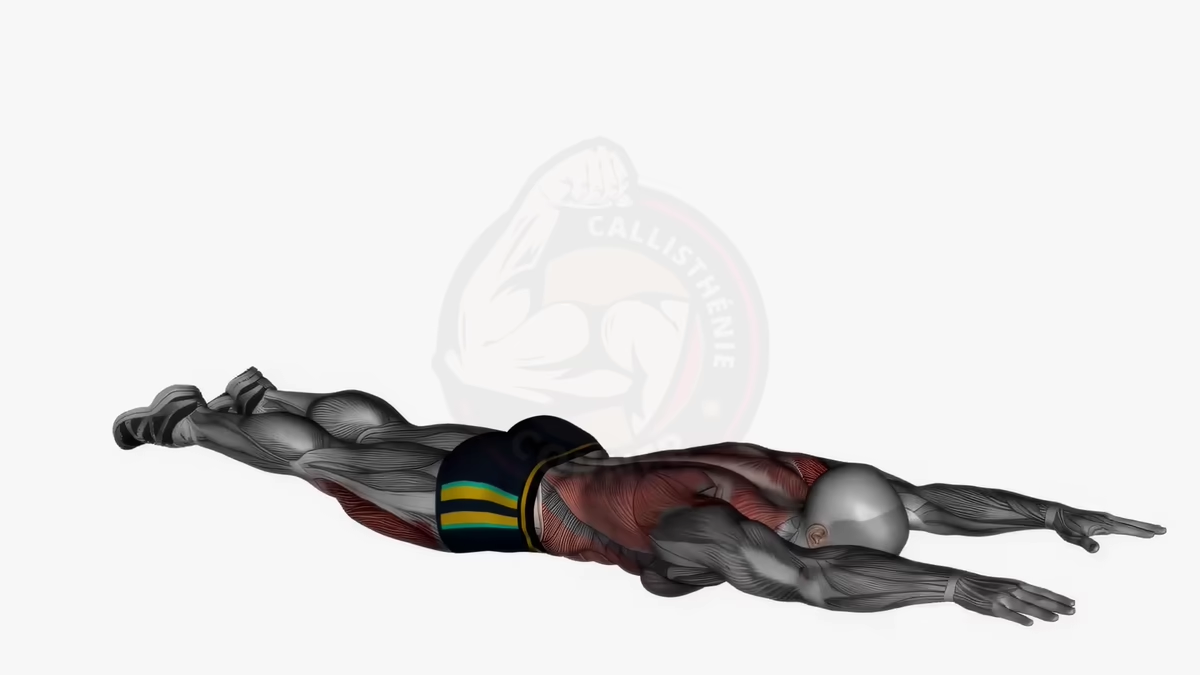
- What: isometric back extension performed face down, arms and legs lifted off the floor.
- Muscles: spinal erectors, multifidus, glutes, entire posterior chain.
- For whom: beginners to advanced, with appropriate adaptations.
- Typical duration: 3 to 5 sets of 15 to 30 seconds.
- Frequency: 3 to 4 times per week maximum.
Perfect technique
Getting the superman hold right comes down to controlled amplitude. Not height, not effort: control.
Starting position
- Lie face down on a mat.
- Extend your arms straight in front of you, palms facing down.
- Extend your legs behind you, toes pointed.
- Rest your forehead on the floor (not your chin).
Execution
- Lightly engage your abs before lifting anything.
- Simultaneously lift your arms, chest, and legs 10 to 15 cm off the floor. No higher.
- Think “long, not high”: imagine someone is pulling you from head to feet, stretching your spine rather than compressing it.
- Hold for 2 to 5 seconds, breathing steadily.
- Lower back down with control. That’s one rep.
Three critical errors to avoid
| Error | Why it’s dangerous |
|---|---|
| Lifting your head to look forward | Compresses the cervical spine, risks neck injury |
| Going too high | Lumbar compression can reach 6000N, well above the safe threshold |
| Holding your breath | Creates dangerous internal pressure, spikes blood pressure |
Keep your gaze on the floor, stay low, and breathe. These three rules make the difference between a back-building exercise and a back-wrecking one.
The debate: friend or enemy of your spine?
This is where the superman hold gets controversial, and where science helps settle the argument.
What the research says
Biomechanist Stuart McGill measured compressive forces on the lumbar spine during the superman hold. His findings: full-amplitude holds can generate up to 6000 Newtons of compression. For reference, the generally accepted safety threshold is around 3400N.
That sounds alarming. But context matters.
Why it’s still worth doing
- Progressive variants reduce the compressive forces drastically. An alternating superman (opposite arm and leg) generates far less load than the full version.
- Multifidus activation increases significantly during the superman hold. The multifidus is a deep spinal stabilizer that’s notoriously hard to target, and its weakness is a leading predictor of chronic back pain.
- Short holds under 10 seconds limit the cumulative stress while preserving the training benefits.
The smart approach
The solution is not to avoid the superman. It’s to do it intelligently:
- Moderate amplitude: 10 to 15 cm off the floor, never higher.
- Short, repeated holds: multiple sets of 2 to 5 second holds rather than one long effort.
- Gradual progression over 8 weeks, not jumping straight to the full version.
8-week progression program
This program takes you from the safest variation to a complete posterior chain training circuit.
Weeks 1-2: Alternating superman
Opposite arm and leg only. This cuts spinal compression roughly in half.
- 3 sets x 8 reps per side
- Hold each rep for 2 seconds
- Rest 45 seconds between sets
Weeks 3-4: Partial superman
Lift arms only OR legs only. Never both at the same time yet.
- 3 sets x 15 to 20 seconds (alternate arms-only and legs-only sets)
- Rest 30 seconds between sets
Weeks 5-6: Full superman, controlled amplitude
Both arms and legs, but keep the amplitude moderate (10-15 cm).
- 4 sets x 20 to 25 seconds
- Rest 30 seconds between sets
Weeks 7-8: Posterior chain circuit
Combine the superman with complementary exercises for a complete back session:
- Superman hold: 30 seconds
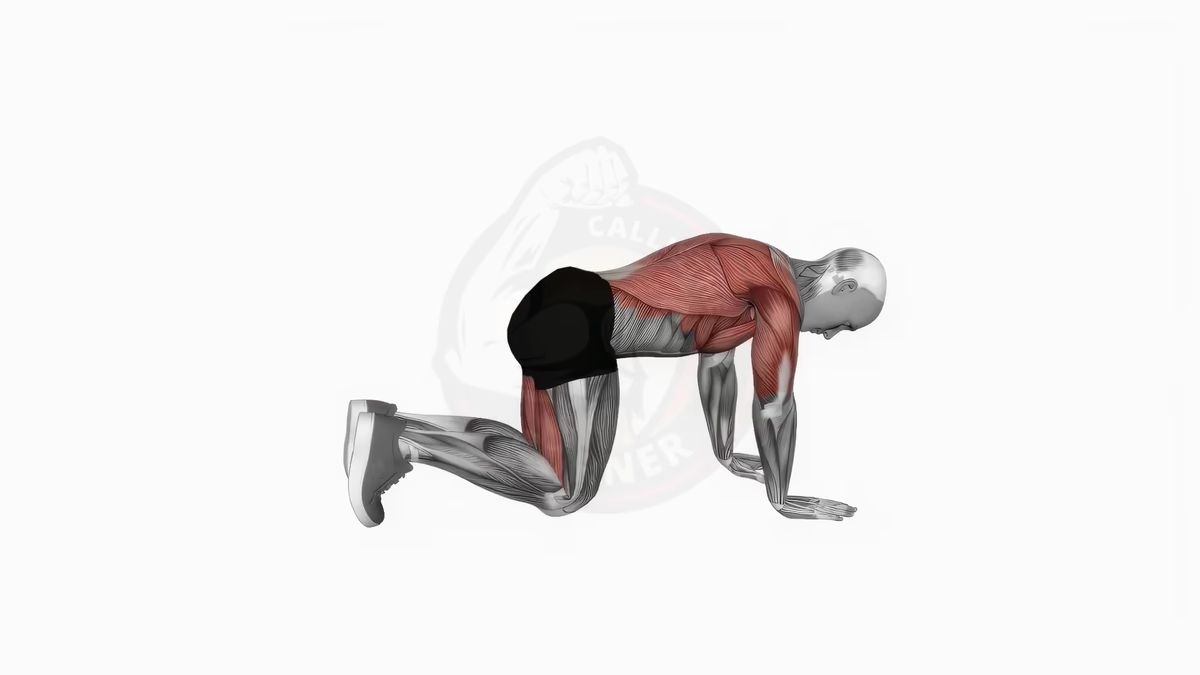
- Bird dog: 10 reps per side
- Hollow hold: 30 seconds
- Rest 60 seconds
- Repeat 3 to 4 rounds
This circuit pairs posterior chain work (superman, bird dog) with anterior chain work (hollow hold) for balanced, 360-degree core development.
Spine-friendly alternatives
Not every session needs the superman. These alternatives target similar muscles with different loading profiles.
Bird dog: McGill’s top pick
The bird dog offers an excellent activation-to-load ratio. Stuart McGill himself considers it one of the best exercises for spinal health. It trains the same deep stabilizers as the superman with significantly less compressive force.
The winning combination
Pair the superman hold (posterior chain) with the hollow hold (anterior chain) for a complete core routine. Thirty seconds each, back to back, covers both sides of your trunk in just one minute.
Bodyweight squat
This one surprises people: the bodyweight squat activates the spinal erectors at levels comparable to the superman, but with far less compressive load. If your back is sensitive, squats can partially fill the same role.
You can also incorporate push-ups into your routine to build a well-rounded bodyweight training session alongside the superman hold.
Checklist: continue or stop
Before and during every set, run through this simple self-check.
Green lights (keep going)
- You feel the work in your lower back AND glutes simultaneously.
- Your breathing stays fluid throughout the hold.
- You’re maintaining moderate amplitude (10-15 cm).
- You’ve been progressing without pain over the weeks.
Red flags (stop immediately)
- Sharp pain in the lower back.
- Tingling or numbness in the legs or arms.
- Your neck cranes forward to look up.
- You must hold your breath to maintain the position.
If any red flag appears, stop the set, rest, and regress to an easier variation. Pain is never a sign of effective training.
Building a stronger back, the smart way
The superman hold is neither a miracle exercise nor a back destroyer. It’s a powerful movement that rewards patience and proper progression. Start with the alternating version, respect the amplitude limits, keep your holds short, and combine it with complementary exercises like the bird dog and hollow hold.
Done this way, the superman hold earns its place in any calisthenics training program as a reliable tool for building posterior chain strength and protecting your spine for the long run.