

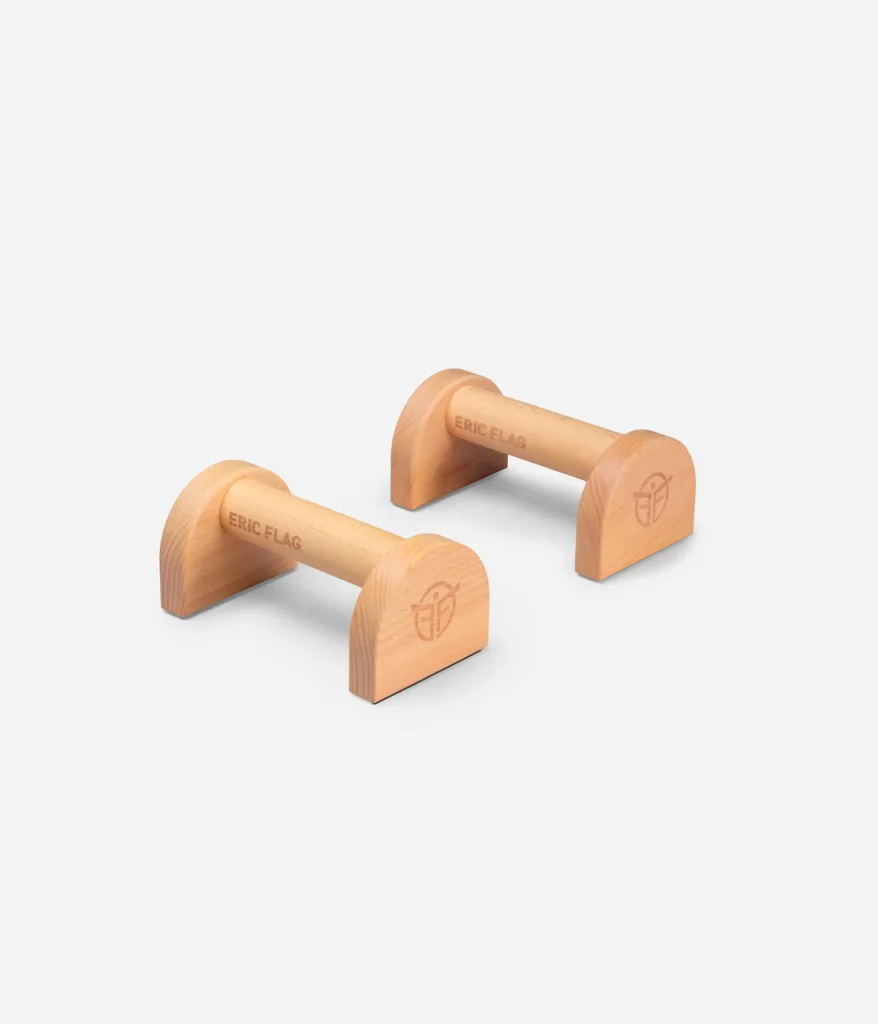
Parallettes are one of the most versatile pieces of calisthenics equipment you can own. Two low parallel bars, and suddenly you have access to deeper push-ups, wrist-friendly training, and the exact positions needed for advanced skills like the L-sit, tuck planche, and handstand push-ups. If you train at home and want to progress beyond basic bodyweight movements, parallettes are worth the investment.
Not sure which ones to buy? Check our best parallettes guide for a breakdown by budget and training level.
Why train with parallettes?
Greater range of motion on pushing exercises
Parallettes elevate your hands off the floor, allowing your chest to drop lower than your wrists on push-ups and dips. This extended range of motion recruits more muscle fiber and builds pushing strength that flat-floor training cannot match.
Wrist-friendly positions
On the floor, your wrists are forced into full extension during push-ups and plank holds. Parallettes let you grip with a neutral wrist position, which reduces strain and is especially valuable for athletes dealing with wrist discomfort or those working toward handstand skills.
Trunk stability and balance
The narrow, elevated grip surface demands constant stabilization from your core, shoulders, and forearms. Every parallettes exercise is also a stability exercise.
Unlocks advanced calisthenics skills
The L-sit, tuck planche, full planche, and frog stand are all easier to learn on parallettes than on the floor, thanks to the elevated grip and neutral wrist position.
Prerequisites
Before starting parallettes training, you should have a baseline of bodyweight strength:
- 15 strict push-ups with full range of motion
- 30 seconds high plank hold with solid form
- 10 dips on a bench or parallel bars
- 45-second plank hold without form breakdown
- 20-second hollow hold with lower back flat on the floor
If you are not there yet, build this foundation first. Our start calisthenics guide will get you there.
10 parallettes exercises from beginner to advanced
1. Static hold on parallettes (beginner)
Grip the parallettes, lock your arms straight, and hold yourself off the floor with straight legs hanging down. This is the most basic position, and it teaches you how to maintain a stable base on the bars. Hold for 20-30 seconds, focusing on depressed (pushed down) shoulders and engaged lats.
2. Push-ups on parallettes (beginner/intermediate)
Standard push-ups with your hands gripping the bars instead of flat on the floor. The elevated position lets you drop deeper, increasing pectoral and anterior deltoid recruitment. Keep your body in a straight line and lower until your chest passes below the level of your hands. 3-4 sets of 8-12 reps.
3. Tuck L-sit (intermediate)
Grip the bars, push yourself up with straight arms, and tuck your knees to your chest. Your hips should be behind your hands, abs contracted hard to keep your knees elevated. This builds the core strength and hip flexor endurance needed for the full L-sit. Hold for 10-20 seconds.
4. L-sit (advanced)
The full L-sit: straight arms, legs extended horizontally in front of you, parallel to the floor. This requires serious abdominal strength, hip flexor endurance, and scapular depression. Parallettes make it more accessible than the floor version because your hands are elevated, giving your legs more clearance. Work toward a 15-second hold with control. Once you master the L-sit, the V-sit is the next progression.
5. Tuck planche (intermediate/advanced)
From a push-up position on the bars, lean your shoulders forward past your hands and tuck your knees to your chest while lifting your feet off the floor. Your entire bodyweight is supported by your arms with a significant forward lean. This is the entry point to tuck planche and eventually full planche and straddle planche. Hold for 5-15 seconds.
6. Pike push-ups on parallettes (intermediate)
Set up in a pike position (hips high, body forming an inverted V) with your hands on the parallettes. Lower the top of your head between the bars, then press back up. This targets the shoulders intensely and serves as a direct progression toward handstand push-ups. The elevated grip allows a greater range of motion than floor pike push-ups. 3-4 sets of 6-10 reps.
7. Planche lean (intermediate)
From a plank position on the parallettes, shift your shoulders forward past your wrists as far as you can while maintaining a locked plank. This builds the anterior deltoid and chest strength needed for planche progressions. Hold for 15-30 seconds, and increase the lean angle as you get stronger.
8. Frog stand on parallettes (beginner/intermediate)
Grip the bars, bend your arms slightly, lean forward, and rest your knees on the backs of your upper arms. Balance on your hands with your feet off the floor. The frog stand teaches you balance under forward lean, a skill that directly transfers to planche and handstand work. Hold for 15-30 seconds.
9. Handstand hold (advanced)
Kick up into a handstand with your hands gripping the parallettes. The bars let you grip rather than balance on flat palms, giving you more control and making wrist extension a non-issue. Start against a wall for safety and work toward freestanding holds. Target 15-30 seconds.
10. Handstand push-ups on parallettes (advanced)
The pinnacle of parallettes pushing strength. From the handstand position, lower yourself until your head drops between the bars (far deeper than floor handstand push-ups), then press back to full lockout. This extended range of motion builds tremendous shoulder and tricep strength. Start with wall-assisted negatives (slow lowering only) before attempting full reps. 3-5 reps is a strong performance at this level.
8-week progressive program
Weeks 1-2: adaptation
Get comfortable on the bars and establish form patterns.
| Day | Exercises | Sets x Reps/Hold |
|---|---|---|
| Day A | Static hold, Push-ups, Frog stand | 3x20s, 3x8, 3x15s |
| Day B | Static hold, Tuck L-sit, Push-ups | 3x20s, 3x10s, 3x10 |
Train 3 times per week, alternating A and B. Rest 60-90 seconds between sets.
Weeks 3-4: volume increase
| Day | Exercises | Sets x Reps/Hold |
|---|---|---|
| Day A | Push-ups, Pike push-ups, Planche lean, Tuck L-sit | 4x10, 3x8, 3x20s, 3x15s |
| Day B | Push-ups, Frog stand, Hollow hold (floor), Tuck L-sit | 4x12, 3x20s, 3x25s, 3x15s |
Weeks 5-6: specialization (A/B split)
| Day | Focus | Exercises | Sets x Reps/Hold |
|---|---|---|---|
| Day A | Push/Planche | Deep push-ups, Pike push-ups, Planche lean, Tuck planche | 4x10, 4x8, 3x25s, 4x8s |
| Day B | Hold/L-sit | Tuck L-sit → L-sit attempts, Frog stand, Handstand hold (wall), Push-ups | 4x15s, 3x25s, 4x15s, 3x10 |
Weeks 7-8: consolidation
| Day | Exercises | Sets x Reps/Hold |
|---|---|---|
| Day A | Deep push-ups, Tuck planche, Handstand hold, L-sit | 3x12, 4x10s, 4x20s, 3x10s |
| Day B | Pike push-ups, Planche lean, Frog stand, Tuck L-sit | 4x8, 3x30s, 3x30s, 4x20s |
Test your progress at the end of week 8.
Tips for faster progress
Slow tempo. Control every rep. A 3-second descent on push-ups and pike push-ups builds far more strength than bouncing through reps.
Isometric pauses. Add 2-3 second holds at the bottom of push-ups or at the hardest point of each movement. This builds strength at the weakest angles.
Unilateral variations. Once bilateral exercises become easy, try single-arm support holds or archer push-ups on parallettes to increase difficulty without adding external weight.
Weighted vest. Adding 5-10% of your bodyweight with a vest can break through plateaus on push-ups, dips, and static holds when bodyweight alone stops challenging you.
When to progress to the next level
Use these benchmarks to know you are ready for more advanced work:
- 15-second L-sit with straight legs and controlled breathing
- 10-second tuck planche without feet touching the bars
- 15 deep parallettes dips with full range of motion
- 30-second handstand hold against the wall with consistent balance
If you are hitting these numbers, you are ready to start working toward the full planche, freestanding handstand, and strict handstand push-ups. The parallettes will continue to be your primary training tool for all of these skills.
For athletes who also train pull-ups and pulling skills, pairing parallettes pushing work with bar pulling creates a balanced, complete calisthenics program.