
Building massive shoulders without equipment demands vertical pressing movements. This guide covers the most effective shoulder exercises at home without equipment, from pike push-ups to handstand push-ups, so you can sculpt powerful deltoids using nothing but your bodyweight.
Shoulder anatomy: understanding the deltoids
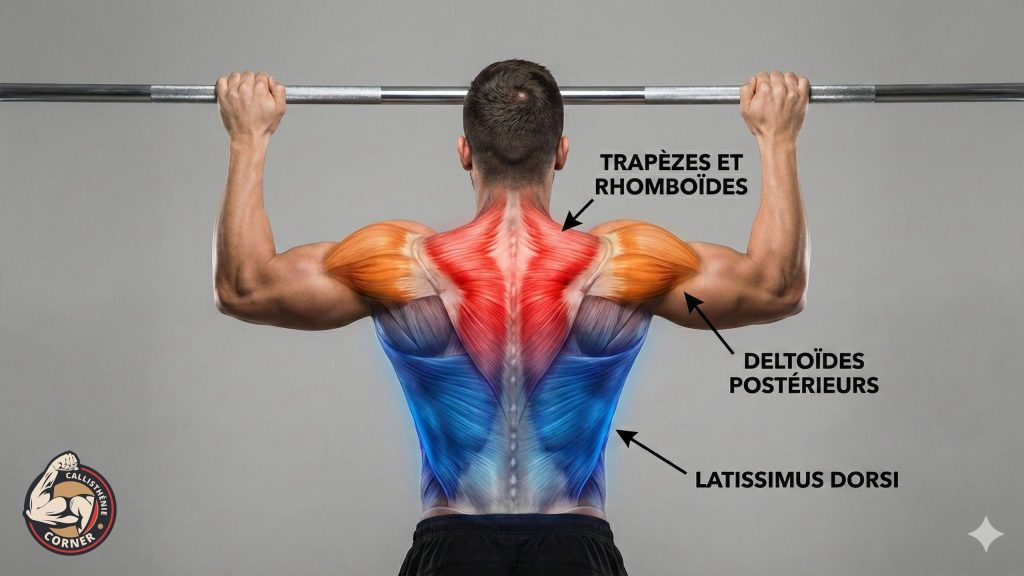
The deltoid is divided into three heads, each with a distinct function. The anterior head raises the arm forward and activates during push-ups. The lateral head performs abduction (lateral raise) and creates shoulder width. The posterior head pulls the arm backward and is often neglected.
The rotator cuff is a group of four small deep muscles that stabilize the joint. Strengthening them prevents injuries during intense movements. Neglect these muscles and chronic pain is guaranteed.
Key point: Vary your exercise angles to target all three heads equally.
Why training shoulders without equipment is a real challenge
The shoulders require vertical pressing, a pattern that is difficult to replicate with bodyweight alone. Going from pike push-ups to handstand push-ups takes 6-12 months minimum. The joint is vulnerable, so progress slowly or risk injury.
Practical tip: Warm up your shoulders for 10 minutes with rotations and mobility drills before every session.
Best shoulder exercises without equipment for beginners
Pike push-ups
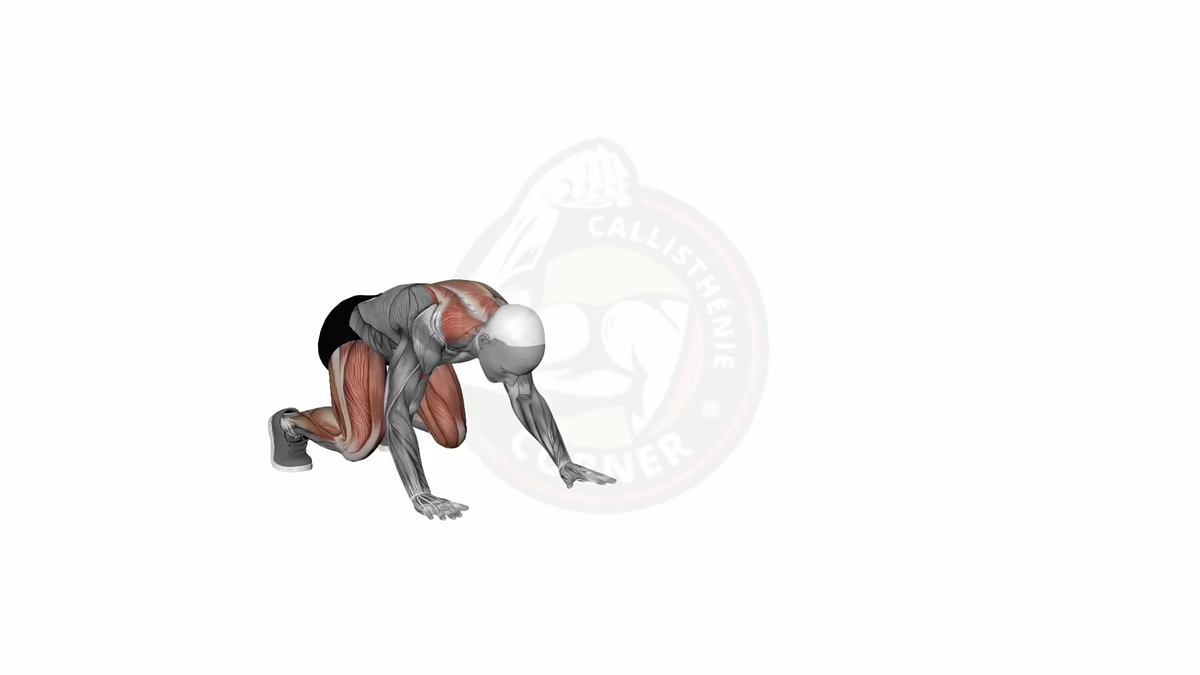
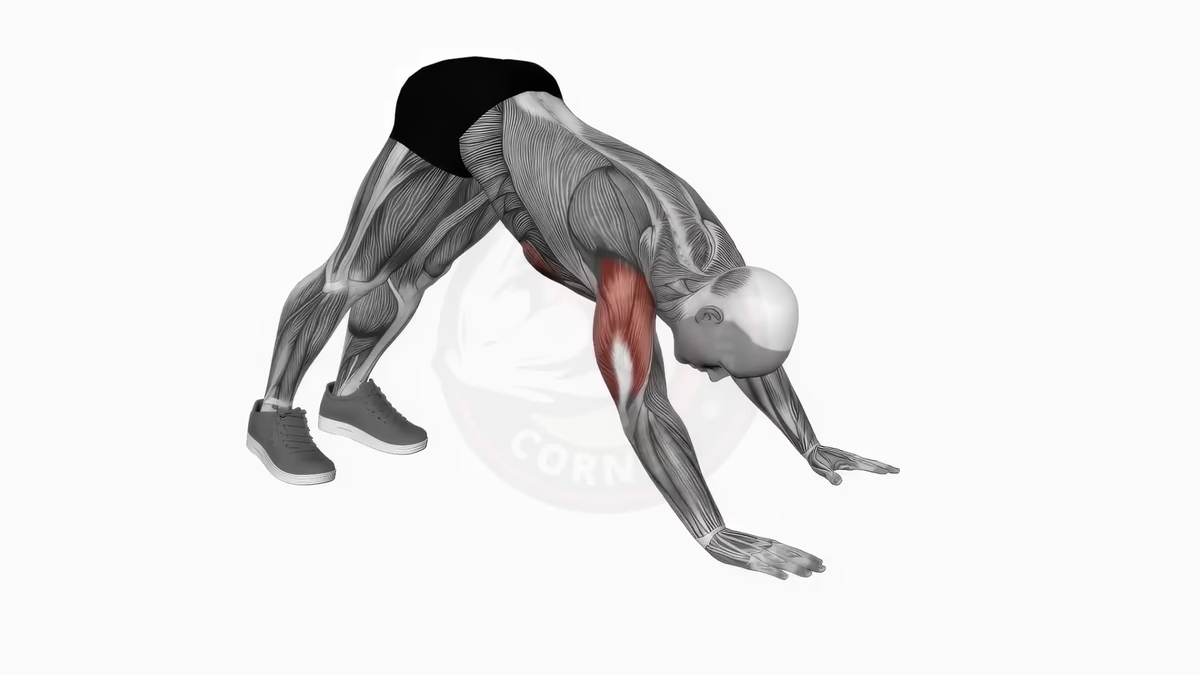
Place yourself in an inverted V position, hips high, hands and feet on the floor. Lower your head between your hands by bending the elbows backward. Push back up using your shoulders. Pike push-ups are the foundation of any bodyweight shoulder program.
Concrete progression: Gradually walk your feet closer to your hands each week to increase the vertical angle.
Frequency: 3 sets of 8-12 reps, twice per week.
Decline push-ups (shoulder focus)
Feet on a chair at about 60 cm, hands on the floor at shoulder width. Lower down while keeping your body aligned. The higher your feet, the more your shoulders work. Decline push-ups shift the load progressively toward your deltoids.
Tip: Do not go above 70 cm of elevation, or the exercise becomes a quasi-handstand push-up.
Frequency: 3 sets of 10-15 reps.
Wall isometric lateral raises
Back against a wall, arms extended out to the sides at 90 degrees. Push hard against the wall for 20-30 seconds. Your lateral deltoids burn intensely.
Technique: Test three heights (45 degrees, 90 degrees, and 135 degrees) to work the full range of motion.
Frequency: 5 sets of 20-30 seconds, can be done daily.
Intermediate shoulder exercises without equipment
Elevated pike push-ups
Feet on a chair, body in a pronounced inverted V. Lower your forehead to the floor. This elevation increases the load by 40-50%.
Progression: Start with feet at 30 cm, increase by 10 cm per month up to 60 cm.
Frequency: 3 sets of 6-10 reps.
L-sit push-ups against the wall
Walk your feet up a wall until you form an L shape (torso vertical). Perform push-ups in this position. This exercise removes the balance component of the handstand and isolates pure pressing strength.
Progression benchmark: Master 8 reps before attempting full handstand push-ups.
Frequency: 3 sets of 5-8 reps.
Shoulder taps in plank
In a high push-up position, alternately tap each shoulder with the opposite hand. Keep your hips completely still. Shoulder taps build anti-rotation stability in the shoulders and core.
Technical tip: Widen your feet to make it easier, bring them closer to increase difficulty.
Frequency: 3 sets of 20-30 total taps.
Advanced shoulder exercises without equipment
Wall-assisted handstand push-ups
In an inverted position against a wall, lower your head to the floor and push back up. Use a cushion to limit the range of motion at first. Wall walks are an excellent way to build comfort in the inverted position before attempting these.
Prerequisites: Master 12 L-sit push-ups before attempting this exercise.
Realistic progression: Aim for 1 rep the first month, 3-5 after 6 months of practice.
Frequency: 5 sets of 1-6 reps depending on your level.
One-arm pike push-ups
In pike position, feet wide apart, one hand behind your back. Lower with a single arm. Extreme strength required.
Tip: Start with slow eccentrics (5 seconds) before attempting the concentric push.
Frequency: 3 sets of 2-4 reps per arm.
Pseudo planche push-ups
Hands at hip level, fingers pointing backward. Lean massively forward, shoulders passing well beyond your hands. Perform push-ups in this position.
Warning: This exercise generates enormous joint stress. Progress very gradually.
Frequency: 3 sets of 3-6 reps.
Complementary exercises for the deltoids
Bodyweight scapular push-ups
In a high push-up position, push the floor away to spread your shoulder blades apart (shoulders rise about 5 cm), then return. This subtle movement strengthens the stabilizers. Plank holds also help develop this foundational stability.
Benefit: Prevents 80% of shoulder pain on advanced movements.
Frequency: 3 sets of 15-20 reps, 3 times per week.
Pike position walking
In pike position, walk forward with your hands for 15-20 meters. Your shoulders constantly support your weight, building muscular endurance.
Frequency: 3 sets of 15-20 meters.
Shoulder training program without equipment
Beginner program (2 sessions/week)
Monday:
- Pike push-ups: 3x6-8
- Decline push-ups: 3x8-12
- Wall isometric raises: 4x20s
Thursday:
- Pike push-ups: 4x6-8
- Shoulder taps: 3x20
- Scapular push-ups: 3x15
Golden rule: Space sessions at least 72 hours apart. Shoulders recover slowly.
Intermediate program (2-3 sessions/week)
Monday (Strength):
- Elevated pike push-ups: 4x6-10
- L-sit push-ups: 3x5-8
- Wall isometric raises: 4x30s
Thursday (Volume):
- Pike push-ups: 5x12-15
- Decline push-ups: 4x15-20
- Shoulder taps: 3x30
Saturday (optional, Endurance):
- Pike walks: 3x20m
- Pike push-ups: 4x15-20
- Scapular push-ups: 4x20
Advanced program (3 sessions/week)
Monday (Max strength):
- Handstand push-ups: 5x3-6
- One-arm pike push-ups: 4x2-4/arm
- Pseudo planche push-ups: 3x3-6
Wednesday (Hypertrophy):
- Elevated pike push-ups (tempo 3-0-3): 4x8-12
- L-sit push-ups: 4x6-10
- Shoulder taps: 3x40
Friday (Technique):
- Handstand push-ups (partial range): 4x5-8
- Pike push-ups: 5x15-20
- Pike walks: 4x20m
Mobility tip: 5 minutes of daily shoulder rotations, even on rest days.
Common mistakes to avoid
Mistake #1, skipping the warm-up: 10 minutes of joint rotations are mandatory. Shoulders are sensitive, so take care of them.
Mistake #2, progressing too fast: Wait until you can perform 10 elevated pike push-ups before trying wall variations. Otherwise, injury is right around the corner.
Mistake #3, elbows flaring too wide: Keep your elbows at 45 degrees maximum from the torso. Elbows at 90 degrees spell disaster for the rotator cuff.
Mistake #4, neglecting the posterior head: Optimal ratio is 1 shoulder session for every 2 back sessions. Otherwise, postural imbalances and chronic pain will follow.
Mistake #5, ignoring pain: Sharp pain means stop immediately. Rest 5-7 days, then resume at 50% volume. If pain persists for 2 weeks, consult a professional.
Tips to maximize shoulder development
Tip #1, ultra-slow progression: Add 1 rep per week or increase the angle by 5 degrees per month. Shoulders cannot handle sudden jumps in difficulty.
Tip #2, full range of motion is mandatory: Forehead touching the floor on pike push-ups, even if it cuts your reps in half. Half reps produce zero muscle growth.
Tip #3, rotator cuff activation: 2 sets of light external rotations before every session. Use a towel for resistance. This stabilizes the joint and improves pressing strength by up to 15%.
Tip #4, sleep is non-negotiable: 8-9 hours on shoulder training days. Less sleep means incomplete recovery and guaranteed stagnation.
Tip #5, realistic patience: 12-24 months for impressive bodyweight shoulders. Strict handstand push-ups remain out of reach for 90% of practitioners even after 2 years. Accept that reality and keep training.
If you are just getting started with calisthenics, begin with pike push-ups and decline push-ups. The more advanced movements will come with time and consistent practice.