What are scissor kicks?
Definition and overview
The scissor kick is a dynamic core exercise that is particularly effective for working the abdominals. Lying on your back, you perform alternating leg beats that resemble the mechanism of a pair of scissors. This ab movement intensely engages the entire core while maintaining constant tension on the deep stabilizer muscles.
Unlike classic crunches that primarily target the rectus abdominis, scissor kicks engage your entire core in a combined isometric and dynamic effort. It is a bodyweight exercise that requires no equipment and can be practiced anywhere.
Muscles worked
Scissor kicks recruit several muscle groups simultaneously. The rectus abdominis is heavily engaged to keep the lower back pressed flat against the floor. The obliques also work to stabilize the trunk during leg movement.
The deep abdominals, particularly the transverse, are constantly engaged to control pelvic position. The hip flexors and quadriceps actively participate in the leg-beating motion. Finally, the lumbar and paraspinal muscles contribute to overall spinal stabilization.
Benefits of scissor kicks
Deep abdominal reinforcement: Unlike superficial exercises, scissor kicks force your transverse abdominis to stay contracted for the entire duration. This develops functional strength that improves posture, reduces lower back pain risk, and helps define the waistline.
Trunk stability: The challenge lies in keeping the upper body perfectly still while the legs move in a coordinated pattern. The pelvic stabilization you develop transfers directly to exercises like the hollow body hold and even advanced skills like the dragon flag.
Coordination and endurance: Maintaining the movement over long sets develops fatigue resistance in your abs. The coordination required to synchronize leg movement while breathing steadily improves your mind-body connection, which proves valuable for more technical calisthenics figures.
How to perform scissor kicks: step-by-step technique
Starting position
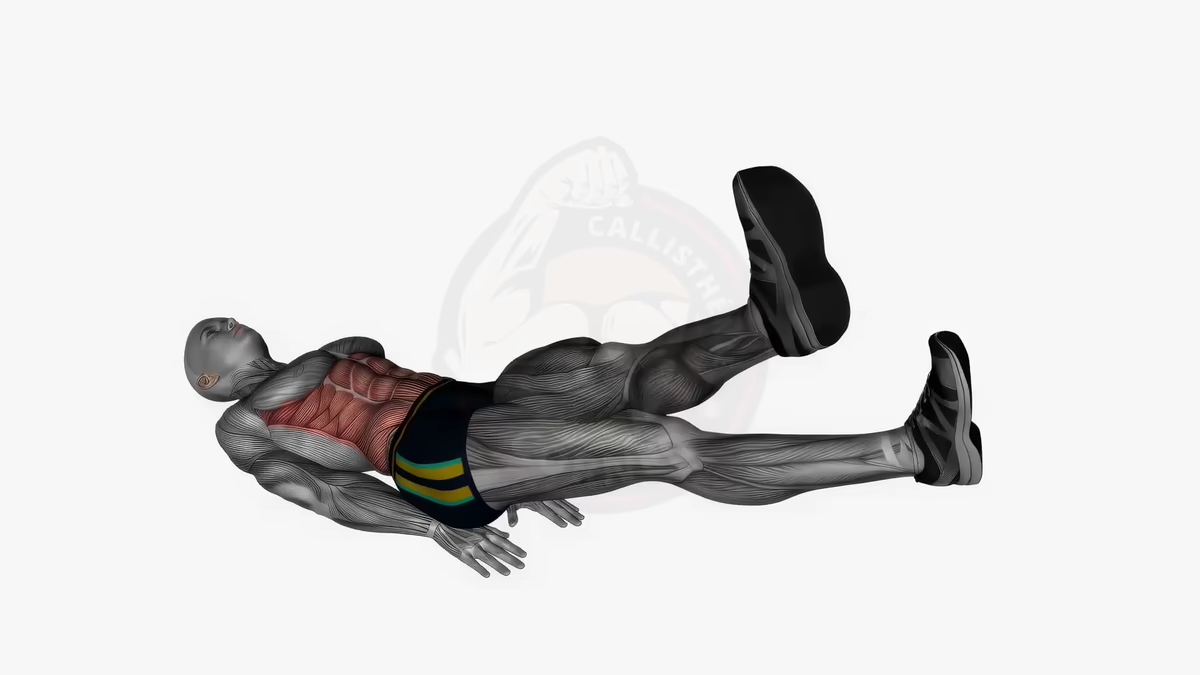
Lie on your back on a mat. Place your hands under your glutes or along your body, palms facing the floor, to stabilize the pelvis. Contract your abdominals and press your lower back firmly against the floor (zero gap). Slightly lift your head and shoulders, looking toward your abs. Your legs are extended and raised about 10 to 15 cm off the floor.
Movement execution
Raise one leg toward the ceiling while keeping the knee straight, as the other leg descends toward the floor without touching it. Then reverse: alternate legs in a continuous beating pattern. Maintain a consistent range of motion and avoid letting your heels touch the floor. Each full alternation counts as one rep.
Breathing
Exhale as one leg rises toward the ceiling, contracting your abs harder. Inhale during the descent. Never hold your breath. Steady breathing maintains oxygen supply to your muscles and lets you hold the position longer.
Common mistakes to avoid
- Arching your lower back: If your lumbar region lifts off the floor, reduce the range of motion or raise your legs slightly higher.
- Going too fast: Rushed movements reduce effectiveness and increase injury risk. Prioritize quality.
- Bending your knees: This significantly reduces ab work intensity. Keep legs straight.
- Pulling on your neck: If hands are behind your head, they support, not pull.
Scissor kick variations
Vertical scissors (beginner)
Vertical scissors are the simplified version ideal for beginners. Instead of lowering one leg near the floor, you perform the alternating motion between two higher positions. One leg points toward the ceiling at 90 degrees, while the other stays at about 60 degrees from the floor.
This beginner variation reduces lower back strain while letting you build the necessary strength. You can maintain this position longer, which promotes muscular endurance. Once you master 3 sets of 30 reps, move to the classic version.
Horizontal scissors (classic)
Horizontal scissors are the traditional form of the exercise. Your legs stay low, just a few centimeters off the floor, alternating in a nearly horizontal plane. This version intensely engages the lower abs and requires constant control.
The difficulty lies in maintaining the low leg position without arching your back. Start with short sets of 15 to 20 reps and increase progressively. This classic variation is the standard for measuring your ab strength progression.
Cross scissors (advanced)
Cross scissors add a rotational component to the movement. Instead of simply alternating up and down, your legs cross at each rep. The right leg passes over the left, then vice versa.
This advanced version recruits the obliques more heavily and improves coordination. The crossing motion significantly increases both the intensity and the complexity of the exercise. Reserve this variation for experienced practitioners who already have a solid core foundation.
Banded scissors (added resistance)
To intensify the exercise, loop a resistance band around your ankles. The band tension forces your abs to work even harder to control the leg movement.
This variation with added resistance develops strength and muscular endurance remarkably well. Choose a resistance level suited to your ability: a light band to start, then increase progressively. This method is particularly effective for breaking through a progress plateau.
Training program
Beginners: 3 sets of 10 to 15 reps (vertical scissors), 1-minute rest, 2 to 3 times per week. Focus on execution quality. When you can complete 3 sets of 20 reps with perfect technique, move up.
Intermediate: 4 sets of 20 to 30 reps (horizontal scissors), 45-second rest, 3 to 4 times per week. Chain with bicycle crunches and side planks.
Advanced: 5 sets of 40 to 60 reps, 30-second rest. Try HIIT format: 40 seconds intense scissors, 20 seconds rest, 8 rounds. Or superset with static holds.
Combining scissor kicks with other ab exercises
Scissor kicks integrate perfectly into a complete ab training routine. For balanced work, combine them with movements that target different areas of your core.
Build an effective ab circuit by chaining: horizontal scissors (30 reps), classic crunches (20 reps), Russian twists (40 reps), and front plank (45 seconds). Repeat this circuit 3 to 4 times with one minute of rest between rounds.
Precautions and contraindications
Scissor kicks are not recommended if you suffer from chronic lower back pain or herniated discs. Consult a healthcare professional if you have a history of back problems.
Always warm up before performing scissor kicks. A few minutes of static core holds and trunk rotations prepare your muscles. If you feel a sharp pain in your lower back, stop immediately and return to an easier variation. Never increase training volume by more than 10% per week.
For a structured ab progression, combine scissor kicks with leg raises and hollow holds to build toward advanced skills.