The russian twist is the reference exercise for building powerful obliques. It combines trunk rotation with an isometric V-sit hold, creating constant tension across the entire abdominal wall. Originally developed for Soviet military conditioning during the Cold War era, this exercise requires zero equipment and delivers serious results when performed correctly.
What is the russian twist?
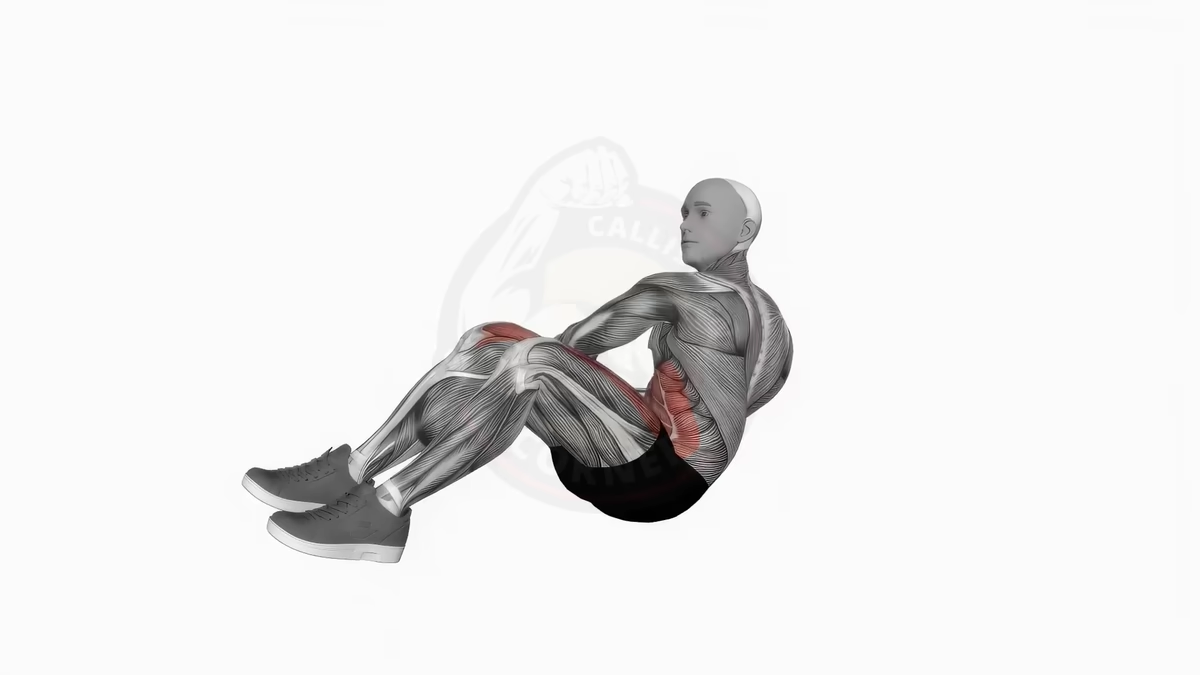
The russian twist is a trunk rotation exercise performed from a seated V-position. You sit on the floor, lean back at roughly 45 degrees, lift your feet slightly, and rotate your torso from side to side.
What makes it effective: the V-position forces your rectus abdominis to work isometrically (holding the position) while the rotations drive your obliques through their full range of motion. Every rep hits the entire core simultaneously.
Muscles worked in detail
Primary muscles
External and internal obliques: The stars of the movement. They generate the rotation and control the deceleration on each side. Well-developed obliques create the V-line definition along the sides of your torso.
Rectus abdominis: Maintains the V-position throughout the set via sustained isometric contraction. Even though you’re not crunching, your “six-pack” muscles are working hard to keep your torso elevated.
Transverse abdominis: The deepest core muscle, acting as your internal weight belt. It stabilizes the spine during rotation and keeps the trunk rigid.
Secondary muscles
- Spinal erectors: Support the posterior chain to prevent you from collapsing backward
- Hip flexors: Hold your legs elevated throughout the set
- Quadriceps: Isometric contraction to maintain knee angle
- Anterior deltoids: Stabilize the arms during rotation, especially with added weight
Perfect technique
Starting position
Sit on a mat with your knees bent at 90 degrees. Lean your torso back to approximately 45 degrees. Lift your feet about 5 cm off the floor. Clasp your hands together at chest level. Your body forms a V-shape between your torso and thighs.
The movement
- Contract your abs and rotate your trunk to the right. Pause for 1 second at the end of the rotation.
- Return to center with control.
- Rotate to the left. Pause 1 second.
- Return to center. One full rotation to each side equals 1 rep.
Key technique points
- Keep your back straight. The moment your spine rounds, you shift the load from your abs to your lower back. If you can’t maintain a flat back, reduce the lean angle.
- Rotate from the trunk, not just the arms. Your shoulders and hands should move because your torso is rotating, not because your arms are swinging independently. This is the most common mistake.
- Breathe out on each rotation. Exhale as you twist, inhale as you return to center.
- Control the tempo: approximately 2 seconds per rotation. Rushing kills the tension and turns the exercise into a momentum drill.
- Eyes follow your hands. This keeps your cervical spine aligned with your thoracic rotation.
Russian twists with weights
Why add weight?
More resistance means more muscle activation. If bodyweight russian twists feel easy at 20+ reps, adding load is the fastest way to continue building oblique strength and size.
How to hold the weight
Hold a dumbbell, plate, or medicine ball at chest level with both hands. Keep your elbows slightly bent. The weight stays close to your body throughout the movement.
Weight recommendations
| Level | Weight | Programming |
|---|---|---|
| Beginner | 2-5 kg | 4 x 8-10 reps, 90s rest (strength) |
| Intermediate | 5-10 kg | 4 x 12-15 reps, 60s rest (hypertrophy) |
| Advanced | 10-20 kg | 3 x 20+ reps, 30s rest (endurance) |
Russian twists with kettlebell
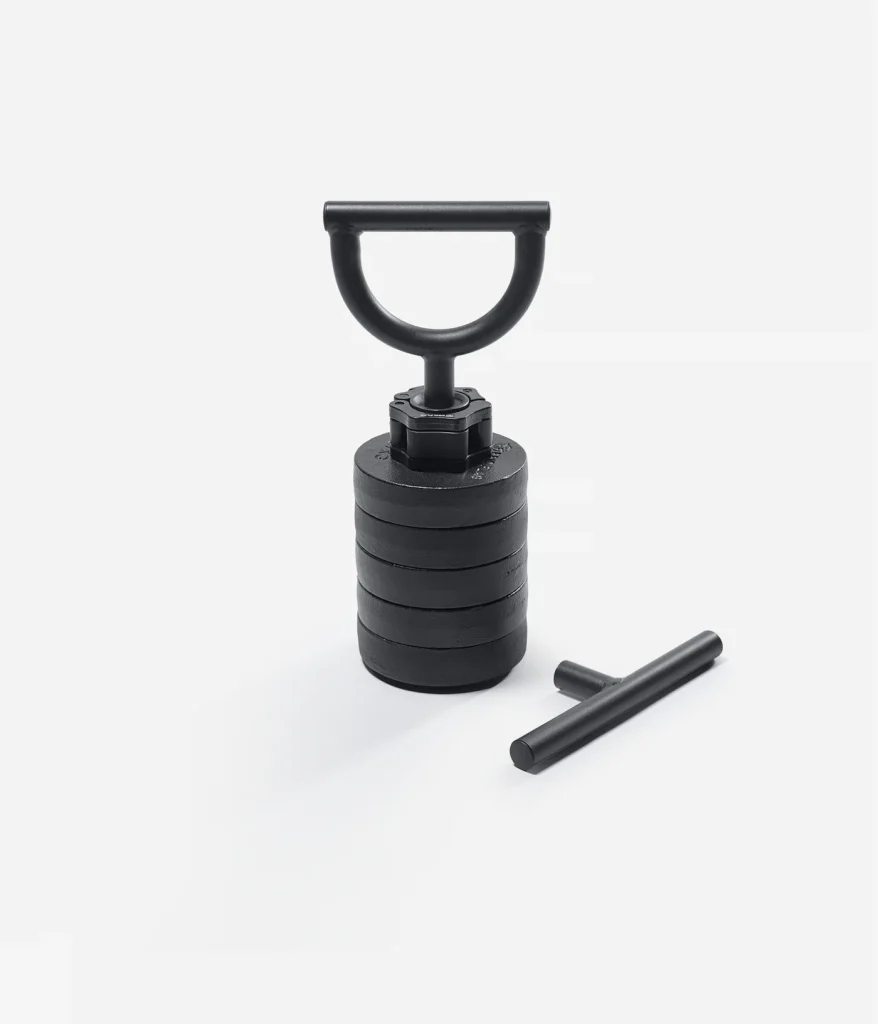
The kettlebell is the ideal tool for russian twists because its offset center of gravity forces your stabilizers to work harder than a symmetrical dumbbell.
Technique: Hold the kettlebell by the handle with both hands at chest height. Elbows slightly bent. Same rotation mechanics as the standard version.
Kettlebell progressions
| Level | Load | Position |
|---|---|---|
| Level 1 | 8 kg | Feet on floor |
| Level 2 | 12 kg | Feet elevated |
| Level 3 | 16 kg | Legs extended |
| Level 4 | 20+ kg | On a decline bench |
Advanced variants: Twist and press (rotate, then press the kettlebell overhead at the end of each rotation) and kettlebell pass (pass the kettlebell under your legs between rotations for added coordination challenge).
Why russian twists are a core game-changer
Russian twists work your abs from an angle that planks and hollow holds don’t reach. The rotational component targets the obliques through their primary function, trunk rotation, while the V-sit position keeps the rectus abdominis under constant tension.
What results to expect
- Weeks 1-2: Better mind-muscle connection with your obliques, improved core awareness during rotation
- Weeks 3-4: Noticeably firmer obliques, better trunk stability during other exercises
- Weeks 5-8: Visible definition along the V-line, measurable strength gains in rotational movements
For maximum core development, combine russian twists with planks, leg raises, and dead bugs in the same program. Each exercise hits a different function of the core: anti-rotation, anti-extension, flexion, and rotation.
Common mistakes
Going too fast. Speed reduces time under tension and lets momentum do the work. Slow down. Feel every rotation.
Moving only the arms. If your shoulders aren’t turning, your obliques aren’t working. Fix: place your hands on your chest and focus purely on trunk rotation before adding the arm reach back in.
Rounding the back. A curved spine under rotational load is a recipe for disc injury. Keep your chest lifted and your back flat.
Holding your breath. Breath-holding increases intra-abdominal pressure excessively. Exhale on each rotation.
Knees moving side to side. Your lower body should stay completely still. Only your upper body rotates. If your knees are swaying, you’re compensating for weak obliques.
Progressions: beginner to expert
Beginner (weeks 1-4): Feet on the floor, bodyweight only. 3 sets of 10 reps per side. 60 seconds rest. Master the rotation pattern before progressing.
Intermediate (weeks 5-12): Feet elevated 5 cm off the floor. 4 sets of 15-20 reps. 45 seconds rest. Add a light weight (2-5 kg) once form is solid.
Advanced (3+ months): 8-12 kg weight, legs extended. 4 sets of 15 reps per side. 30 seconds rest. Control is paramount at this level.
Expert: Mason twists on a decline bench. Supersets with bicycle crunches or side planks. 15-20 kg kettlebell passes.
15-minute core circuit with russian twists
This circuit hits your abs from every angle. Complete 3 rounds with 60 seconds rest between rounds.
Round 1:
- Plank hold: 30 seconds
- Russian twists (bodyweight): 15 reps per side
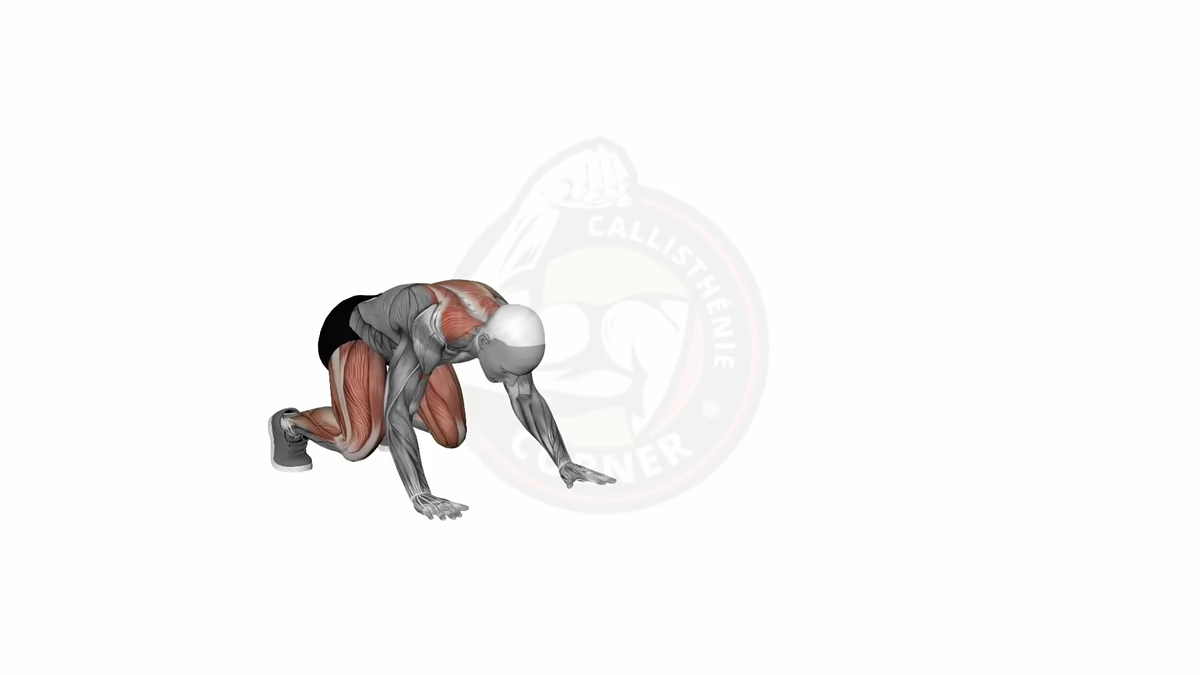
- Mountain climbers: 20 reps total
Round 2:
- Weighted russian twists: 12 reps per side
- Bicycle crunches: 20 reps total
- Side plank: 20 seconds per side
Round 3:
- Fast russian twists (bodyweight): 30 reps total
- Dead bug: 10 reps per side
- Hollow hold: 20 seconds
Three rounds takes about 15 minutes and delivers a comprehensive core workout. Add this circuit 2-3 times per week after your main training session.
Frequently Asked Questions
Are russian twists bad for your back?
Not when performed correctly. The key is maintaining a straight back throughout the movement and rotating from the trunk, not the lower back. If you round your spine or use excessive weight, the rotational load can stress the lumbar discs. Start with bodyweight, keep your chest lifted, and reduce the lean angle if you feel any lower back discomfort.
How many russian twists should I do?
Aim for 3 to 4 sets of 15 to 20 reps per side, 3 times per week. Your obliques need recovery just like any other muscle group. Once bodyweight reps feel easy at 20+ per side, add light weight (2 to 5 kg) rather than pushing to extremely high rep counts.
Do russian twists slim your waist?
Russian twists build and define the oblique muscles, but they do not spot-reduce fat from your waist. No exercise can target fat loss in a specific area. Visible oblique definition comes from a combination of consistent core training and a caloric deficit that lowers overall body fat. New to structured training? Our beginner calisthenics guide covers programming fundamentals.