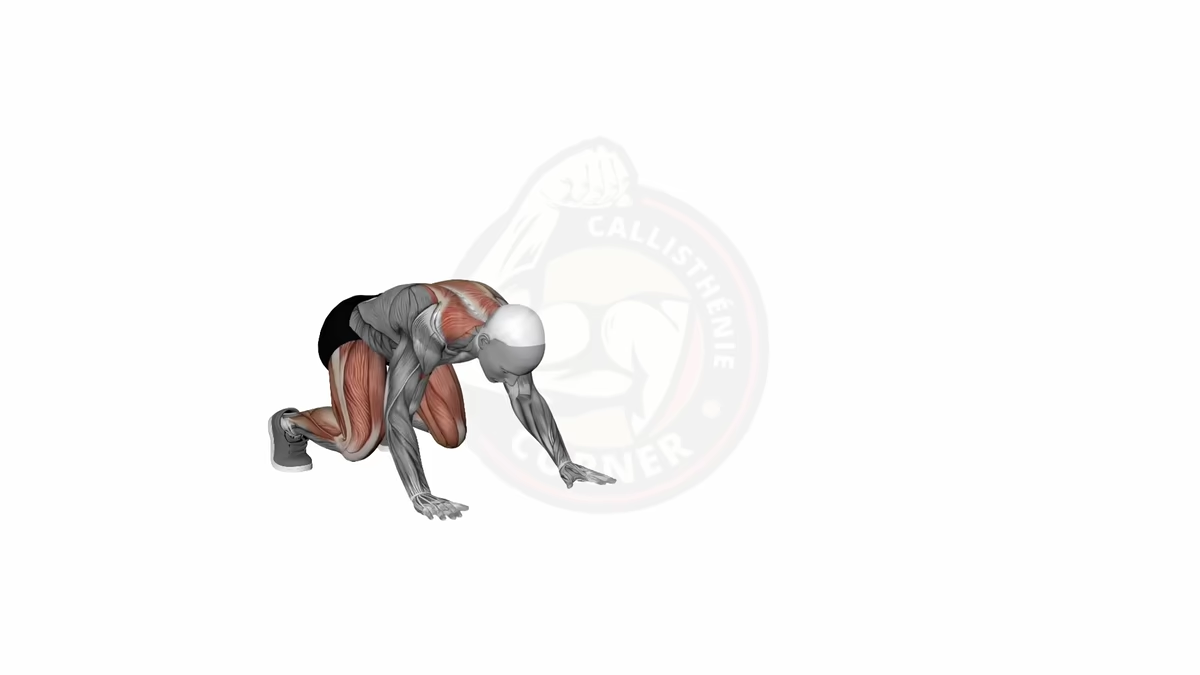

The reverse plank, also called the “reverse hold” or “Purvottanasana” in yoga, is a core exercise that works the opposite side of the traditional plank. Instead of facing the floor, you face the ceiling with your body supported on your hands and heels. This position targets the entire posterior chain: glutes, hamstrings, lower back, triceps, and shoulders.
Why the reverse plank matters
The reverse plank is often underestimated compared to the classic plank, but it is essential for improving posture, strengthening the trunk, and balancing the muscles across your entire body. It challenges full-body strength and endurance while compensating for the harmful effects of constant forward flexion in daily life: sitting at a desk, looking at screens, driving.
If you spend most of your day in a seated position, the reverse plank directly counteracts the muscular imbalances that build up over time. Combined with the standard plank and side plank, it provides complete 360-degree core coverage.
How to perform the reverse plank in 3 steps
Step 1: Starting position
- Sit on the floor with your legs extended and together in front of you
- Place your hands behind you, under or slightly behind your shoulders
- Point your fingers backward for the best shoulder and chest opening (fingers forward or to the side is acceptable for comfort, but backward position strengthens the shoulders more)
Step 2: Execute the movement
- While inhaling, push through your hands and heels to raise your hips toward the ceiling
- Keep your shoulders pulled away from your ears and your shoulder blades squeezed together
- Contract your glutes and abs to create a straight line from your shoulders to your heels
Step 3: Hold the position
- Keep your head aligned with your body, gaze directed toward the ceiling
- Do not let your hips drop or push them excessively high
- Keep your legs straight without arching your lower back excessively
- Maintain a slight bend in the elbows to avoid joint lockout
- Breathe calmly and steadily throughout
Muscles worked during the reverse plank
Primary muscles:
- Glutes
- Abdominals (entire core)
- Hamstrings
- Lower back
Secondary muscles:
- Posterior chain muscles
- Triceps
- Shoulders (posterior deltoids)
- Obliques
- Quadriceps (to keep legs extended)
- Hands and scapular stabilizers
The reverse plank is unique in that it activates both the anterior and posterior core simultaneously. The glutes and hamstrings hold the body up while the abdominals and obliques maintain alignment, creating a comprehensive strengthening stimulus.
Key benefits of the reverse plank
| Category | Specific benefits |
|---|---|
| Global strengthening | Strengthens postural muscles, tones glutes, legs, trunk, and builds arm musculature |
| Posture improvement | Corrects muscular imbalances, promotes better spinal alignment, compensates for prolonged sitting |
| Flexibility and mobility | Opens the shoulders, extends the hips, improves thoracic mobility |
| Injury prevention | Prevents back pain, improves general physical conditioning, builds strength and endurance |
For beginners who struggle with wrist discomfort, the forearm variation (described below) provides the same posterior chain benefits without loading the wrists.
Duration targets and progression
For beginners: hold the position for 10 to 15 seconds. Perform 2 to 3 sets with rest between them. Listen to your body and go by feel. If your hips start to sag, stop the set rather than holding with poor form.
For advanced practitioners: progressively increase hold time and the number of sets. Work toward sustained holds of 30 to 60 seconds, or even 2 to 3 minutes in a yoga context. As with any isometric exercise, never push through pain to reach a target time.
A good progression path:
- Week 1-2: 3 sets of 10-15 seconds
- Week 3-4: 3 sets of 20-30 seconds
- Week 5-6: 3 sets of 30-45 seconds
- Week 7+: 3 sets of 45-60 seconds
Common mistakes to avoid
- Hips dropping: this signals insufficient activation of the glutes and hamstrings. Focus on pushing your hips up by squeezing your glutes as hard as possible.
- Shoulders shrugging up: keep your shoulders pulled down away from your ears. Shoulder tension reduces the exercise’s effectiveness and creates neck strain.
- Holding your breath: creates unnecessary tension throughout the body. Maintain calm, rhythmic breathing during the entire hold.
- Excessive lower back arch: indicates either weak glutes or limited flexibility. Engage your core harder and slightly reduce your hip height.
- Head dropping back: keep your head in line with your spine. Looking straight up at the ceiling is fine, but letting the head hang back strains the cervical spine.
- Locked elbows: maintain a slight bend to protect the elbow joints and distribute the load more evenly between arms and posterior chain.
Reverse plank variations
On the forearms
Perform the reverse plank resting on your forearms instead of your hands. This reduces wrist pressure and is ideal for those with wrist mobility limitations. The core challenge remains the same.
Alternating leg lift
From the reverse plank position, lift one leg at a time while maintaining your hip height. This intensifies the muscular work by removing one support point and demanding greater glute and core activation.
Dynamic reverse plank
Alternate between a seated position and the full reverse plank in a controlled, rhythmic pattern. This adds a concentric component to what is normally a purely isometric exercise, building both strength and endurance.
Single-leg reverse plank
Hold the reverse plank with one leg elevated throughout the entire hold. This increases the demand on stabilizer muscles and makes the exercise significantly more challenging. Switch sides each set.
Integrate the reverse plank into your core routine alongside the plank, side plank, and hollow hold for a well-rounded approach to core strength and postural health.