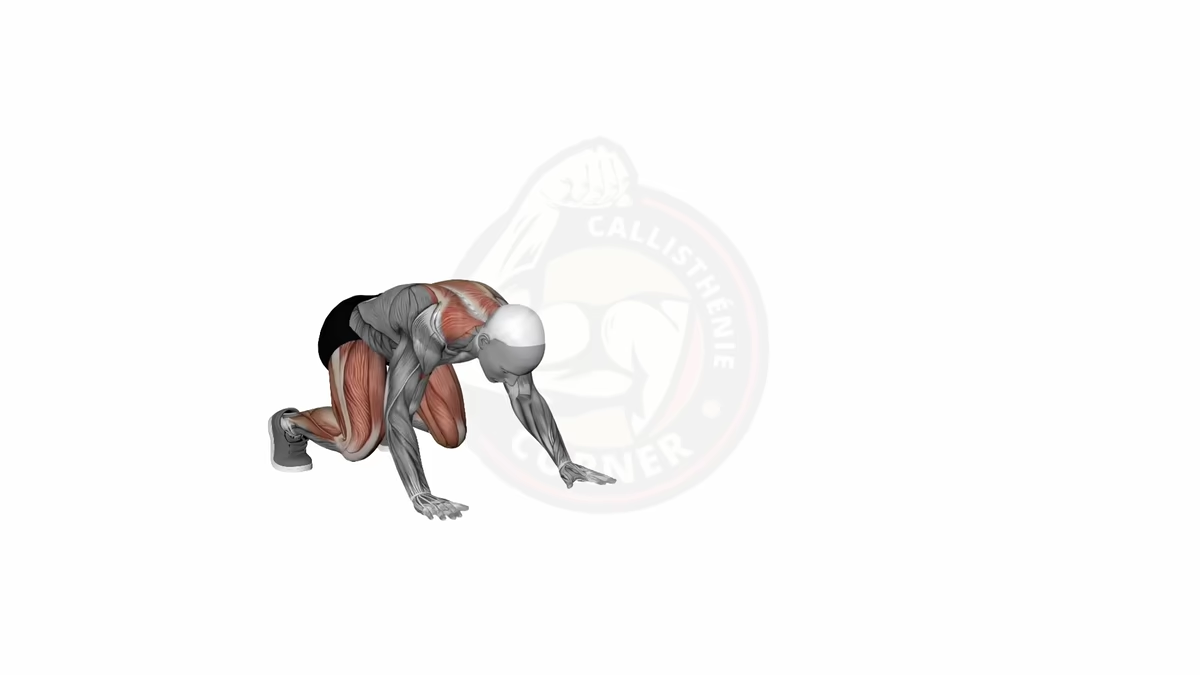
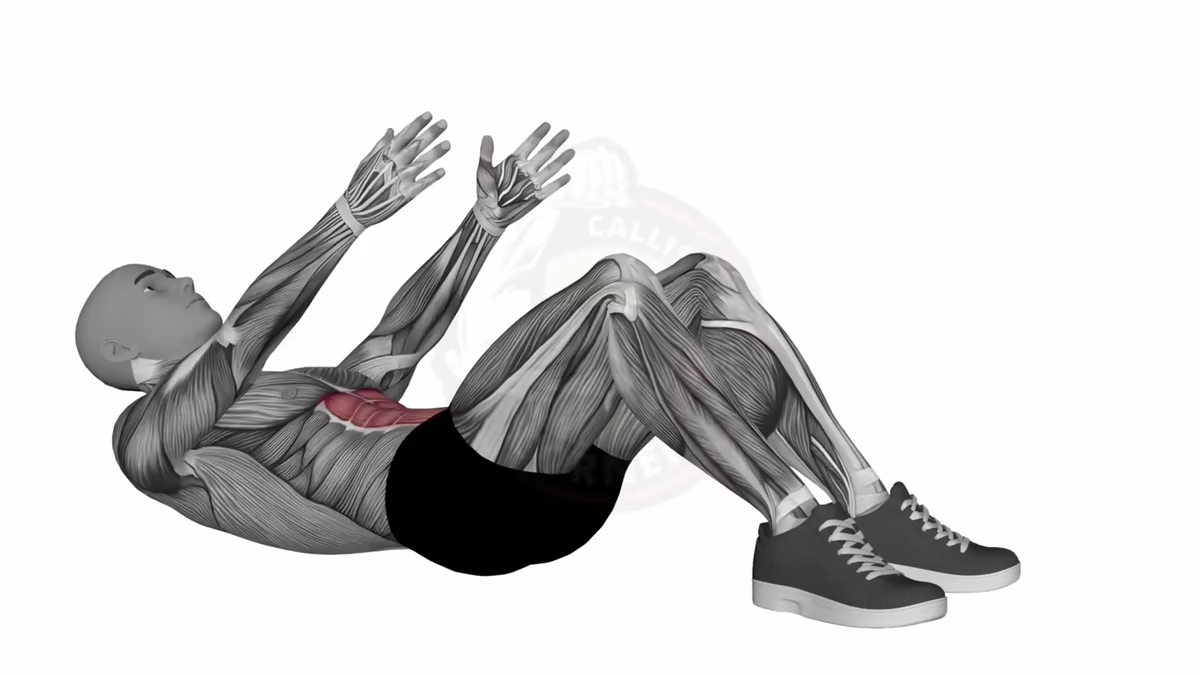
Among the foundational exercises for strengthening the abdominal wall, the crunch is one of the most efficient. Simple in appearance but remarkably effective, it allows you to:
- Target primarily the rectus abdominis (the “six-pack” muscle)
- Improve your posture and overall stability
- Build a solid foundation for your core
Whether you are a calisthenics beginner or an experienced athlete, crunches will always have a place in your training.
Proper crunch technique
To perform a crunch effectively and safely, follow these steps:
- Lie on your back, knees bent, feet flat on the floor and hip-width apart.
- Cross your arms on your chest or place your hands lightly behind your head without pulling on it.
- Engage your abs by inhaling, then exhale as you slowly lift your shoulders off the floor.
- Rise by contracting your abs, without using momentum. The movement is short and controlled: your lower back stays on the floor throughout.
- Return to the starting position by controlling the descent. Do not let gravity do the work.
Do not forget: Breathe correctly throughout the exercise. Exhale on the way up, inhale on the way down.
The crunch is not a sit-up. You are not coming all the way up to your knees. The range of motion is deliberately short because the goal is to isolate the rectus abdominis through a focused contraction, not to involve the hip flexors.
Benefits of the crunch
When performed correctly, the crunch offers several key advantages:
- Core strengthening: It primarily targets the rectus abdominis, building the visible “six-pack” muscles and the deeper core stabilizers that support every movement you do.
- Posture improvement: Strong abs help maintain good posture in daily life, reducing the tendency to slouch or round forward.
- Spine protection: A strong core acts as a shield for your lumbar spine. It helps prevent lower back pain, one of the most common complaints among desk workers and athletes alike.
- Accessibility: Requires zero equipment and can be adapted to any fitness level. You can do crunches anywhere, anytime.
Common mistakes to avoid
To maximize the benefits of crunches and avoid injury, watch out for these frequent errors:
Pulling on your neck: This is the number one mistake. When your hands are behind your head, the temptation is to pull your head forward to “help” the movement. This leads to neck pain and takes tension away from your abs. Fix: Keep your neck aligned with your spine. If your hands are behind your head, think of them as resting there lightly, not gripping. Alternatively, cross your arms on your chest to remove the temptation entirely.
Using momentum: Swinging your body up and down turns the crunch into a ballistic movement that your abs barely feel. Fix: Slow down. Each rep should take about 2 seconds up and 2 seconds down. If you cannot do it slowly, reduce the number of reps rather than speeding through them.
Arching the lower back: If your lower back lifts off the floor, your abs are disengaged and your lumbar spine takes the load. Fix: Press your lower back firmly into the floor before you begin. Maintain that contact throughout every rep. Think about pushing your belly button toward the ground.
Poor breathing: Holding your breath or breathing randomly reduces abdominal activation and builds unnecessary internal pressure. Fix: Exhale forcefully as you crunch up. This engages the transverse abdominis and creates stronger contraction. Inhale as you lower back down.
Training routines by level
To integrate crunches into your sessions effectively:
Beginner
- 3 sets of 15 crunches
- 30 seconds rest between sets
- Focus entirely on technique and controlled movement
Intermediate
- 4 sets of 20 crunches
- Feet elevated on a bench or step
- 30 seconds rest between sets
Elevating the feet shifts the angle slightly and increases the demand on the upper portion of the rectus abdominis.
Advanced
- 5 sets of 25 crunches
- Hold a weight plate on your chest (start with 5 kg, progress to 10-15 kg)
- 45 seconds rest between sets
The added weight forces your abs to generate more force through the same range of motion. Keep the movement just as controlled as the bodyweight version.
Combine crunches with other exercises for well-rounded core development. On their own, crunches are effective for the rectus abdominis, but your core needs rotational work, anti-extension, and lower-ab emphasis too.
Alternatives and complementary exercises
To diversify your ab training and progress faster, consider these exercises alongside crunches:
Plank: A static hold that engages the entire trunk. Where crunches work the abs dynamically through flexion, the plank trains anti-extension and full-body stability. Every core routine benefits from including both.
Leg raises: Target the lower portion of the rectus abdominis and the hip flexors. Hanging leg raises, in particular, provide an excellent complement to crunches by working the abs from the opposite direction.
Hollow hold: An isometric exercise that builds exceptional core endurance and stability. It teaches the full-body tension that transfers directly to calisthenics skills like front levers and muscle-ups.
Russian twists: Add the rotational component that crunches lack. Strong obliques improve performance in nearly every athletic movement.
Final word
The crunch is a fundamental calisthenics exercise for strengthening the abdominal wall. Easy to set up but demanding in terms of technique, it delivers considerable benefits when correctly integrated into a training routine. Focus on precise execution, stay consistent, and your abs will respond.
Frequently Asked Questions
Are crunches bad for your back?
Not when performed correctly. The crunch is a short-range movement that keeps your lower back on the floor, which minimizes spinal stress. Problems arise when people pull on their neck, arch their lower back, or do hundreds of reps with poor form. Focus on controlled movement, keep your lower back pressed into the floor, and crunches are perfectly safe for most people.
How many crunches should I do a day?
Quality matters more than quantity. Beginners can start with 3 sets of 15 reps, while intermediate and advanced athletes can work up to 4-5 sets of 20-25 reps. Training your abs 3 to 4 times per week is more effective than doing hundreds of crunches every day. Your muscles need recovery time to grow stronger.
Do crunches burn belly fat?
No. Spot reduction is a myth. Crunches strengthen and build the abdominal muscles, but they do not selectively burn fat from your midsection. Visible abs come from reducing overall body fat through a combination of consistent training, proper nutrition, and a calorie deficit. Crunches build the muscle; diet reveals it.
What is the difference between crunches and sit-ups?
The main difference is range of motion. Crunches lift only the shoulders off the floor, isolating the rectus abdominis through a short, controlled contraction. Sit-ups bring your entire torso up toward your knees, involving the hip flexors much more. Crunches are generally safer for the lower back and better at isolating the abs, while sit-ups are a more demanding full-range movement.