
Calf anatomy
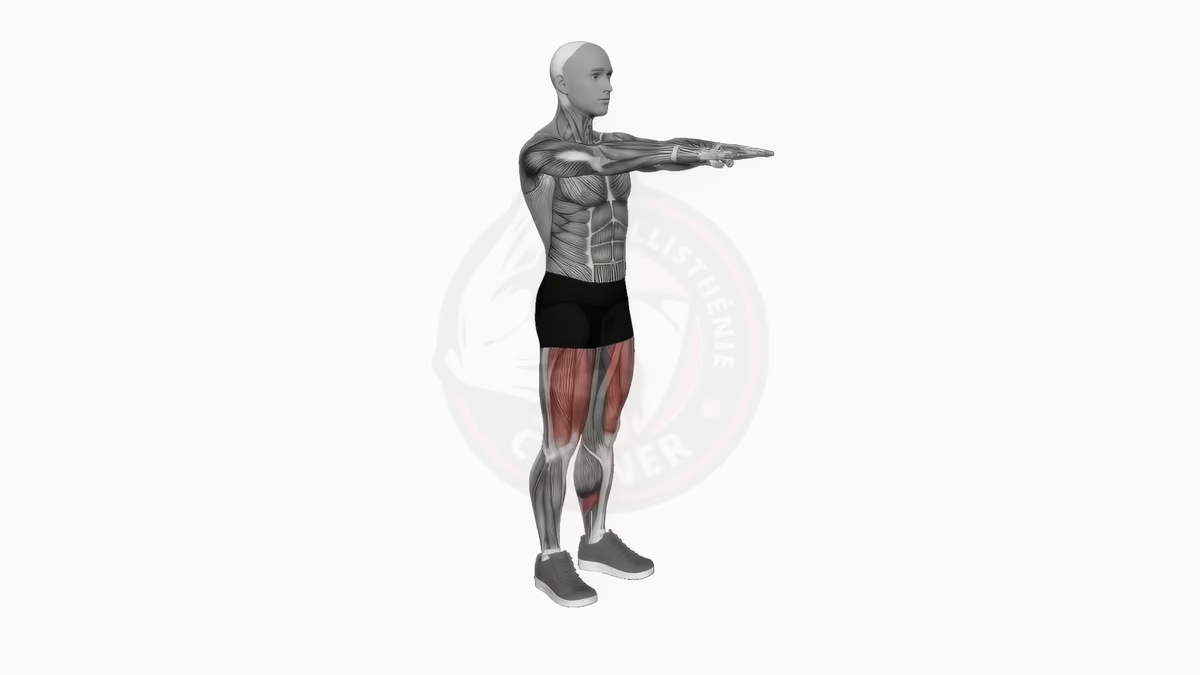
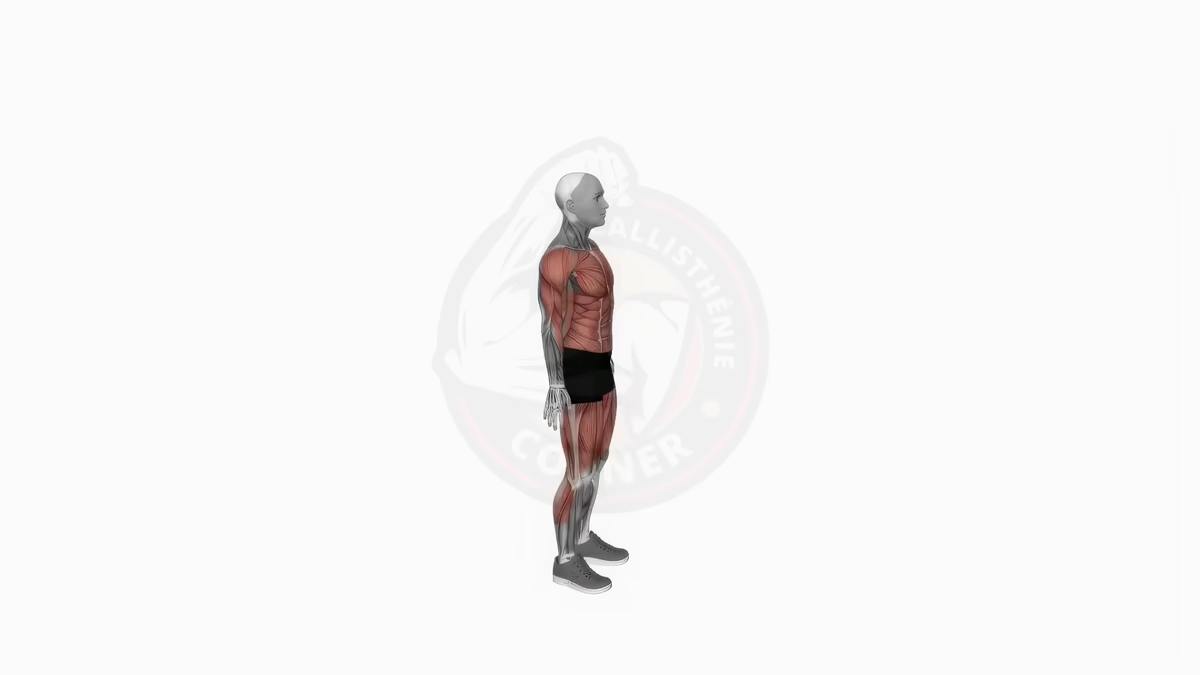
Before talking exercises and programs, let’s lay the groundwork. Your calves consist of a group of three muscle segments: the triceps surae, the gastrocnemius (two superficial heads, often called “the twins”), and the soleus (the deep muscle underneath). These three muscles join to form the Achilles tendon.
-
The gastrocnemius is trained with legs straight (standing). It gives your calf its visible volume. Two heads: a lateral (outer) and a medial (inner). When you perform standing calf raises, this is the muscle doing the work.
-
The soleus is trained with knees bent (seated or in a squatting position). It is a deep muscle, less visible, but essential for strength and endurance. Neglect it and your calf will lack density and thickness. Train both positions for complete development.
Strong calves improve your performance in air squats, jump squats, running, and calisthenics in general. They stabilize your ankle, prevent injuries, and increase explosiveness.
Another challenge: the soleus contains 90% slow-twitch fibers. These fibers have a growth capacity 50% lower than fast-twitch fibers. In other words, even with hard training, the soleus gains volume slowly. That is biology, not a lack of effort on your part.
Prerequisites for training your calves
Good news: no strength prerequisites. Calves are accessible to everyone, from complete beginners to advanced athletes.
Ankle mobility required: To exploit the full range of motion during calf raises, your ankle must be able to flex and extend freely. Simple test: seated, knee bent, pull your toes toward you with one hand. If you feel intense stiffness or pain, work on your mobility first with calf stretches (30 seconds, 3 times per day).
No Achilles tendon pain: If your Achilles tendon is painful, inflamed, or tender to touch, stop all calf training and rest. Strengthening is prevention, not treatment for active inflammation.
The 5 essential exercises without equipment
Mandatory warm-up before every session: your calves and ankles must be warm before loading. Perform 20 ankle rotations in each direction (seated or standing), then 10 light unloaded extensions (rise onto toes, lower back down). Finish with 30 seconds of calf stretching (place the ball of your foot against a wall, leg straight, lean forward). 3-5 minutes total. This prevents cramps and prepares your tendons.
1. Standing calf raises (gastrocnemius)
The foundational exercise. Standing, feet hip-width, rise onto the balls of your feet by contracting your calves. Go as high as possible, pause 1 second at the top, lower down in a controlled manner until you feel the stretch at the bottom. Legs completely straight.
No cheating with half reps. Lower until you feel your heels stretched (without touching the heels to the floor on a flat surface). Rise until you are standing only on the balls of your feet. Full range of motion equals results.
Beginner target: 4 sets of 20 reps. Intermediate: 4 sets of 30 reps. Advanced: 5 sets of 40+ reps or switch to single-leg.
2. Staircase calf raises (maximum range of motion)
Place the ball of your foot on the edge of a step, heels hanging off. Rise onto your toes, pause, then lower your heels below the step level. The range of motion doubles compared to flat ground.
This version is harder and more effective. The stretch at the bottom activates more muscle fibers. Start with both feet, progress to single-leg. Important: balance matters, hold onto a railing at first.
Target: 4 sets of 15-20 reps (full range makes this harder than the floor version).
3. Single-leg calf raises (unilateral progression)
Same movement as the standing raise, but on one leg. The other leg is bent behind you or crossed. Your working calf supports 100% of your bodyweight, doubling the resistance.
Hold onto a wall or support for balance at first. Focus on maximum contraction at the top, slow and controlled descent. Do not compensate with your body: only the calf does the work.
Target: 3 sets of 10-15 reps per leg. Progress to 20 reps per leg before adding slow tempo.
4. Seated/bent-knee calf raises (soleus)
Seated on a chair, feet flat on the floor, knees bent at 90 degrees. Rise onto the balls of your feet, contract, lower back down. Bent knees deactivate the gastrocnemius and activate the soleus.
Without load, this exercise is light. To increase difficulty with bodyweight: place a heavy backpack on your thighs, or do it single-leg. Alternative: hold a quarter-squat position, then perform calf raises from there.
Target: 4 sets of 25-30 reps. High volume is necessary for the soleus (slow-twitch fibers).
5. Jump squats / Explosive jumps (power)
Lower into a squat, then explode upward pushing hard with your calves. Land softly, repeat. Your calves provide the final push during the jump, developing power and explosiveness. The jump squat trains the calves in a way no isolation exercise can replicate.
Variations: single-leg jumps, box jumps (if available), double unders with a rope (if you have one). The goal is to create explosive ankle extension, not just bend the knees.
Target: 3 sets of 10-15 explosive jumps. Rest 90 seconds between sets (this is intense).
12-week high-frequency program
Calves respond to high volume and frequency. Train them 3 times per week, with at least 48 hours of rest between sessions. Short rest periods (60 seconds) are optimal since slow-twitch fibers recover quickly.
Session A (Gastrocnemius focus):
- Standing calf raises: 4 sets x 20-25 reps, 60s rest
- Staircase calf raises: 3 sets x 15-20 reps, 60s rest
- Single-leg calf raises: 3 sets x 10-12 reps per leg, 90s rest
Session B (Soleus + explosivity):
- Seated calf raises: 4 sets x 25-30 reps, 60s rest
- Standing calf raises: 3 sets x 20 reps, 60s rest
- Jump squats: 3 sets x 12-15 jumps, 90s rest
Session C (Total volume):
- Staircase calf raises: 4 sets x 20 reps, 60s rest
- Seated calf raises: 4 sets x 25 reps, 60s rest
- Single-leg calf raises: 2 sets x 15 reps per leg, 90s rest
Weeks 1-4: Adaptation
Perform sessions A, B, C each week (Monday/Wednesday/Friday or Tuesday/Thursday/Saturday). Focus on perfect technique, full range of motion, no cheating. Goal: acclimate your tendons to the volume.
Weeks 5-8: Volume increase
Same structure, but increase reps by 20-25%. If you were doing 4x20, move to 4x25. Or add one extra set per exercise. Your calves should burn by the end of each set. If it feels easy, increase more.
Weeks 9-12: Intensification
Switch to unilateral variations (single-leg) on all standing exercises. Reduce reps (10-15 per leg) but increase difficulty. Add slow tempo (3-1-3: 3s up, 1s pause, 3s down). Integrate 10-second isometric pauses in the contracted top position.
After 12 weeks: Measure your calves (circumference at the widest point). Compare with the start. If you gained 0.5-1.5 cm, that is a win. Continue with the same structure but vary exercises and intensities to avoid stagnation.
Mistakes to avoid and tips for faster progress
Partial range of motion (mistake #1). You go up halfway, come back down halfway, and wonder why your calves are not growing. Full range is non-negotiable. Lower to maximum stretch, rise to maximum contraction. 15 complete reps are worth more than 30 cheated reps.
Tempo too fast. You bounce your heels up and down like a spring, using momentum instead of muscular contraction. Solution: controlled tempo. 2 seconds up, 1 second contracted pause, 3 seconds down. Eliminate momentum. Force your calves to work, not your kinetic energy.
Volume too low. You do 3 sets of 10 reps and think that is enough. It is not. The calves (especially the soleus) contain mostly slow-twitch fibers. They respond to high volume, not low intensity. Minimum 15-20 reps per set, ideally 20-30. If you are doing fewer than 15 reps, increase the volume or switch to single-leg.
Neglecting the soleus. You only do standing raises because that is what shows. The soleus represents 60% of the triceps surae mass. Neglect it and your calf will lack density. Include at least 2 sessions per week with seated/bent-knee work.
Ignoring cramps. Your calves cramp during or after training? Normal with high volume. Solution: hydrate properly, stretch your calves 30 seconds after each set, and increase volume gradually instead of doubling it overnight. Cramps are a signal to slow the progression.
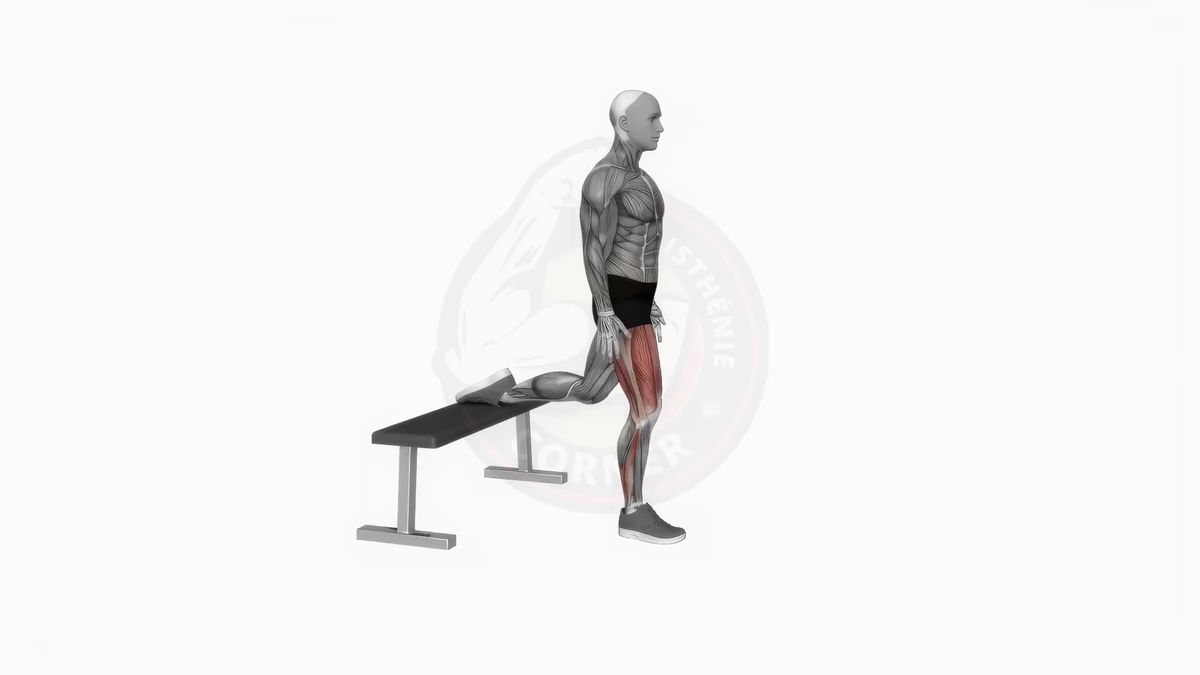
Daily volume and cardio: Outside your 3 heavy sessions, walk on your toes 5-10 minutes per day. Around the house, at the office, everywhere. High accumulated volume equals growth. Integrate jump rope (on toes), hill sprints, and anything that forces your calves to push repeatedly. The pistol squat also demands significant calf involvement for balance and ankle stability.
Building strong calves at home requires high volume and frequency. Genetics set the ceiling, but training determines whether you reach it or stagnate at 50%. Follow this program for 12 weeks, measure your progress, adjust. Your calves may never become massive, but they will become solid, functional, and resilient. And that is what counts in calisthenics. If you want a complete bodyweight program, check out our guide to getting started.