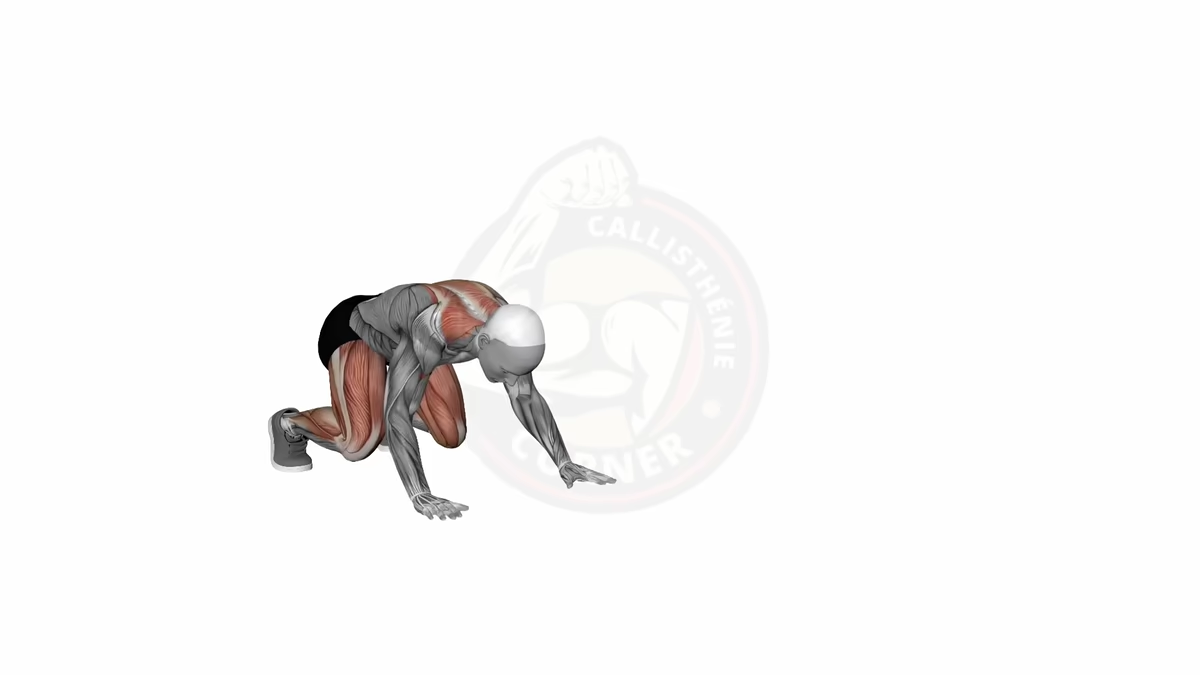
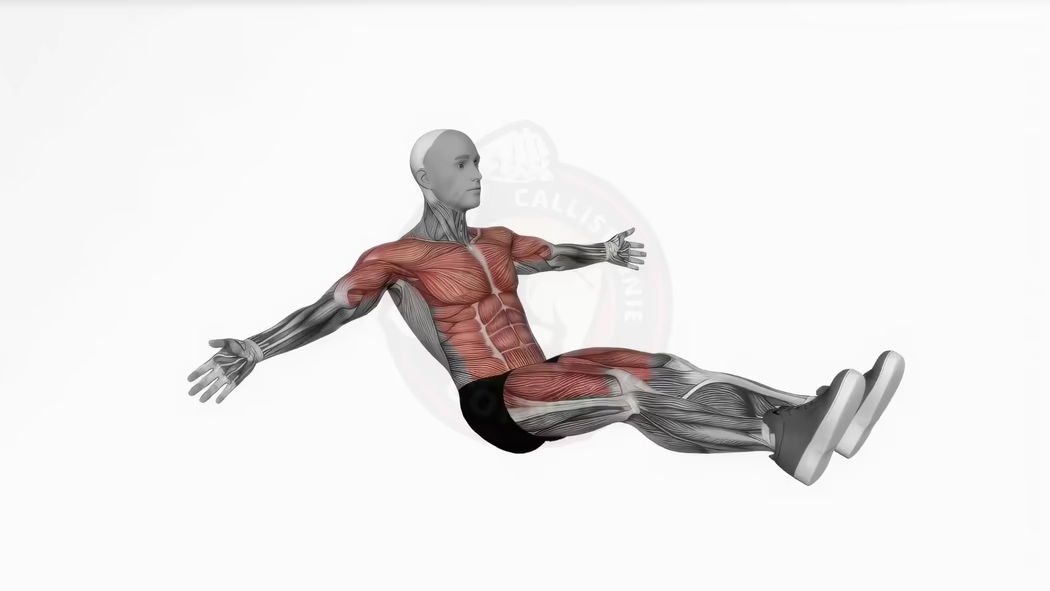
Among the variations of the classic crunch, the butterfly crunch stands out for its ability to isolate the abdominal muscles more effectively. This exercise is valued for its technical simplicity and its targeted intensity. Ideal for strengthening the core, it is an excellent choice for anyone looking to diversify their ab routine.
Correct execution technique
To perform a butterfly crunch with proper form:
- Lie on your back on a mat.
- Place the soles of your feet together, letting your knees fall open to each side (the “butterfly” position).
- Place your hands crossed on your chest or lightly behind your head without pulling.
- Engage your abs as you inhale, then exhale as you lift your shoulders off the floor while strongly contracting the abdominals.
- Return slowly to the starting position, controlling the descent.
Make sure to keep your feet on the floor and focus the effort entirely on the abdominals.
Why the butterfly position works
The butterfly leg position is not just for show. By opening your knees to the sides and pressing the soles of your feet together, you effectively neutralize the hip flexors. In a standard crunch, the hip flexors can “steal” work from the abs, especially when fatigue sets in. With the butterfly position, that compensation path is cut off, and the rectus abdominis has no choice but to handle the load alone.
This makes the butterfly crunch a particularly honest exercise. If your abs are not strong enough, you simply will not be able to lift your shoulders off the floor. There is no way to cheat.
Benefits of the butterfly crunch
Greater isolation: By limiting hip flexor involvement, the butterfly crunch places more demand on the rectus abdominis. The upper portion of the abs gets a focused workout that few crunch variations can match.
Hip mobility improvement: The open-knee position stretches the inner thighs and hip adductors while you train. Over time, this contributes to better hip flexibility and overall mobility, a bonus that standard crunches do not offer.
Accessible to all levels: Whether you are a beginner or an advanced athlete, the butterfly crunch fits into any program. Beginners benefit from the reduced compensation, while advanced practitioners appreciate the purer muscle engagement.
Targeted upper ab strengthening: The movement pattern emphasizes the upper section of the rectus abdominis. Combined with exercises that target the lower abs (like the hollow body hold), you get complete abdominal coverage.
Common mistakes to avoid
Arching your lower back: Keep your lower back in contact with the mat throughout the movement. If your lumbar spine lifts off the floor, your abs have disengaged and the exercise loses its effectiveness. Focus on pressing your lower back down before every rep.
Pulling with your arms: Whether your hands are behind your head or crossed on your chest, the movement must be initiated by the abdominals. If you place your hands behind your head, your fingertips should barely touch. The moment you start pulling your neck forward, you are compensating.
Lack of control: Avoid jerky, rushed movements. The butterfly crunch is not a speed exercise. Each rep should take about 3 seconds: 1 second up, 1 second hold at the top, 1 second controlled descent. If you cannot maintain this tempo, reduce the rep count.
Letting the knees close: During the effort, some people instinctively bring their knees together. This reactivates the hip flexors and defeats the purpose of the butterfly position. If your knees keep closing, it may indicate tight adductors. Work on hip flexibility separately.
Programming by level
Beginner
- 3 sets of 12 to 15 reps
- 60-second rest between sets
- Focus on maintaining the butterfly position and feeling the abs contract
- 2 to 3 sessions per week
At this stage, the priority is technique. Do not rush for high reps. If you can complete 3 sets of 15 with perfect form, you are ready for the next level.
Intermediate
- 4 sets of 20 reps
- 45-second rest between sets
- Add a brief squeeze at the top of each rep
- 3 sessions per week
At the intermediate level, you should feel a strong burn in the upper abs by the third set. If not, slow down the tempo or add a 1-second pause at the top of each rep to increase time under tension.
Advanced
- 5 sets of 25 reps with a 2-second pause in the top position
- 30-second rest between sets
- 3 to 4 sessions per week
The 2-second hold at the top transforms this exercise. It eliminates any residual momentum and forces the abs to contract isometrically at their shortest length. This is where real abdominal endurance is built.
Integrating the butterfly crunch into a full routine
The butterfly crunch works best as part of a balanced ab training session. Here is how to combine it with complementary exercises:
Upper abs focus: Start with butterfly crunches (your primary exercise), then move to standard crunches as a finisher.
Full ab circuit: Butterfly crunches (20 reps), followed by Russian twists (30 reps) for obliques, then hollow body hold (30 seconds) for deep core stability. Rest 60 seconds, repeat 3 to 4 rounds.
Superset approach: Alternate butterfly crunches with a plank hold. Perform 15 butterfly crunches, immediately hold a plank for 30 seconds, rest 45 seconds, repeat for 4 rounds. This combination hits both the dynamic and isometric components of core strength.
Alternatives and complementary exercises
To add variety to your ab training:
Classic crunch: The foundation exercise. If you have not mastered it yet, start there before adding the butterfly variation.
Hollow body hold: For building global core stability. While the butterfly crunch targets the upper abs in a dynamic fashion, the hollow hold trains the entire core isometrically.
Russian twists: For targeting the obliques. The butterfly crunch focuses on the rectus abdominis, so pairing it with Russian twists ensures you cover the lateral muscles too.
Final word
The butterfly crunch is an effective variation for targeting the abs with greater precision while improving hip mobility. Integrated regularly into your calisthenics training, it will help you build a strong, sculpted core. Add it to your sessions without hesitation to diversify your workouts and push past plateaus.