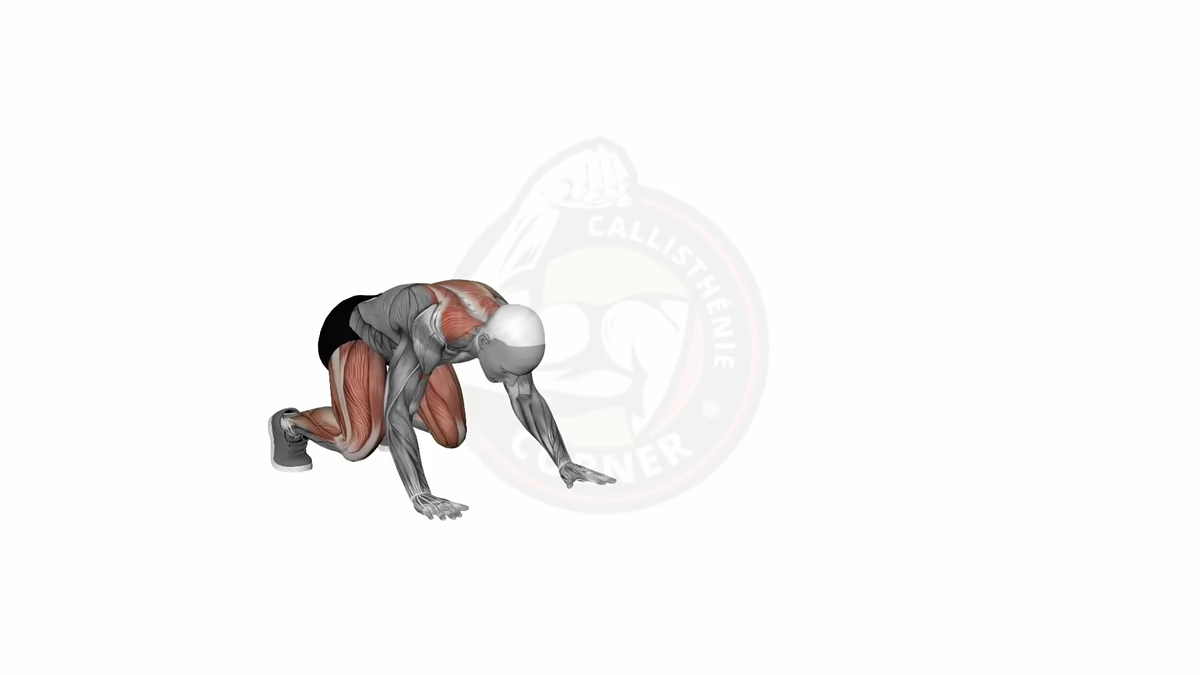
The bicycle crunch has become a staple in modern fitness programs. This dynamic exercise gained popularity thanks to its remarkable effectiveness for strengthening and sculpting the abdominal wall, while engaging multiple muscle groups simultaneously.
Appreciated by athletes of all levels, the bicycle crunch stands out for its versatility and accessibility: all you need is a mat on the floor. Let’s explore why this exercise deserves a prime spot in your ab training routine.
Definition and description
The bicycle crunch is a core exercise that primarily targets the abdominal wall, with special emphasis on the obliques. Unlike standard crunches, it adds a dynamic pedaling motion that mimics riding a bicycle, hence the name.
Starting position
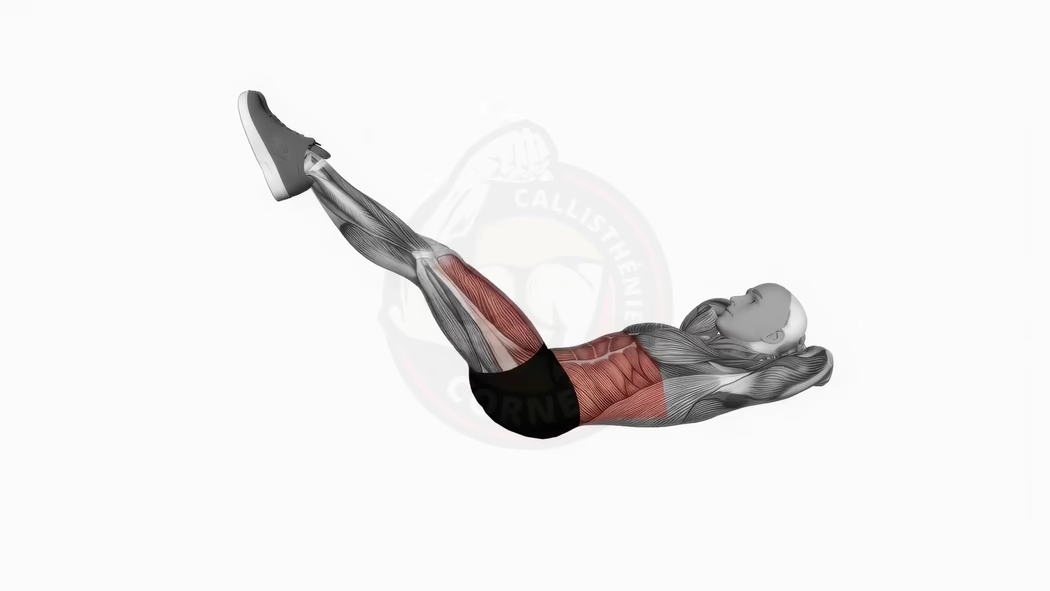
To perform the bicycle crunch correctly:
- Lie on your back on a comfortable mat
- Place your hands behind your head, elbows flared out to the sides
- Lift your legs with knees bent at a 90-degree angle
Movement execution
- Lift your shoulders slightly off the floor
- Extend your right leg forward while simultaneously bringing your left knee toward your chest
- Rotate your torso to bring your right elbow toward your left knee
- Return to the center position, then repeat on the opposite side (left elbow toward right knee)
- Continue alternating sides in a fluid motion, as if pedaling a bicycle
The key is fluidity. Each rep flows into the next without pausing at center. Think of it as a continuous pedaling rhythm, not a series of isolated twists.
Breathing
Breathing plays a critical role in the effectiveness of this exercise. Exhale when you rotate and contract your abs (the effort phase). Inhale when you return to the center position. This breathing pattern optimizes muscular engagement and prevents premature fatigue.
Muscles worked
The bicycle crunch is valued for its ability to engage multiple muscle groups simultaneously, making it a comprehensive trunk exercise.
Abdominals
- External and internal obliques: The primary target, located on the sides of the waist. They generate the rotation and control the deceleration.
- Rectus abdominis: The central “six-pack” muscle, working to keep the shoulders elevated throughout the set.
- Transverse abdominis: The deepest core muscle, stabilizing the trunk during rotation.
Back muscles
- Lumbar muscles: Engaged to maintain trunk stability during the exercise.
- Spinal erectors: Contribute to posture maintenance and prevent you from collapsing.
Leg muscles
- Quadriceps: Engaged during leg extension.
- Hamstrings: Active during knee flexion.
- Hip flexors: Activated throughout the pedaling motion.
- Glutes: Contribute to pelvis stabilization.
Benefits
Muscular strengthening
- Effectively sculpts and tones the entire abdominal wall
- Develops functional trunk strength
- Strengthens the deep stabilizer muscles
Posture improvement
- Contributes to better daily posture
- Strengthens the core, improving overall stability
- Can help prevent lower back pain by reinforcing the support muscles
Metabolic benefits
- Increases caloric expenditure during exercise
- Boosts metabolism and promotes fat burning
- Contributes to weight management when integrated into a complete routine
Coordination and balance
- Improves coordination between the upper and lower body
- Develops body awareness
- Builds muscular endurance that transfers to other athletic activities
The ACE study: why bicycle crunches are so effective
Research has demonstrated that the bicycle crunch ranks among the most effective ab exercises in terms of muscle activation. A widely cited study by the American Council on Exercise (ACE) classified the bicycle crunch as one of the top exercises for stimulating the abdominal muscles, particularly the obliques.
Compared to traditional crunches, the bicycle crunch generates significantly higher electromyographic (EMG) activity in the abdominal muscles, indicating superior muscular engagement. This effectiveness comes from the combination of movements that recruit multiple muscle groups simultaneously.
Common mistakes to avoid
Pulling on your neck: Place your hands lightly behind your head without exerting pressure. Your hands support your head; they do not lift it.
Going too fast: A pace that is too high reduces effectiveness and increases injury risk. Prioritize quality over quantity. Each rotation should be deliberate and controlled.
Arching your back: If your lower back lifts off the floor, it can lead to lumbar pain. Press your lower back into the mat throughout the entire set.
Excessive rotation: Do not force the twist beyond your comfortable range of motion. The goal is to bring your elbow toward the opposite knee, not necessarily to touch it.
Holding your breath: Avoid holding your breath during effort. Consistent breathing maintains core engagement and prevents unnecessary internal pressure.
Variations by level
Beginner
- Legs on the floor: Start by working only the upper body rotation with your feet planted on the ground. This removes the balance challenge and lets you focus on the twist.
- Reduced range of motion: Limit how far you extend the straight leg to make the movement easier to control.
Intermediate
- Arms extended: Reach your arms forward instead of placing them behind your head. This increases the lever arm and the difficulty.
- One leg straight: Keep one leg extended forward throughout while performing the movement with the other, then switch sides.
Advanced
- Double crunch: Simultaneously lift the upper body and legs to intensify the abdominal work.
- Reversed bicycle crunch: Start with legs extended upward and bend the knees as you bring them toward your chest.
- Elevated legs: Keep the non-active leg hovering a few centimeters off the floor to maintain constant tension.
- Gym ball bicycle crunch: Add an unstable surface that forces your muscles to work harder for balance.
Complete ab circuit program
Integrate bicycle crunches into this full circuit (repeat 3 rounds):
| Exercise | Reps / Duration |
|---|---|
| Plank | 30-60 seconds |
| Bicycle crunches | 15-20 reps per side |
| Russian twists | 15 reps per side |
| Leg raises | 10-15 reps |
| Rest | 60 seconds between rounds |
This circuit hits the core from every angle: anti-extension (plank), rotation (bicycle crunches and russian twists), and lower ab emphasis (leg raises). Three rounds takes roughly 15 minutes and delivers a thorough abdominal session.
Frequently Asked Questions
Are bicycle crunches effective for abs?
Very. The ACE study ranks bicycle crunches among the top exercises for abdominal activation, especially for the obliques. The combination of rotation, flexion, and a dynamic pedaling motion recruits the rectus abdominis, obliques, and transverse abdominis simultaneously. Few exercises hit as many core muscles in a single movement.
How many bicycle crunches should I do?
For beginners, start with 2 to 3 sets of 10 reps per side and focus on slow, controlled movement. Intermediate athletes can aim for 3 sets of 15 to 20 reps per side. Advanced practitioners can push to 3-4 sets of 20 to 25 reps per side. Quality always beats quantity: if your form breaks down, stop the set.
What muscles do bicycle crunches target?
The primary targets are the external and internal obliques, which generate and control the rotation. The rectus abdominis keeps the shoulders elevated, while the transverse abdominis stabilizes the trunk. Secondary muscles include the hip flexors, quadriceps, hamstrings, and glutes, all working during the pedaling motion.
Are bicycle crunches bad for your neck?
Not if you use proper form. Neck pain during bicycle crunches almost always comes from pulling on the head with the hands. Your hands should rest lightly behind your head to support it, not lift it. If you still feel neck strain, try crossing your arms over your chest instead, or reduce your rep count until your core is strong enough to do the work without compensating.