
Skills
How to do a perfect Muscle Up
The muscle up fascinates and intimidates in equal measure. This iconic street workout and calisthenics movement combines strength, technique and coordination. Whether you are just starting out in calisthenics or you are an experienced athlete, this guide will walk you through every step towards mastering the muscle up. Get ready to push your limits and impress at the park!
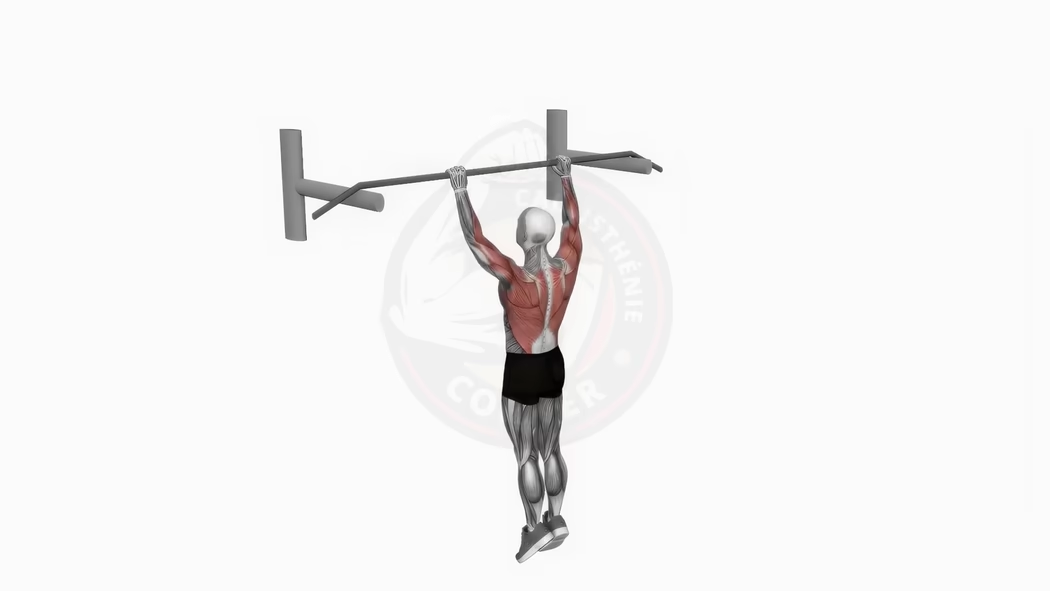
Muscle up fundamentals: definition and biomechanics
The muscle up is a strength exercise that consists of moving from a hanging position under a bar to a support position above it, in one fluid movement. It breaks down into three distinct phases: the pull, the transition and the push.
Muscles worked in each phase of the muscle up
| Phase | Primary muscles | Secondary muscles |
|---|---|---|
| Pull | Lats, biceps | Forearms, rear deltoid |
| Transition | Lats, pectorals | Triceps, front deltoid |
| Push | Triceps, pectorals | Front deltoid, trapezius |
The biomechanics of the muscle up require precise coordination between these different muscle groups. During the pull phase, your body must generate enough power to create the momentum needed for the transition. It is during this critical phase that the pectorals and triceps take over to propel the body above the bar.
Also worth exploring: the Human Flag, another impressive calisthenics skill.
Muscle up variants: bar vs rings
The muscle up can be performed on two main supports: the pull-up bar and gymnastic rings. Each variant presents its own challenges and advantages.
| Criteria | Pull-up bar | Rings |
|---|---|---|
| Stability | More stable | Less stable, requires more control |
| Technique | Requires a specific technique to clear the bar | More natural transition, but demands more strength |
| Muscle recruitment | High forearm engagement | Greater shoulder stabiliser activation |
| Learning curve | Generally easier for beginners | Can feel more intuitive for some, but more physically demanding |
The choice between bar and rings depends on your goals and preferences. The pull-up bar is often recommended for beginners because it offers more stability. Rings, on the other hand, allow greater freedom of movement and strengthen the stabiliser muscles more effectively.

Essential prerequisites before attempting the muscle up
Before you dive into learning the muscle up, make sure you have mastered certain fundamentals. These prerequisites will allow you to approach the exercise safely and maximise your chances of success.
- Pull-up strength: Ability to perform at least 10 strict pull-ups with good form.
- Dip power: Ability to complete 15 to 20 dips on parallel bars.
- Shoulder mobility: Sufficient flexibility to pass your elbows above the bar.
- Core strength: A solid core to maintain body alignment throughout the movement.
- Explosiveness: Ability to perform explosive pull-ups, bringing your chest to the bar.
These prerequisites are essential because they form the base of strength and control needed to execute a muscle up. Without them, you risk compensating with incorrect movements, increasing your injury risk and limiting your progression.
Readiness test: are you ready for the muscle up?
To assess your level of readiness, complete the following tests:
- Max pull-up test: Perform as many strict pull-ups as you can in one set.
- Dip test: Perform as many dips on parallel bars as you can in one set.
- Explosive pull-up test: Try to bring your chest to the bar in one explosive pull-up.
- Mobility test: From a hanging position, try to pass your elbows behind the bar.
| Test | Minimum result | Interpretation |
|---|---|---|
| Pull-ups | 10 reps | Ready for specific training |
| Dips | 15 reps | Sufficient strength for the push phase |
| Explosive pull-up | Chest touching the bar | Adequate explosiveness for the transition |
| Mobility | Elbows behind the bar | Sufficient flexibility for the transition |
If you achieve these minimum results, you can consider starting to work on the muscle up. Otherwise, focus on strengthening these areas before progressing.
Muscle up technique step by step
Mastering the muscle up technique takes patience and practice. Here is a detailed breakdown of the movement to guide your learning:
Starting position
Hang from the bar with a grip slightly wider than shoulder width. Use a pronated grip (palms facing forward).
Pull phase
Initiate the movement with an explosive pull. Pull the bar towards your solar plexus, not towards your chin as in a standard pull-up.
Transition
At the top of the pull, rotate your wrists to bring your elbows above the bar. This is the most technical phase of the movement.
Push phase
Once your elbows are above the bar, push like a dip to hoist yourself fully upward.
Final lockout
Finish in a support position, arms fully extended, above the bar.
The key to a successful muscle up lies in the fluidity of the chain between these phases. The transition, in particular, demands precise coordination between the end of the pull and the beginning of the push.
The transition: the keystone of a successful muscle up
The transition is often considered the most challenging part of the muscle up. Here are the key points to nail it:
- Timing: Initiate the transition at the peak of your explosive pull.
- Wrist rotation: Quickly switch from an underhand to an overhand grip position.
- Hip engagement: Use the momentum of your hips to facilitate the passage.
- Gaze: Fix a point in front of you to maintain body alignment.
- Speed: The transition must be fast to take advantage of the momentum generated by the pull.
Common mistakes during the transition include a wrist rotation that is too slow, a lack of explosiveness in the initial pull, or poor coordination between the upper and lower body. Work on each aspect separately before combining them in the full movement.
12-week progressive program to your first muscle up
To master the muscle up, follow this 12-week program. It will help you progressively develop the strength, technique and coordination required.
| Weeks | Focus | Key exercises |
|---|---|---|
| 1-3 | Base strengthening | Pull-ups, dips, core work |
| 4-6 | Explosiveness | Explosive pull-ups, high jumps |
| 7-9 | Transition technique | Bar swings, negative muscle ups |
| 10-12 | Full movement integration | Assisted muscle ups, full muscle up attempts |
Each phase of this program targets a specific aspect of the muscle up. Start by strengthening your base of strength, then develop the required explosiveness. Next, focus on the transition technique before integrating all elements into the complete movement.
Specific exercises for weak points
To progress efficiently, identify and work on your weak points. Here are targeted exercises for each aspect of the muscle up:
- High pull-ups: Bring the bar to chest level to strengthen the pull phase.
- Deep dips: Lower further than usual to improve push strength.
- Bar swings: Practise the pendulum motion to master the dynamics of the muscle up.
- Negative muscle ups: Start from the top position and lower slowly to strengthen the transition.
- False grip: Train yourself to hold the bar with this specific grip to make the transition easier.
Incorporate these exercises into your routine based on your specific needs. The key is to work regularly on your weaknesses while maintaining balance in your overall training.
Common mistakes in the muscle up
Even with good preparation, certain mistakes can hinder your progress towards a clean muscle up. Here are the most frequent ones and how to correct them:
- Pull not high enough: Make sure you pull the bar to the lower chest, not just to the chin.
- Elbows flared out: Keep your elbows close to your body during the pull for better efficiency.
- Excessive swing: A slight swing is useful, but too much momentum compromises technique.
- Slow transition: The transition must be fast and fluid to capitalise on the pull's momentum.
- Premature push: Wait until your elbows are above the bar before starting the push phase.
These mistakes can not only prevent you from completing the movement, but also increase the risk of injury. Focus on clean and controlled execution, even if it means progressing more slowly at first.
How to prevent injuries when practising the muscle up
Practising the muscle up, while rewarding, can be demanding on your body. Here are some tips to minimise the risks:
- Warm up thoroughly, with special attention to your shoulders and wrists.
- Progress gradually, without skipping steps.
- Listen to your body and respect recovery times.
- Vary your exercises to avoid overloading a specific area.
- Maintain good technique, even when you are tired.
Recovery plays a key role in injury prevention. Allow yourself enough rest between intense sessions and include mobility and stretching exercises in your routine.
From kipping to strict: evolving your muscle up technique
The muscle up comes in two main variants: the kipping muscle up and the strict muscle up. Each has its place in your progression.
| Aspect | Kipping Muscle Up | Strict Muscle Up |
|---|---|---|
| Technique | Uses body momentum | Pure strength only |
| Difficulty | More accessible for beginners | Requires more strength and control |
| Usefulness | Good for initial learning | Develops superior strength |
| Injury risk | Potentially higher if poorly executed | Generally safer with proper technique |
The kipping muscle up can serve as a stepping stone towards the strict muscle up. It lets you get familiar with the movement and build confidence. However, in the long run, aiming for the strict muscle up will bring you more benefits in terms of strength and control.
To transition from kipping to strict, gradually reduce the swing amplitude while increasing your pull and push strength. This process can take time, but it is well worth the effort for complete mastery of the movement.
Integrating the muscle up into your calisthenics training
Once you have mastered the muscle up, it is time to integrate it effectively into your training routine. Here are some key points to consider:
- Frequency: Start with 2-3 sessions per week dedicated to the muscle up.
- Volume: Begin with 3-5 sets of 3-5 reps, depending on your level.
- Progression: Gradually increase volume or difficulty (for example, by moving to the strict muscle up).
- Complementarity: Combine the muscle up with other calisthenics movements like the front lever for balanced development.
- Periodisation: Alternate between high-volume phases and recovery phases to optimise your progress.
Remember that the muscle up is just one element among many in your calisthenics practice. Make sure to maintain balance with other exercises for harmonious development of your body.
Muscle up and recovery: finding the right balance
Recovery is just as important as training itself. Here are some signs that you need more rest:
- Persistent pain in the shoulders or elbows
- Decreased performance over several consecutive sessions
- General fatigue or lack of motivation
- Difficulty maintaining good technique
To optimise your recovery, adopt these strategies:
- Sleep enough, ideally 7-9 hours per night.
- Hydrate properly before, during and after training.
- Include mobility sessions and stretching in your routine.
- Consider using techniques like foam rolling to relieve muscle tension.
- Adjust your nutrition to support recovery and muscle growth.
Adequate recovery will not only allow you to progress faster, but also to practise the muscle up safely over the long term.
Beyond the muscle up: advanced progressions and variations
Once the muscle up is mastered, new challenges open up. Here are some advanced variations to continue your progression:
These advanced variations require a higher level of strength and control. Approach them progressively and make sure you have a solid foundation before attempting them.
Key takeaways for mastering the muscle up
To wrap up, here is a summary of the essential points to remember:
- Build a solid strength base in pulling and pushing.
- Work on your explosiveness and transition technique.
- Progress step by step, without neglecting preparatory exercises.
- Focus on execution quality rather than quantity.
- Listen to your body and allow yourself enough rest.
- Vary your training to stimulate different aspects of the movement.
- Be patient and persistent: mastering the muscle up takes time.
With regular practice and a methodical approach, you will achieve smooth, controlled muscle ups. Remember that every athlete progresses at their own pace. Celebrate every small step forward and keep pushing your limits.
Remember: The muscle up is much more than a simple strength exercise. It represents a technical and mental challenge that will push you to develop a deep connection with your body. By mastering this movement, you will open the door to many other advanced calisthenics skills.
Related guides: Front Lever, Back Lever, Human Flag, Start Calisthenics, Scapular Pull-ups, Hollow Hold.