
Skills
Everything about the Full Planche
The full planche is one of the most impressive and demanding skills in calisthenics. It requires considerable strength, balance and solid technique. Whether you are a beginner in calisthenics or an advanced practitioner, this complete guide will give you everything you need to work towards mastering the full planche.
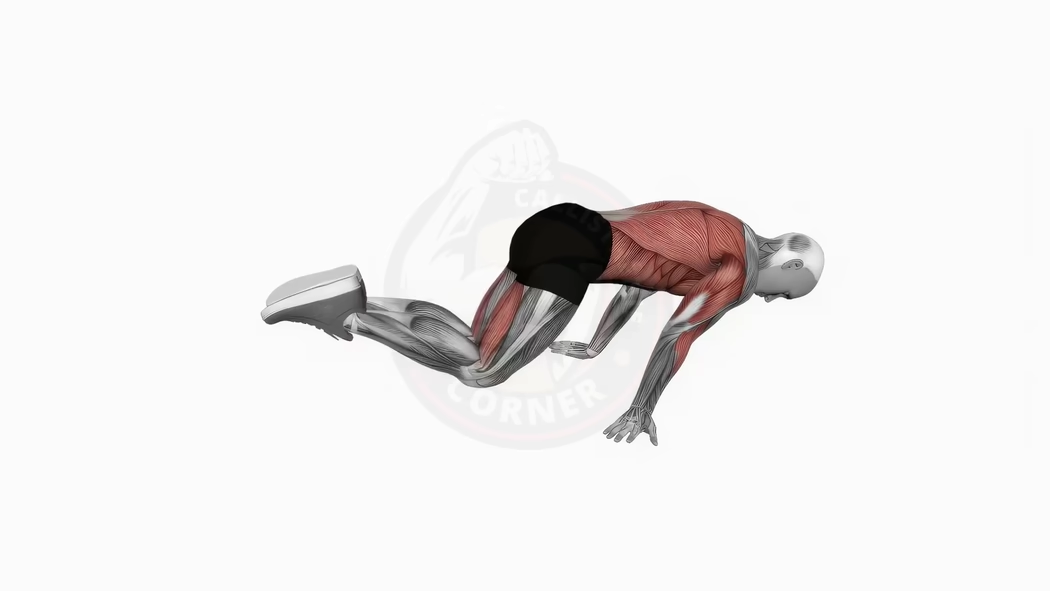
Benefits of the Full Planche
Overall strength improvement
The full planche intensely targets the upper body muscles, particularly the shoulders, triceps and core. Training these muscles not only improves your calisthenics performance but also carries over to many other physical activities.
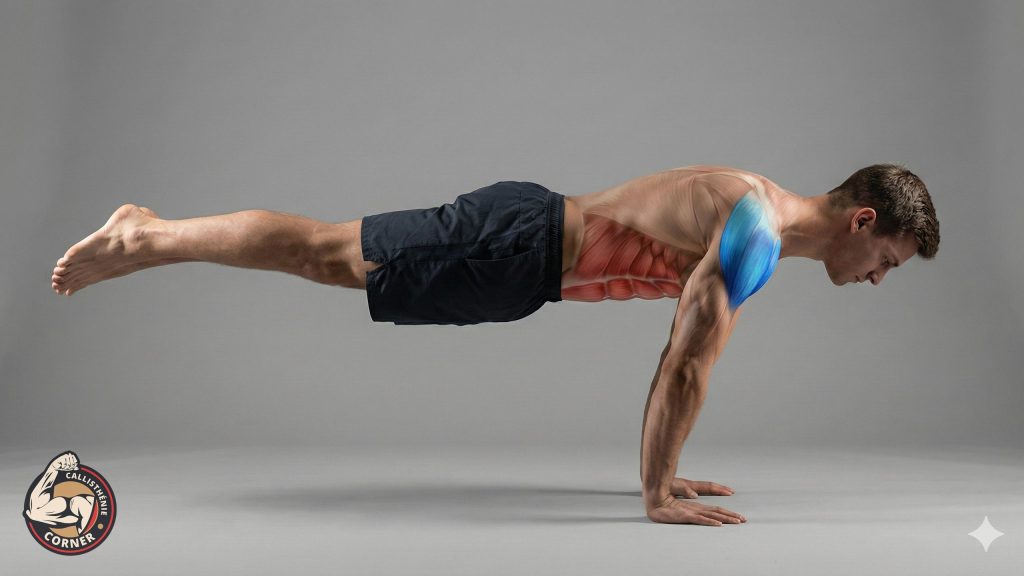
Balance and coordination development
Holding the full planche position demands precise coordination and an excellent sense of balance. These skills will benefit you in other exercises and daily activities alike.
Prerequisites for the Full Planche
Before you start working on the full planche, make sure you have a solid base of strength and stability. Here are the essential preparatory exercises:
- Push-ups: Develop the pectorals, triceps and deltoids.
- Dips: Strengthen the triceps, shoulders and lower pectorals.
- L-sit: Strengthens the core and hip flexors.
- Elbow plank: Works the core and improves shoulder stability.
Progressions towards the Full Planche
Tuck Planche
Start with the tuck planche, where your knees are tucked towards your chest. This exercise builds the foundational strength needed for the full planche.
Advanced Tuck Planche
Once you are comfortable with the tuck planche, progress to the advanced tuck planche. Your knees are slightly further from your chest, which increases the difficulty and the lever arm on your shoulders.
Straddle Planche
Next, work on the straddle planche where your legs are spread apart. This reduces the lever, making the exercise more accessible before attempting the full planche.
Full Planche
Finally, move to the full planche by keeping your body completely horizontal and parallel to the ground. This exercise requires maximum strength and flawless technique.
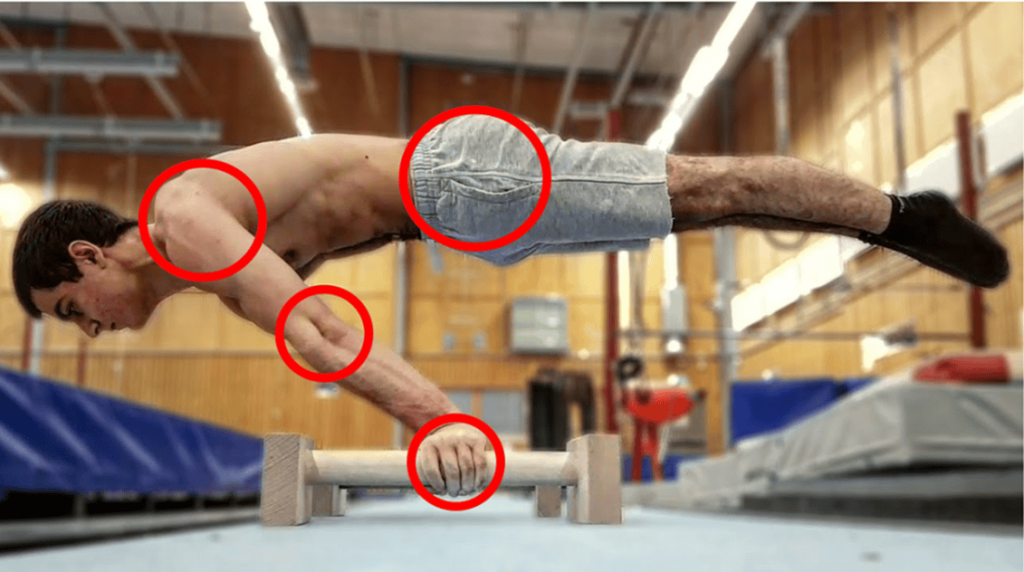
Using parallettes for your planche training
Using parallettes can be an excellent alternative to complement or adapt your training. They allow a better grip, reduce wrist pressure and make it easier to engage the stabiliser muscles. The bars also provide elevation that facilitates working on progressions like tuck planches and advanced planches, helping you develop the strength and balance you need safely.
Weekly training program for the Full Planche
To progress efficiently towards the full planche, here is a weekly training program. Adapt it to your current level.
| Day | Exercise | Sets | Reps / Duration |
|---|---|---|---|
| Monday | Tuck Planche | 5 | 10-15 sec |
| Tuesday | L-sit | 5 | 5-10 sec |
| Wednesday | Rest | - | - |
| Thursday | Advanced Tuck Planche | 5 | 10-15 sec |
| Friday | Dips and Push-ups | 4 | 8-12 |
| Saturday | Straddle Planche | 5 | 5-10 sec |
| Sunday | Rest | - | - |
Progression tip: Gradually increase hold duration as you get stronger. When you can comfortably hold 15 seconds on a given progression, it is time to move to the next one.
Tips and techniques for the Full Planche
Use resistance bands
Resistance bands can help lighten your bodyweight, making the progression towards the full planche easier. They are particularly useful during the early learning phases.
Maintain correct posture
Keep your body aligned and avoid arching your back. Correct posture is crucial to prevent injuries and maximise training effectiveness.
Breathe properly
Controlled breathing improves endurance and stability during the full planche hold. Inhale deeply before getting into position and exhale slowly while maintaining the pose.
Common mistakes to avoid
- Skipping the warm-up: Warming up is essential to prepare your muscles and prevent injuries. Spend at least 5 minutes on a thorough warm-up before every session.
- Progressing too fast: Progress gradually to avoid injuries and allow your body to adapt. Do not skip steps in the progression.
- Ignoring recovery: Rest is essential for your muscles to repair and grow stronger. Do not neglect rest days in your program.
The full planche is a significant challenge, but it is achievable with patience, determination and proper training. Follow this guide to progress step by step towards this ambitious goal. Always listen to your body and never rush the process.