
Skills
How to master the Dragon Flag
The dragon flag is an ideal exercise if you want to develop your abs. Popularised by Bruce Lee, this body-strengthening skill is impressive yet approachable. However, it is not easy to perform. It requires remarkable strength and preparatory work that should not be underestimated. Whether you are a beginner in calisthenics or more advanced, this guide explains everything step by step.
What is the dragon flag?
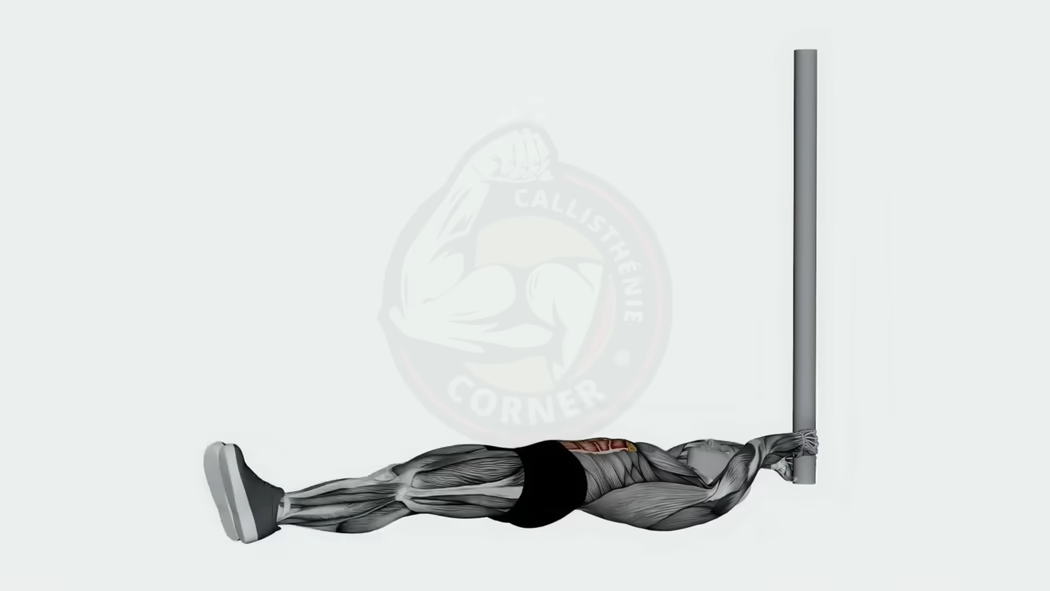
The dragon flag is a static calisthenics movement in which the trunk and legs are held in suspension. This exercise demands a particular core strength, because only your shoulders and upper back remain in contact with the bench or floor.
Without this specific strength, gravity will easily pull you down. The dragon flag is not a movement to take lightly. It can also be a source of instability.
Also worth discovering: the Human Flag, a more difficult related skill.
Why you should include the dragon flag in your training
Integrating the dragon flag into your training is valuable for several reasons. First, this calisthenics skill contributes to core strengthening. By targeting different muscle groups, it promotes the development of stabiliser muscles, particularly those in the abdominal region.
It also improves balance when practised regularly. This advanced calisthenics movement develops muscular endurance as well. By continuously practising this exercise, you subject the targeted muscles to intense effort, allowing you to perform prolonged physical activities with ease.
Furthermore, this exercise will help you develop strong mental and physical discipline, a discipline that will prove useful in other areas of your life.
Technical requirements for proper execution
To execute the dragon flag correctly, you absolutely must pay attention to certain technical points. This is to avoid building bad habits during the learning process.
First and foremost, you must maintain your pelvis in posterior pelvic tilt. This is an essential technical point for almost all calisthenics skills. Posterior pelvic tilt:
- Ensures more effective abdominal recruitment
- Guarantees the safety of your back
- Improves your alignment and form
Mastering this technique will help you understand roughly a third of how calisthenics skills are executed. It is not a complicated technique. You simply need to push your pelvis forward while squeezing your glutes.
Muscles worked during the dragon flag
The dragon flag being very similar to the front lever, they recruit practically the same muscles. However, the proportions are different.
The abdominal wall is the first to be recruited for stabilisation and suspension of the torso and thighs. The hip flexor muscles are also of great use for this stabilisation and hold.
The shoulders, triceps and lats are secondarily engaged to help push against the support. The goal is to counterbalance the lever effect of the torso and legs as a whole.
The glutes are also engaged during this advanced calisthenics exercise. They maintain the posterior pelvic tilt position and assist with the upward push.
Your thighs play a part as well, since the quadriceps are needed to keep the legs straight. And let us not forget the pectorals, which work to maintain grip stability.
Prerequisites for the dragon flag
Truthfully, there are no strict prerequisites for learning the dragon flag. But to make sure you are ready, we recommend mastering the hollow hold. This exercise teaches you the proper pelvic position to adopt.
Aim to hold at least 30 seconds before attempting the dragon flag. Also work on building a solid base of strength. Practise Australian pull-ups regularly.
Progression levels for the dragon flag
To begin, you need to reduce the difficulty of the dragon flag. The approach is to reduce the horizontal distance between your shoulders and your feet. You can easily achieve this by:
- Bringing your thighs closer to your torso
- Bringing your feet closer to your glutes
- Spreading your legs apart
- Approaching the vertical position
These methods can be combined, offering you a multitude of progression levels. Once you are lying on a bench or the floor, you must firmly grip a bar or solid support. With your arms and shoulders bearing all the weight, you need to get comfortable with the position.
Do your best to find the ideal weight distribution on your upper back and shoulders. Start from a vertical position to avoid being pulled down by gravity.
Tuck Dragon Flag
Depending on your level, start with the tuck dragon flag, which allows you to fully bend your legs and hips. This is the easiest starting point.
Advanced Tuck Dragon Flag
Next, do the advanced version. This means fully bending the legs while keeping the hips semi-flexed. Practice several sets with one leg before attempting these variations with the second.
One-leg Dragon Flag
Extend one leg fully while keeping the other tucked. Alternate legs between sets. This significantly increases the lever arm and brings you closer to the full movement.
Full Dragon Flag
The complete movement: body fully extended, only shoulders and upper back on the bench. Remember that the exercise becomes easier when you reduce the horizontal distance between your feet and shoulders.
The goal is to gradually work your way towards the final dragon flag movement.
Complementary exercises for the dragon flag
Although we already mentioned the hollow hold as a prerequisite, it remains indispensable for your progression. It is the most useful exercise for virtually all calisthenics skills.
Taking the time to include this movement in your dragon flag training will be very beneficial. Not only will it strengthen your abdominal muscles, but it will also give you particular strength in the back and triceps.
The hollow hold also works shoulder extension to develop your lats. Additionally, progression in pull-ups will be useful for learning the dragon flag.
Common mistakes to avoid
The dragon flag being difficult to execute, there are a number of mistakes to watch out for:
- Bad grip: A poor grip can prevent you from succeeding at this movement. You must position your arms and shoulders correctly. They must also be firmly anchored to provide the necessary support.
- Curved body: It is absolutely essential to keep the body straight during execution. Be careful not to bend your back or legs, so as not to unnecessarily stress your spine.
- Fast descent: You must control your descent phase. It is important not to go down too fast, in order to recruit all the stabiliser muscles.
- Lack of warm-up: You must be sufficiently warmed up before attempting the dragon flag.
Dragon flag training program
A specific program to build the strength needed for the dragon flag. Adapt the difficulty level to your current abilities.
| Exercise | Sets | Reps / Duration | Rest |
|---|---|---|---|
| One-leg dragon flag (static, level 2) | 3-4 | 10-20 seconds | 2-3 min |
| Full dragon flag negative (level 3) | 3-4 | 10-20 sec total (1-3 descents) | 3-5 min |
| Advanced tuck dragon flag concentric (level 1) | 3-4 | 5-8 reps | 2-3 min |
| Ab wheel rollout | 3-4 | 5-8 reps | 2-3 min |
| Pull-ups or floor tricep extensions (optional) | 3-4 | 8-15 reps (adjust to intensity) | 1-2 min |
The dragon flag is a genuine challenge in calisthenics. It demands not only consistent practice but also patience. It is one of the most demanding skills for the body and the abs, as they are subjected to intense constraints. If you succeed, you will be proud to have achieved great mastery. But regular training is necessary to reach that level.