
Skills
Complete guide to the Human Flag
The human flag is a street workout skill that impresses with its raw strength and control. Whether you are a beginner in calisthenics or already experienced, this guide shows you how to progress at your own pace with variations adapted to your level.
What you need to master before learning the Human Flag
Before jumping in, it is important to develop a solid base of strength and core control. Without these foundations, attempting this skill could frustrate you or worse, lead to injury. Here are the base exercises you must master to succeed at the human flag:
- Pull-ups: At least 10 strict reps with full range of motion. If you can do a muscle-up, even better.
- Dips: Same here, 10 reps is a good starting point.
- Side plank: You must be able to hold a side plank for at least 60 seconds. This will strengthen your obliques and prepare you for the lateral forces of the human flag.
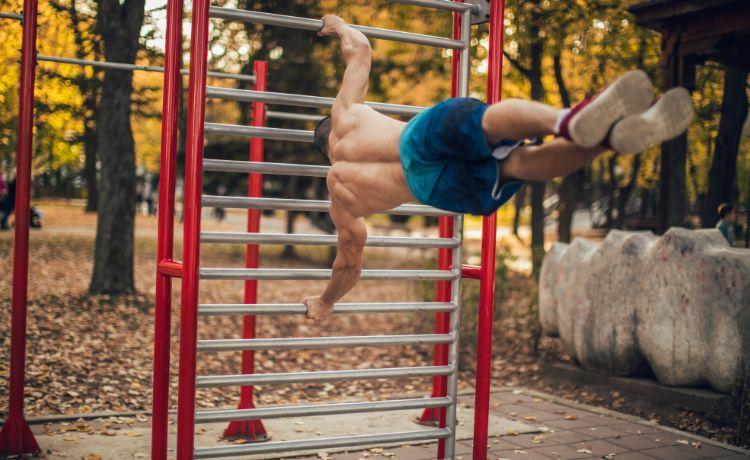
Steps to achieve the Human Flag
Step 1: The starting position
To begin, you need to ensure a solid grip. On a vertical bar, place your top hand in an overhand grip (palm facing forward) and your bottom hand in an underhand grip (palm facing you). The spacing of your arms is very important: they should form an angle close to 90 degrees once you are in the flag position.
Your body must stay straight, your abs fully engaged, and your legs extended. Do not let your shoulders compress into your neck, as this can destabilise you and expose you to injury. Mastering this starting position is essential if you want to learn the human flag.
Key point: The human flag requires perfect coordination between the arms, shoulders, trunk and legs. This movement is a combination of raw strength and muscular precision. The obliques, lats, core belt and lateral muscle chain all play a key role in keeping your body in the correct position.
Tuck Flag: a key step towards the Human Flag
The tuck flag is an ideal variation for beginners. It consists of tucking your legs towards your body, which reduces the load on your muscles and makes the exercise more accessible. By shortening the lever formed by your body, you can focus more on strengthening your arms and core while maintaining good stability.
This variation will help you develop the strength and control needed before moving on to the Human Flag 90 degrees, then the full Human Flag.
The importance of core strength in the Human Flag
The human flag is much more than a demonstration of arm strength. In reality, core engagement plays a decisive role in succeeding at this exercise. When you are in the horizontal position, your body must resist intense gravitational force that tries to make you bend or rotate.
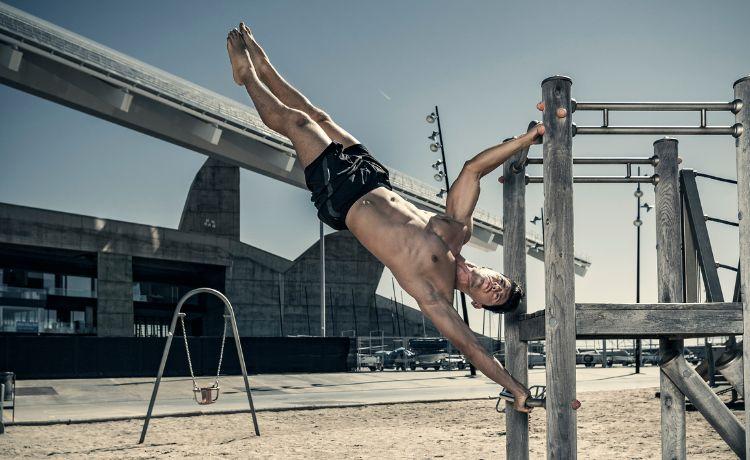
Why is core strength essential?
The human flag primarily targets the lateral muscle chain, including the obliques, lats and trunk stabiliser muscles. The role of your core is to distribute forces evenly throughout your body, from shoulder to feet.
- Hip stabilisation: Without strong core bracing, the hips tilt, which compromises the alignment of your entire body and makes holding the position impossible.
- Injury prevention: By strengthening the stabiliser muscles, core training ensures better force distribution across the joints, particularly the shoulders and spine. This protects the bones and tendons from overload.
- Force transmission: During the human flag, the force you generate with your arms and legs must be transmitted through the trunk. Insufficient core engagement causes energy loss, preventing you from holding the position for long.
Step 2: The Human Flag 90 degrees
When starting to learn the human flag, it is often too ambitious to aim directly for the horizontal position. An essential progression is the Human Flag 90 degrees, which lets you build the necessary strength while keeping better control of your body.
The Human Flag 90 degrees consists of holding your body at a right angle to the ground, with your legs pointing towards the sky, rather than trying to hold them parallel. This variation simplifies the movement by reducing the gravitational pull on your legs, while allowing you to focus on developing strength in your arms, shoulders and trunk.
How to execute the Human Flag 90 degrees
- Starting position: Position yourself as for a classic human flag (see step 1), but instead of aiming for horizontal, raise your legs upward forming a 90-degree angle with your body.
- Movement: Propelling yourself slightly, keep your legs straight towards the sky and hold your body in suspension. This movement still relies on arm strength: the top hand pulls while the bottom hand pushes against the bar.
- Muscle engagement: Your core and obliques are crucial here for stabilising your body. This is excellent preparation before moving to the full horizontal human flag.
By working this progression, you effectively strengthen your stabiliser muscles and learn to control your movements while respecting the biomechanics of the human flag. Once comfortable with the 90-degree version, you can approach the horizontal version with more ease and confidence.
Step 3: The Full Human Flag
When you have mastered the Human Flag 90 degrees and the tucked variations, it is time to go for the full Human Flag. The goal is to hold your body perfectly horizontal, with legs extended and body aligned. To reach this position with control and precision, here is what you need to do:
- Stabilise your grip: Make sure your top hand pulls firmly while your bottom hand pushes hard against the bar. This coordination is essential for maintaining balance.
- Engage your core and obliques: They play a fundamental role in keeping your body straight and aligned. Without their engagement, holding the position is impossible.
- Keep your legs straight: Your legs must stay perfectly straight and aligned with your trunk. This distributes forces properly and optimises tension throughout your body.
Tips for experienced practitioners
For those who already master the human flag but want to push further, here are some tips to perfect your movement:
- Increase hold time: Aim to hold the position for at least 15 seconds on each side. This will build your endurance and movement mastery.
- Work on variations: Try variations like the Human Flag Pull-up (pulling in the flag position) or the Clutch Flag, which challenge your stabiliser muscles even more.
- Control your form: The most common mistake among advanced practitioners is rounding the back. To avoid this, actively engage your glutes and abs, and keep the body line straight.
12-week Human Flag training program
This 12-week program takes you from side plank to the full human flag. 3 sessions per week, in addition to your regular training.
Weeks 1-4: Building the base
Goal: Strengthen the stabiliser muscles and master the side plank.
- Side plank (each side): 4 x 45 sec, rest 60 sec
- Overhand pull-ups: 4 x 8-10, rest 90 sec
- Dips: 4 x 10-12, rest 90 sec
- Dead hang: 3 x 30 sec, rest 60 sec
Target by end of week 4: 60 seconds of side plank without shaking, 12 strict pull-ups.
Weeks 5-8: Introduction to the Tuck Flag
Goal: Learn the position and develop specific strength.
- Tuck Flag: 5 x 5-10 sec, rest 2 min
- Weighted side plank: 3 x 30 sec, rest 90 sec
- Archer pull-ups: 4 x 6 (each side), rest 2 min
- Slow tempo dips (3-1-3): 4 x 6-8, rest 2 min
Target by end of week 8: Hold the Tuck Flag for 15 seconds on both sides.
Weeks 9-12: Progression to the full Human Flag
Goal: Move from the Tuck Flag to the Human Flag 90 degrees, then horizontal.
- Human Flag 90 degrees: 5 x 5-8 sec, rest 2-3 min
- Tuck Flag with progressive extension: 4 x 3-5 sec, rest 2 min
- Negative Human Flag: 4 x 3 reps, rest 2 min
- Dynamic side plank: 3 x 10, rest 90 sec
Target by end of week 12: Hold the Human Flag 90 degrees for 10 seconds. First attempts at the horizontal Human Flag.
Tips for progressing
- Train both sides: The human flag engages each arm differently. Alternate to balance your strength.
- Film yourself: Body alignment is crucial. A video will show you if your hips are sagging.
- Warm up your shoulders: 5 minutes of mobility work before every session.
- Be patient: The human flag can take 6 months to 2 years depending on your starting level.
Common mistakes to avoid
- Bending your arms: Always keep your arms straight to maximise the effectiveness of the movement and protect your joints.
- Not engaging the lower body: Your legs must be straight and aligned with the rest of your body, otherwise you lose balance.
- Forcing without core bracing: If you do not properly engage your core belt, you will not hold the position. The human flag is as much about core strength as arm strength.
Mastering the Human Flag: a structured progression path
The human flag is an iconic street workout skill that demands a perfect combination of strength and body control. Whether you are a beginner or already experienced, it is essential to progress step by step to achieve this movement with precision.
Start with the Tuck Flag, a variation where the legs are tucked to reduce the difficulty, then move on to the Human Flag 90 degrees, which lets you work on strength while keeping progressive control. These steps are solid foundations for mastering the full Human Flag, where the body stays horizontal, legs straight and perfectly aligned.
Remember that patience and consistency are your allies. Respect each step, train regularly and work your core, and you will progress safely towards this impressive skill.