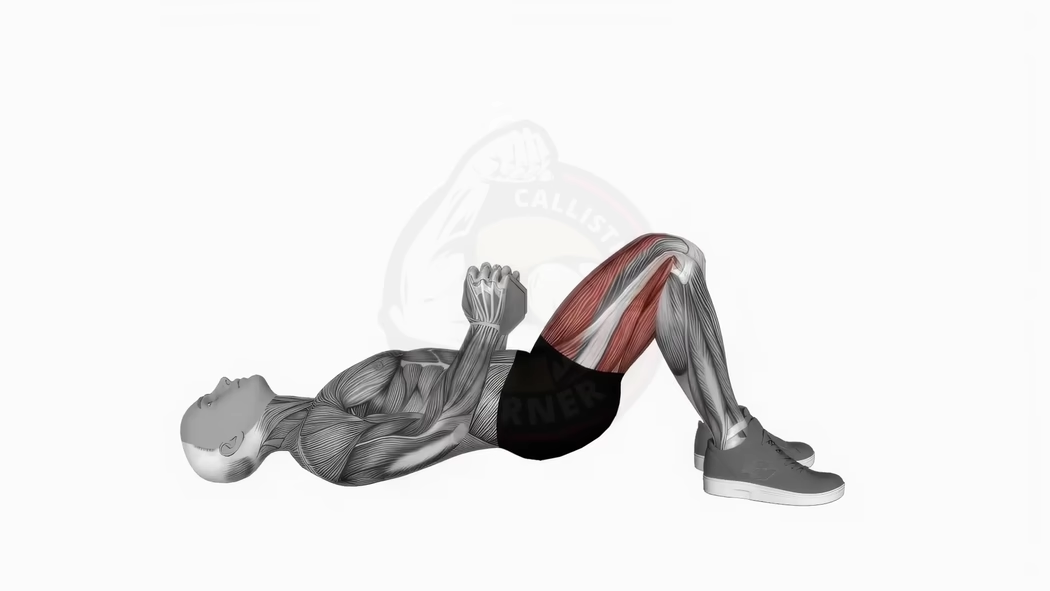
The glute bridge, also called a hip bridge, is a foundational exercise for targeting the back of the legs and the glutes. Simple to learn, effective at any level, and requiring zero equipment: it’s the starting point for all glute training in calisthenics.
Muscles worked during the glute bridge
By performing the glute bridge, you primarily engage:
- Gluteus maximus: the main target muscle, responsible for hip extension.
- Biceps femoris (hamstrings): plays a key role in hip extension and knee flexion.
- Semitendinosus and semimembranosus: stabilize the pelvis and assist knee flexion.
The glute bridge also engages the abdominals and trunk muscles, reinforcing core stability. For optimal execution, contract your abs throughout the movement to avoid arching your lower back. This maintains a straight line and protects your spine.
This exercise is particularly well suited for beginners, since the technique is simple to master. Whether at home or in the gym, the glute bridge requires nothing more than a mat.
Prerequisites for the glute bridge
The glute bridge is accessible to everyone. Before you start:
- Basic core stability: you can hold a plank for 30 seconds.
- Hip mobility: no pain when lying on your back with knees bent.
- Body awareness: you can identify a flat back vs. an arched back.
Quick test: Lie on the floor, knees bent, and try to press your lower back flat against the ground by contracting your abs. If you can do it, you’re ready.
Proper glute bridge technique
To perform the glute bridge correctly, follow these steps:
1. Starting position: Lie on your back, feet hip-width apart and close to your glutes. Arms alongside your body, palms facing down. Head and neck aligned with your spine.
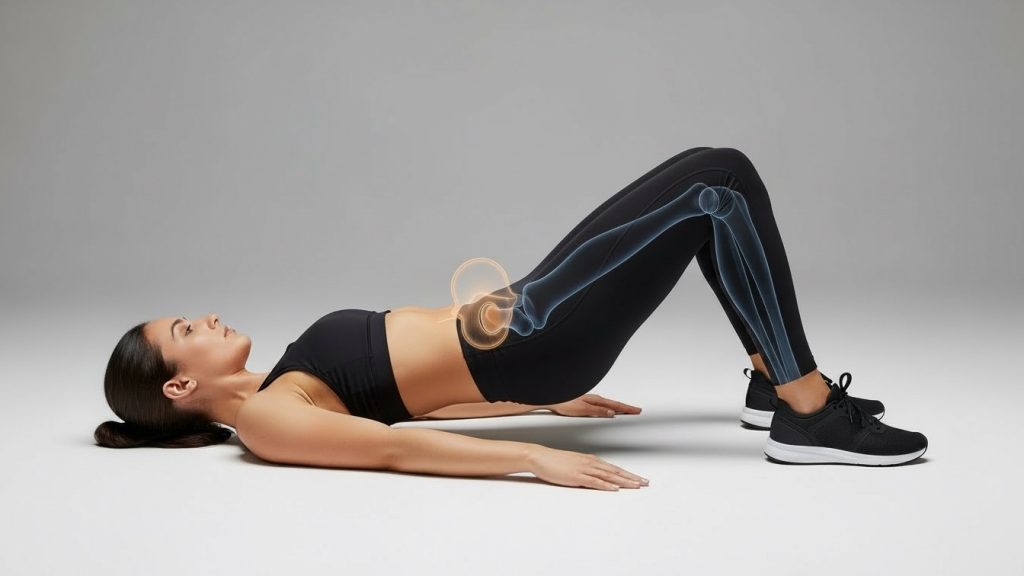
2. Upward movement: Contract your glutes and lift your pelvis until you form a straight line from your lower back through your glutes to your thighs. Push through your heels, not your toes.
3. Top position: Hold the top position for 1-2 seconds. Squeeze your glutes hard at the peak of the movement.
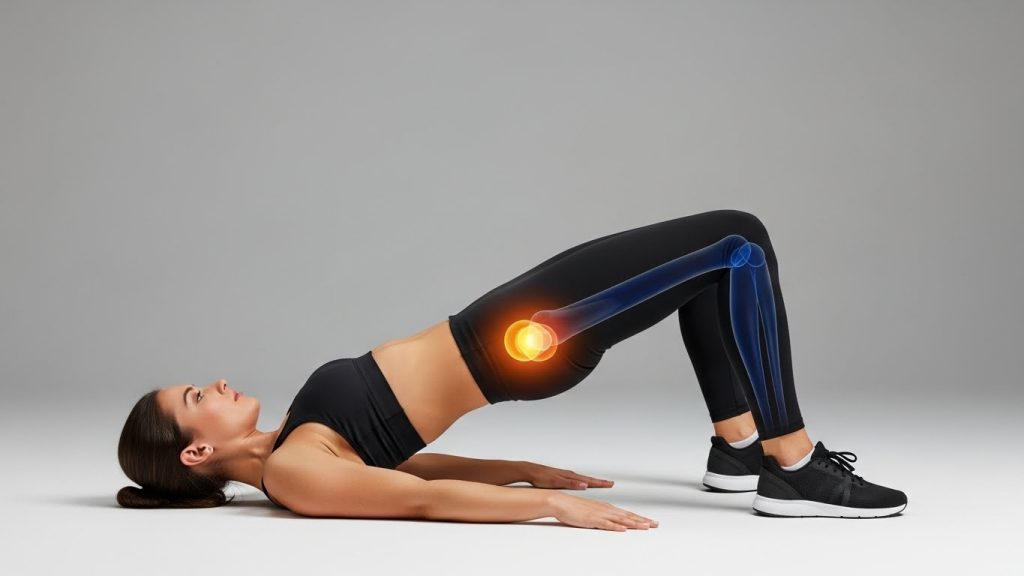
4. Downward movement: Lower your pelvis in a controlled manner, without letting it rest completely on the floor. This keeps the muscles under tension.
5. Breathing: Exhale on the way up, inhale on the way down. Never hold your breath.
Key technique points:
- Knees a fist-width apart (no contact between them)
- Push through your heels to maximize glute activation
- Keep your arms relaxed, don’t push with them
- Lower back stays flat on the floor during the descent
The hollow hold is an excellent complementary exercise to strengthen your abs and improve stability during the glute bridge.
Common mistakes and corrections
- Arched lower back: Contract your abs to keep your back flat. If you can’t manage it, reduce the range of motion.
- Head lifted off the floor: Keep your head on the ground to maintain neck alignment with the spine.
- Knees touching: Place your feet hip-width apart and maintain a fist-width gap between your knees.
- Pushing with your toes: Push through your heels to properly engage the glutes.
- Holding your breath: Exhale going up, inhale going down. Smooth breathing optimizes performance.
Glute bridge variations for progression
To intensify your glute bridge and explore advanced variations:
-
Weighted glute bridge: Place a dumbbell or barbell across your hips. Increases resistance and demands more from your glutes.
-
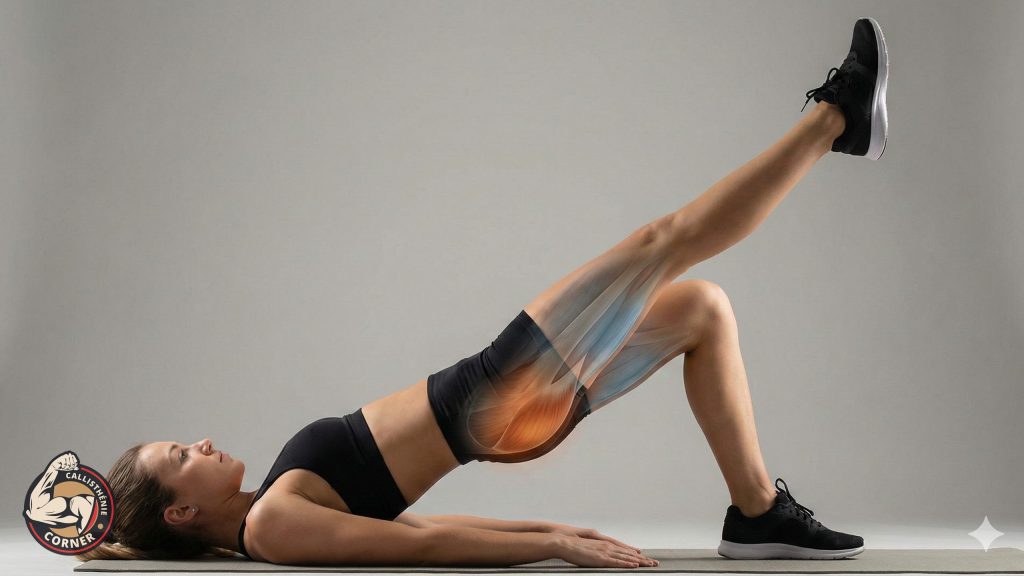
Single leg glute bridge: Perform the exercise on one leg, the other extended or bent. This variation increases difficulty and requires greater core engagement.
-
Elevated glute bridge: Elevate your feet on a step or bench. This increases the range of motion.
-
Isometric glute bridge: Hold the top position for 30 seconds to 1 minute. Builds muscular endurance.
What comes after the glute bridge?
Once you’ve mastered the glute bridge (20 reps single leg per side), progress toward:
- Hip thrust: The glute bridge’s bigger brother. Back elevated on a bench, maximum range of motion, easy to load heavy.
- Nordic curl: Targets the hamstrings eccentrically. An excellent complement to glute work.
- Bulgarian split squat: Intense unilateral work for glutes and quads.
- Pistol squat: For complete bodyweight leg training.
The glute bridge is the foundation of all glute strengthening exercises. Master it perfectly before moving on to advanced movements.