
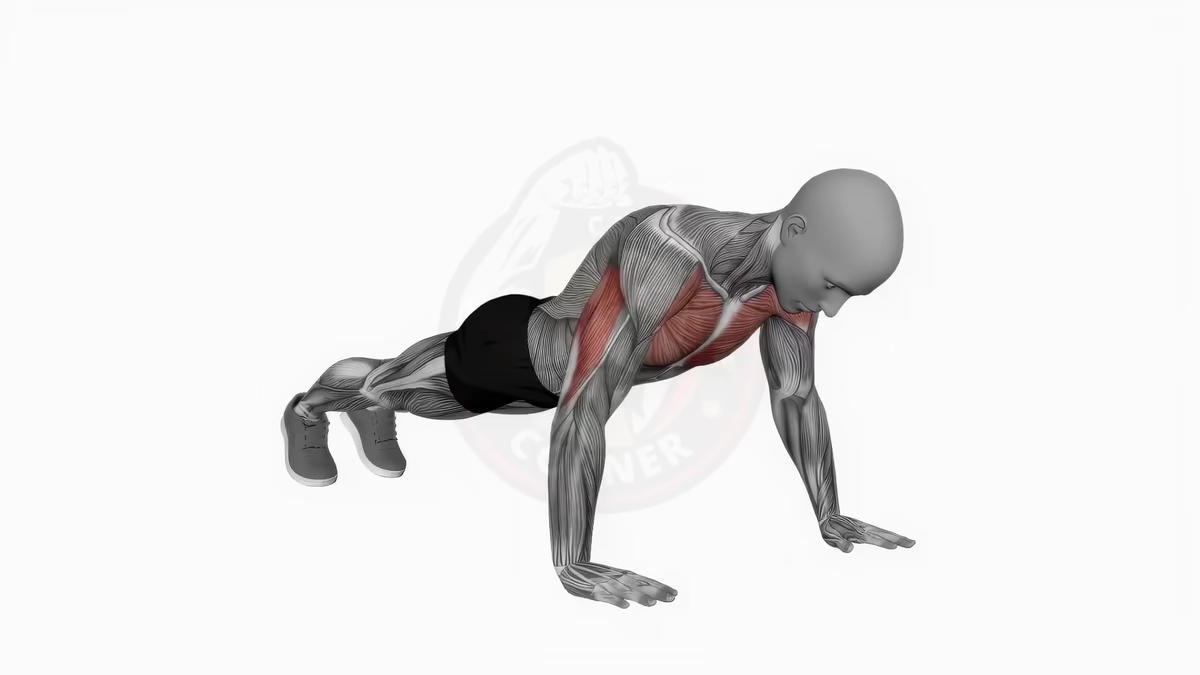
The push-up is the single most important upper-body exercise in calisthenics. Master it and you have a direct path to the one-arm push-up, the planche, and every pressing movement in between.
Muscles worked during push-ups
The push-up is a compound movement that trains the entire upper-body pushing chain simultaneously.
| Muscle group | Role |
|---|---|
| Pectoralis major | Primary pushing force |
| Triceps brachii | Elbow extension at lockout |
| Anterior deltoids | Shoulder flexion during the press |
| Serratus anterior | Scapular protraction at the top |
| Core (rectus abdominis, obliques) | Full-body tension throughout |
The serratus anterior is often overlooked — it’s what keeps your shoulder blades flat against your ribcage. Weak serratus = winging scapulae = shoulder injuries.
Perfect push-up technique
Before adding reps, own the movement. One perfect push-up is worth ten sloppy ones.
Setup: Hands slightly wider than shoulder-width. Fingers spread, middle finger pointing forward. Elbows at roughly 45° from the torso — not flared wide (bench press mistake), not tucked tight (it’s not a tricep extension).
Body line: From crown to heel, one straight line. Squeeze your glutes, brace your abs, press the floor away. The moment your hips sag or your lower back arches, the set is over.
Range of motion: Descend until your chest grazes the floor — not your stomach, not your chin. Full depth builds full strength. Half reps build half strength.
The push: Don’t just push up. Push through the floor and think about spreading the ground apart with your hands. This slight external rotation cue keeps the shoulder joint in its safest position.
Common mistakes
The most common error is treating push-ups as a chest isolation exercise. They’re not — they’re a full-body tension drill where the chest happens to do most of the work.
Hips too high (pike push-up): You’re offloading your core. Fix: reset, squeeze glutes, reestablish body line.
Hips sagging: Core isn’t engaged. Fix: regress to knee push-ups until core endurance matches upper body strength.
Elbows flared at 90°: This impinges the shoulder joint under load. Fix: bring elbows to 45°.
Partial range: Stopping 5 cm before the floor doesn’t count. Fix: use a low surface as a target (book under chest) to learn the feel of full depth.
Progressions toward advanced variations
The push-up is a ladder, not a ceiling.
Knee push-up → same mechanics, ~50% of bodyweight. The real beginner starting point.
Classic push-up → the standard. Own 4×15 in perfect form before moving forward.
Slow tempo (3-1-3) → 3s down, 1s pause at the bottom, 3s up. More time under tension than doubling your reps.
Decline push-up → feet elevated, shifts emphasis to upper chest and front deltoids. Preparation for handstand push-ups.
Diamond push-up → hands together below the sternum, elbows tight. Tricep isolation within the push-up pattern.
Archer push-up → one arm bends fully, the other extends straight to the side. Unilateral loading — the direct prerequisite for the one-arm push-up.
One-arm push-up → the goal. Requires months of unilateral work. Don’t rush it — the archer push-up is the patient path there.
How many push-ups before moving to progressions?
A simple rule: 4×15 in perfect form before moving to the next variation. Not 4×15 where the last 3 reps are questionable — 4×15 where all 60 reps look identical.
Progress slowly. The push-up is one of the few exercises where rushing progression is immediately visible in form breakdown.